Battery manufacturing has moved far beyond conventional consumer electronics. Today, lithium-ion battery production supports electric mobility, battery energy storage systems (BESS), industrial equipment, backup power, renewable energy integration and other electrification applications. According to the International Energy Agency (IEA), global lithium-ion battery manufacturing capacity exceeded 4 TWh by the end of 2025, while EV battery deployment reached 1.2 TWh during 2025.
This growth is creating demand for manufacturing systems that can deliver repeatable quality, production scalability, traceability and reliable testing.
Understanding different battery manufacturing use cases is therefore important before investing in machinery or designing a production plant. The right manufacturing architecture depends on the battery chemistry, cell format, pack design, production volume, testing requirements and final application.
What Are Battery Manufacturing Use Cases?
Battery manufacturing use cases refer to the different applications, industries and production requirements for which batteries are manufactured and assembled.
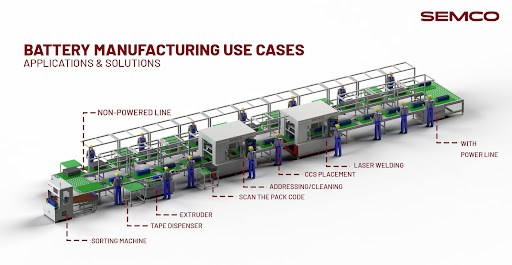
A battery manufacturing facility may produce cells, modules, battery packs or complete energy storage systems depending on its position in the supply chain. Pack-level manufacturing commonly involves processes such as cell inspection, sorting, stacking, compression, welding, BMS integration and end-of-line testing.
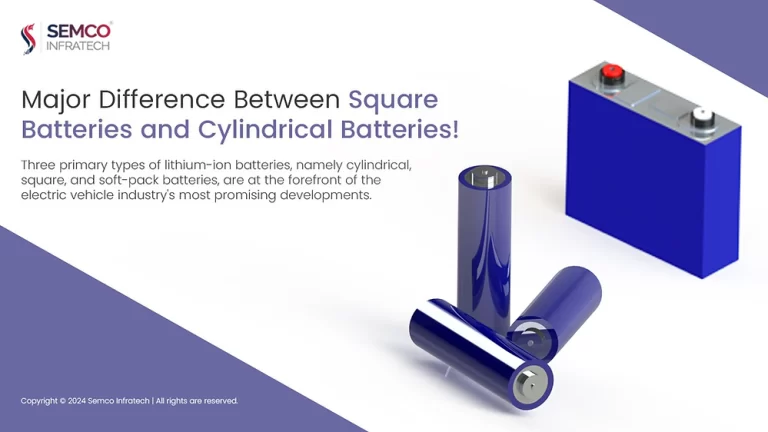
The manufacturing process also changes according to cell format. Prismatic, cylindrical and pouch cells require different handling, assembly and joining approaches.
For example, a high-volume EV battery plant may require highly automated material handling, vision inspection, precision welding and extensive traceability. A smaller industrial battery manufacturer may instead require a semi-automatic assembly line with flexible testing equipment.
Semco Infratech provides battery assembly, testing, cell sorting, precision welding, ESS solutions and plant-planning capabilities for different production requirements.
The key point is simple: there is no single battery manufacturing setup that is optimal for every application.
Electric Vehicle Battery Manufacturing
Electric vehicles are one of the largest battery manufacturing applications globally. The IEA reports that EVs accounted for more than 70% of global battery deployment in 2025, with EV battery deployment reaching 1.2 TWh.
EV battery manufacturing demands extremely consistent electrical and mechanical performance because battery packs directly affect vehicle range, safety, charging performance and operating life.
Typical manufacturing requirements can include:
- Cell voltage and internal-resistance inspection
- Cell sorting and grading
- Automated cell handling
- Module or pack stacking
- Compression and structural assembly
- Spot or laser welding
- BMS integration
- Insulation and safety testing
- End-of-line electrical testing
- Traceability and production data management
Different EV platforms can also require different pack architectures and cell formats. Therefore, manufacturers need production systems that can accommodate the required configuration rather than simply purchasing the highest level of automation available.
Battery Energy Storage System Manufacturing
Battery Energy Storage Systems are another major battery manufacturing use case. BESS installations are used to store electricity and support applications such as renewable-energy integration, peak-load management, grid services and backup power.
The battery-storage market is also influencing manufacturing strategies. The IEA notes that stationary storage accounted for one-third of battery deployment in the United States in 2025, with deployment expanding across power grids and data centres.
BESS manufacturing can include production of:
- Battery modules
- Battery packs
- Rack-based battery systems
- Containerized BESS
- Commercial and industrial energy-storage systems
- Utility-scale energy-storage systems
Manufacturing equipment for these applications may include cell sorting systems, stacking equipment, compression systems, welding stations, battery testers, insulation testing and pack-level end-of-line testing.
Semco Infratech offers automated and semi-automated battery assembly solutions covering prismatic, cylindrical and pouch battery packs, along with testing and ESS-oriented manufacturing solutions.
Industrial Battery Manufacturing
Industrial batteries are used in applications where reliable energy delivery is essential. These can include material-handling equipment, industrial vehicles, backup systems, telecom infrastructure, automation equipment and other electrically powered machinery.
Unlike some high-volume automotive applications, industrial battery manufacturers may need greater product flexibility because customers can require different voltage levels, capacities, mechanical dimensions and communication interfaces.
This makes modular battery manufacturing equipment particularly valuable.
A suitable production setup may combine manual workstations with automated testing, welding and inspection. This approach allows manufacturers to maintain production flexibility while automating the stages where precision and repeatability have the greatest impact.
Semco’s portfolio includes manual, semi-automatic and fully automatic battery assembly solutions, allowing manufacturers to select an automation level based on production requirements rather than forcing every application into one manufacturing model.
Consumer Electronics and Portable Battery Manufacturing
Consumer electronics represent another important battery manufacturing application. Smartphones, laptops, tablets, power banks, wearable devices and portable electronics require compact batteries with controlled dimensions, consistent electrical characteristics and reliable protection systems.
Manufacturing requirements can include:
- Cell inspection
- Cell grading
- Precision welding
- Protection-circuit integration
- BMS or battery protection integration
- Capacity testing
- Charge-discharge testing
- Insulation and safety testing
- Final quality inspection
Production volumes can be high, but the required equipment depends heavily on the battery format and product architecture.
For manufacturers working on smaller production volumes, R&D projects or specialized battery packs, an all-in-one workstation can sometimes be more practical than investing immediately in a complete automated line. Semco’s SI-Y BA-Standard, for example, integrates functions including cell testing, internal-resistance measurement, spot welding, BMS testing, charge-discharge and final inspection within one workstation.
Renewable Energy and Solar Battery Manufacturing
The growth of solar and renewable-energy installations has increased the importance of battery storage because generation and consumption do not always occur at the same time.
Battery systems can store surplus electricity and make it available when required. This creates manufacturing demand for batteries designed for residential, commercial, industrial and utility-scale energy-storage applications.
LFP chemistry has become particularly important in stationary storage. The IEA has highlighted the increasing use of LFP batteries in storage because energy density is generally less critical for stationary applications than it is for EVs.
Manufacturers targeting renewable-energy storage therefore need to consider:
- Battery chemistry
- Cell capacity
- Pack voltage
- Energy capacity
- Thermal-management requirements
- BMS architecture
- Mechanical design
- Safety testing
- Production scalability
The manufacturing line should be designed around these requirements from the beginning instead of attempting to retrofit unsuitable machinery later.
Battery R&D, Prototyping and Laboratory Manufacturing
Not every battery manufacturer needs a gigawatt-scale automated factory.
Universities, battery startups, engineering companies and R&D laboratories often manufacture small batches for product development, validation and testing.
In these environments, flexibility can be more important than maximum production speed.
Typical requirements may include:
- Cell characterization
- Cell sorting
- Manual or semi-automatic assembly
- Spot welding
- BMS testing
- Charge-discharge testing
- Battery cycling
- Pack-level electrical testing
- Data logging and traceability
An adaptable workstation can allow engineers to modify pack configurations and test new designs without rebuilding an entire production line.
This is one reason battery manufacturing equipment should be selected according to production objectives, expected volume and future scalability, rather than automation level alone.
Why Battery Testing Is Critical in Manufacturing
Battery manufacturing is not simply an assembly operation. Testing is fundamental to product quality.
A battery pack can appear mechanically correct while still having electrical, insulation, communication or performance problems. Manufacturing systems therefore need appropriate inspection and testing at multiple stages.
Common testing requirements include:
- Open-circuit voltage (OCV)
- Internal resistance (IR)
- Capacity
- Charge-discharge performance
- BMS communication
- Insulation resistance
- Withstand voltage
- Air-tightness or leak testing
- End-of-line testing
Semco Infratech’s manufacturing portfolio includes OCV/IR testing, battery testers, BMS testers, charging and discharging systems and end-of-line testing solutions.
Testing should not be treated as an optional final step. Detecting defective cells or assemblies earlier in the production process can prevent defective products from progressing through multiple additional manufacturing stages.
Manual vs Semi-Automatic vs Fully Automatic Battery Manufacturing
Choosing automation is one of the most important decisions when establishing a battery manufacturing facility.
Manual manufacturing can be appropriate for prototypes, low-volume production and highly customized battery packs. Its main advantages are lower initial investment and greater flexibility, but production consistency and throughput depend heavily on operators.
Semi-automatic manufacturing combines human handling with automated processes such as testing, welding, sorting or compression. It can provide a practical balance between flexibility and productivity.
Fully automatic manufacturing is generally appropriate for high-volume production where consistent cycle times, traceability and repeatability are critical.
Semco supports all three approaches. Its plant-planning solutions include fully automatic and semi-automatic configurations, while its equipment portfolio covers cylindrical, prismatic and pouch battery manufacturing requirements.
The correct choice should be based on production volume, labour availability, product complexity, capital budget and expected future demand—not simply on which option appears technologically superior.
Why Choose Semco Infratech for Battery Manufacturing Solutions?
Calling any company the “best” without defining the criteria is meaningless. A more useful question is whether a supplier can provide the technology, integration capability, testing infrastructure and scalability required for your specific battery manufacturing project.
Semco Infratech has built its offering around these areas.
End-to-End Manufacturing Solutions
Semco provides more than individual machines. Its solutions cover battery assembly lines, testing and validation, cell sorting, precision welding, ESS solutions and plant setup.
Multiple Cell Formats
Battery manufacturing requirements differ significantly between cylindrical, prismatic and pouch cells. Semco offers equipment and assembly-line solutions covering these formats.
Flexible Automation
Manufacturers can choose manual, semi-automatic or fully automatic production approaches depending on their production requirements and investment strategy.
Integrated Testing and Quality Control
Testing can be integrated into the manufacturing workflow through OCV, IR, BMS, charge-discharge, insulation and end-of-line testing solutions.
Plant Planning and Scalability
Semco states that its consultation services cover plant layout planning, process simulation, prototype development and certification support. This is important because poor plant planning can create bottlenecks that are expensive to correct after installation.
Production-Ready Automation
For high-volume applications, Semco’s prismatic fully automatic assembly line integrates processes such as cell aging, OCV sorting, automatic stacking, compression, laser cleaning, polarity inspection, laser welding and EOL testing.
How to Select the Right Battery Manufacturing Solution
Before purchasing battery manufacturing equipment, manufacturers should define the complete production requirement.
Consider these factors:
- Battery chemistry: LFP, NMC or another chemistry.
- Cell format: Cylindrical, prismatic or pouch.
- Pack voltage: Required series configuration.
- Pack capacity: Required Ah and kWh.
- Production volume: Daily, monthly and annual targets.
- Automation level: Manual, semi-automatic or fully automatic.
- Testing requirements: OCV, IR, capacity, insulation, BMS and EOL testing.
- Traceability: Production data and serial-number tracking.
- Future expansion: Ability to increase capacity later.
- Factory layout: Material flow, operator movement, safety zones and utilities.
A common mistake is to purchase machines first and design the manufacturing process afterward. The better approach is to define the product, process flow and production target first, then engineer the equipment around those requirements.
The Future of Battery Manufacturing
Battery manufacturing is becoming increasingly automated, data-driven and application-specific.
The IEA reports that global lithium-ion battery manufacturing capacity surpassed 4 TWh in 2025, although manufacturing remains highly concentrated geographically. The report also notes that establishing production capacity is only the first step, with many facilities taking years to approach nominal output.
This means future competitiveness will not depend solely on installing more machines. Manufacturers will need:
- Higher production consistency
- Better quality control
- Automated inspection
- Production traceability
- Flexible manufacturing
- Faster product changeovers
- Better testing
- Scalable factory architecture
- Efficient material handling
Companies that design their manufacturing infrastructure around these requirements will be better positioned to respond to changing battery technologies and market demand.
Conclusion
The most important battery manufacturing use cases span EV batteries, BESS, renewable-energy storage, industrial batteries, consumer electronics and R&D applications. Each application has different requirements for cell format, capacity, automation, testing, safety and production volume.
There is no universal battery manufacturing line that is automatically right for every manufacturer.
The better strategy is to select equipment based on the complete manufacturing process—from cell inspection and sorting through assembly, welding, testing and final validation.
Semco Infratech offers assembly lines, battery testing equipment, cell sorting, welding systems, ESS solutions and plant-planning support across different battery manufacturing requirements.
For manufacturers planning a new battery production facility or upgrading an existing line, the right equipment partner should be evaluated on technical capability, integration, customization, testing, scalability and after-sales support rather than price alone.
Ideation by Manpreet Singh
Article Citations / References
- International Energy Agency (IEA), Global EV Outlook 2026 – Electric Vehicle Batteries.
- International Energy Agency (IEA), Global EV Outlook 2025 – Electric Vehicle Batteries.
- International Energy Agency (IEA), Batteries and Secure Energy Transitions.
- Semco Infratech, BESS Assembly Line Solutions and Battery Manufacturing Equipment.
- Semco Infratech, Equipment Provider and Battery Manufacturing Plant Consultation.
- Semco Infratech, Prismatic Fully Automatic Assembly Line.