
Single Side Plasma Cleaning

Technical Excellence

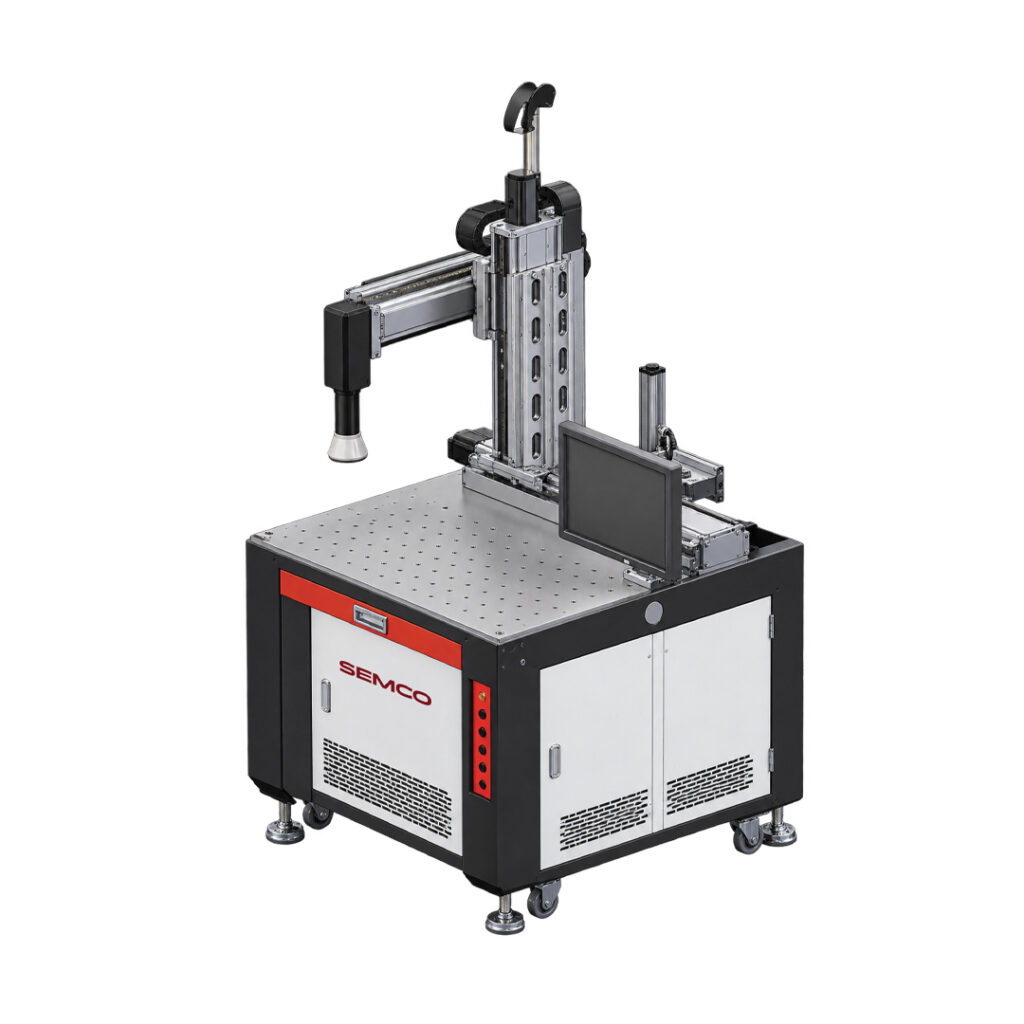
The Single Side Plasma Cleaning Machine is developed for lithium battery manufacturing applications where surface preparation is required to enhance adhesion at battery pole surfaces. The machine uses plasma cleaning technology to treat the surfaces of individual battery cell poles before subsequent manufacturing operations.

The equipment incorporates a plasma unit specified at 400–1200 W, a gantry-type XYZ motion module and a plasma cleaning head. The XYZ axes position the cleaning head to process individual cell poles, while the machine supports a maximum cleaning size of 500 × 300 mm. Its listed equipment dimensions are 1000 × 880 × 1650 mm, with a machine weight of approximately 200kg.

The operating process involves manually placing the battery pack on the machine, using the servo-driven XYZ axes to move the plasma cleaning head across individual battery poles, and manually removing the battery after cleaning. The configuration includes an industrial computer, a 19-inch widescreen display and a dedicated control system.
Designed for battery production environments, the Semco Single Side Plasma Cleaning Machine provides a dedicated solution for battery pole-surface treatment. Its application, process settings and compatibility should be evaluated against the battery format and production requirements of the intended manufacturing line.
Line Speed

6m / 7m / 8m

Dimensions

40 ft – 200 ft

Power Requirement

20 kW – 200 kW

Key Fixture Features

Single Side Plasma Cleaning Machine

Request a Quote

Looking for the right solution? Our experts are here to guide you with specifications, customization options, and pricing details.
The Semco SI-R SSPC-1200W Single Side Plasma Cleaning Machine is designed for cleaning lithium battery pole surfaces to enhance adhesion. The system uses a plasma cleaning head mounted on an XYZ gantry motion system to process individual battery cell poles. With an output power range of 400–1200 W and a maximum cleaning size of 500 × 300 mm, the machine supports battery manufacturing processes that require controlled surface preparation.

Suitable for industries such as:

EV battery production, energy storage manufacturing, battery research labs, electronics assembly, and OEM-based fabrication units.

Parameter Specification
Product name Single Side Plasma Cleaning Machine
Model Semco SI-R SSPC-1200W
Plasma unit model D610-1200W
Plasma unit brand JPT
Output power 400–1200 W
Input gas connection Intake pipe diameter: Ø 8 mm
Output gas pressure 0.1–0.4 MPa
Operating frequency 18–40 kHz
Maximum cleaning size 500 × 300 mm
Motion system Gantry-type XYZ
XYZ-axis travel 500 × 300 × 300 mm
Servo motors 400 W × 3
Industrial computer Listed as “17 + 128 G” in the source
Monitor 19-inch widescreen
Machine dimensions (L × W × H) 1000 × 880 × 1650 mm
Input power supply 220 VAC, as listed in the equipment parameter table
Maximum machine power ≤ 6 kW
Machine weight Approximately 200 kg

Product Name

Description

Applications

This product is used for:

Support & Warranty

Reviews

There are no reviews yet.

Be the first to review “Single Side Plasma Cleaning”

Your email address will not be published. Required fields are marked *

Faq

Frequently Asked Questions

Find quick answers to common questions about our BESS Assembly Line, including automation capabilities, supported battery types, customization options, safety standards, and production scalability.

What is a BESS Assembly Line?
A BESS Assembly Line is an automated system used to assemble battery energy storage modules and packs efficiently and accurately.
It is used to produce battery modules, battery packs, and complete energy storage systems.
Yes, the line supports fully or semi-automated operations based on production requirements.
It supports lithium-ion batteries including prismatic, cylindrical, and pouch cells.
How is product quality ensured?
In-line testing, vision inspection, and automated checks ensure consistent quality and reliability.
Yes, the assembly line can be customized to match specific capacity, layout, and production needs.
The system includes safety interlocks, fault detection, and controlled assembly environments.
Yes, it is designed for high-throughput and scalable manufacturing.

Faq

Frequently Asked Questions

Find quick answers to common questions about our BESS Assembly Line, including automation capabilities, supported battery types, customization options, safety standards, and production scalability.

A Single Side Plasma Cleaning Machine uses plasma to treat a surface. The Semco SI-R SSPC-1200W is designed for cleaning lithium battery pole surfaces to enhance adhesion.
The model number is Semco SI-R SSPC-1200W.
Its primary application is plasma cleaning of lithium battery pole surfaces to enhance adhesion during battery manufacturing.
The technical specification lists a plasma output power range of 400–1200 W.
The specified operating frequency is 18–40 kHz.
The maximum cleaning size listed in the specification is 500 × 300 mm.
Yes. The machine uses a servo-driven gantry-type XYZ motion system with specified travel of 500 × 300 × 300 mm.
The operator manually places the battery pack on the machine. The XYZ axes move the plasma cleaning head to clean individual battery cell poles, after which the operator removes the battery.
Semco
A Single Side Plasma Cleaning Machine uses plasma to treat a surface. The Semco SI-R SSPC-1200W is designed for cleaning lithium battery pole surfaces to enhance adhesion.
The model number is Semco SI-R SSPC-1200W.
Its primary application is plasma cleaning of lithium battery pole surfaces to enhance adhesion during battery manufacturing.
The technical specification lists a plasma output power range of 400–1200 W.
The specified operating frequency is 18–40 kHz.
The maximum cleaning size listed in the specification is 500 × 300 mm.
Yes. The machine uses a servo-driven gantry-type XYZ motion system with specified travel of 500 × 300 × 300 mm.
The operator manually places the battery pack on the machine. The XYZ axes move the plasma cleaning head to clean individual battery cell poles, after which the operator removes the battery.