
Battery Nickel Steel Strips Spot Welding Machine

Technical Excellence

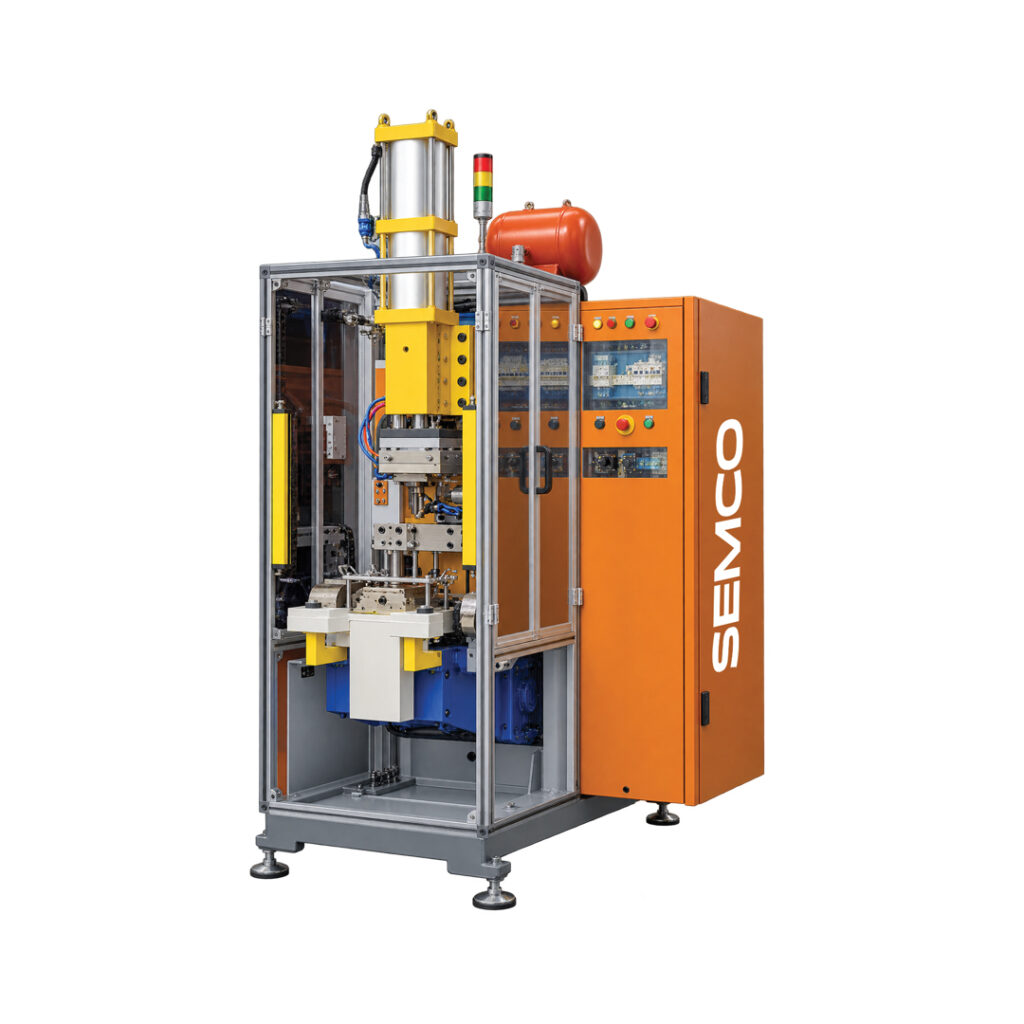
The Nickel Steel Strips Spot Welding Machine is an industrial welding solution designed to join nickel steel strips with consistent weld strength and surface quality. Developed for battery manufacturing applications, the machine combines medium-frequency inverter DC welding technology with pneumatic pressure control, a dedicated welding fixture, and an integrated electrical control system.

The medium-frequency inverter welding power supply operates at 1000 Hz, converting electrical energy into DC welding current to improve energy efficiency and reduce losses compared with conventional mains-frequency welding systems. The equipment is designed to provide controlled welding performance while supporting the production requirements of workpieces with multiple welding points and changing specifications.

The machine incorporates a pneumatic vertical pressurization mechanism to apply welding pressure and hold the workpiece in position. Its positioning mold supports accurate workpiece placement, while the programmable controller enables operators to adjust welding time, current, pulse count, and other process parameters. Multiple welding specifications can be stored for convenient use across different production requirements.

A circulating water-cooling system helps manage heat generated during welding and supports stable operation. Additional functions, including weld-point counting, preset weld-point settings, fault diagnostics, and audible and visual alarms, assist operators in monitoring the process and maintaining equipment performance.

Semco Infratech provides battery manufacturing and testing equipment for industrial applications. The SI-JG-NSWM is suitable for manufacturers seeking a controlled, energy-efficient spot welding solution for nickel steel strip joining, subject to confirmation of the workpiece dimensions and welding requirements.
Line Speed

6m / 7m / 8m

Dimensions

40 ft – 200 ft

Power Requirement

20 kW – 200 kW

Key Fixture Features

Battery Nickel Steel Strips Spot Welding Machine

Request a Quote

Looking for the right solution? Our experts are here to guide you with specifications, customization options, and pricing details.
The Nickel Steel Strip Spot Welding Machine is designed for welding nickel steel strips used in battery manufacturing applications. Featuring medium-frequency inverter technology, a pneumatic pressurization system, and a programmable welding controller, the machine supports consistent weld quality, efficient energy use, and reliable operation. Its adjustable welding parameters and positioning fixture help accommodate different workpiece requirements and production processes.

Suitable for industries such as:

EV battery production, energy storage manufacturing, battery research labs, electronics assembly, and OEM-based fabrication units.

Parameter Specification
Product model Semco SI-JG-NSWM
Equipment type Medium-frequency inverter spot welding machine
Recommended welding power model MD-40KA
Welding frequency 1000 Hz
Input voltage 380 V ±10%, three-phase
Input frequency 50 Hz
Secondary voltage 9.7–13.6 V
Maximum short-circuit current Up to 40 kA for MD-40
Welding pressure 7,300 N for MD-40
Upper/lower platform opening 320 mm for MD-40
Cooling water flow 30 L/min for MD-40
Air supply pressure 0.6 MPa
Water supply pressure 0.15–0.60 MPa
Operating temperature ≤40°C
Operating humidity ≤90%
Input-to-chassis insulation resistance ≥2.5 MΩ
Welding control Programmable controller with touchscreen interface
Welding modes Single-point and continuous welding
Pulse count 1–20
Welding current adjustment 4–80 kA controller range stated in the specification
Welding time adjustment Multiple adjustable time parameters
Cooling method Circulating water cooling
Product material specified 201 stainless steel
Workpiece width 135–350 mm
Workpiece length 400–1200 mm

Product Name

Description

Applications

This product is used for:

Support & Warranty

Reviews

There are no reviews yet.

Be the first to review “Battery Nickel Steel Strips Spot Welding Machine”

Your email address will not be published. Required fields are marked *

Faq

Frequently Asked Questions

Find quick answers to common questions about our BESS Assembly Line, including automation capabilities, supported battery types, customization options, safety standards, and production scalability.

What is a BESS Assembly Line?
A BESS Assembly Line is an automated system used to assemble battery energy storage modules and packs efficiently and accurately.
It is used to produce battery modules, battery packs, and complete energy storage systems.
Yes, the line supports fully or semi-automated operations based on production requirements.
It supports lithium-ion batteries including prismatic, cylindrical, and pouch cells.
How is product quality ensured?
In-line testing, vision inspection, and automated checks ensure consistent quality and reliability.
Yes, the assembly line can be customized to match specific capacity, layout, and production needs.
The system includes safety interlocks, fault detection, and controlled assembly environments.
Yes, it is designed for high-throughput and scalable manufacturing.

Faq

Frequently Asked Questions

Find quick answers to common questions about our BESS Assembly Line, including automation capabilities, supported battery types, customization options, safety standards, and production scalability.

The Semco SI-JG-NSWM is a medium-frequency inverter spot welding machine designed for joining nickel steel strips in compatible battery manufacturing and industrial applications.
The machine uses medium-frequency inverter DC welding technology with a 1000 Hz welding transformer system. This supports controlled welding and reduced energy losses compared with traditional power-frequency systems.
The supplied specification identifies 201 stainless steel as the product material. Compatibility with nickel steel strips and other materials should be confirmed through material testing and sample welding.
The document specifies workpiece widths of 135–350 mm and lengths of 400–1200 mm. The final fixture configuration must be checked against the actual workpiece design.
Yes. The programmable controller supports adjustment of welding current, welding time, pulse count, and other process settings. It also supports single-point and continuous welding modes.
Yes. The equipment uses circulating water cooling to manage heat generated by the welding transformer and electrode assembly.
The machine combines controlled welding parameters, pneumatic pressure, workpiece positioning, cooling, and process monitoring. Actual weld quality depends on material, thickness, electrode condition, fixture alignment, and validated process settings.
The technical specification includes a positioning mold for the welding equipment. The exact fixture design and compatibility should be confirmed for the customer's workpiece.
Semco
The Semco SI-JG-NSWM is a medium-frequency inverter spot welding machine designed for joining nickel steel strips in compatible battery manufacturing and industrial applications.
The machine uses medium-frequency inverter DC welding technology with a 1000 Hz welding transformer system. This supports controlled welding and reduced energy losses compared with traditional power-frequency systems.
The supplied specification identifies 201 stainless steel as the product material. Compatibility with nickel steel strips and other materials should be confirmed through material testing and sample welding.
The document specifies workpiece widths of 135–350 mm and lengths of 400–1200 mm. The final fixture configuration must be checked against the actual workpiece design.
Yes. The programmable controller supports adjustment of welding current, welding time, pulse count, and other process settings. It also supports single-point and continuous welding modes.
Yes. The equipment uses circulating water cooling to manage heat generated by the welding transformer and electrode assembly.
The machine combines controlled welding parameters, pneumatic pressure, workpiece positioning, cooling, and process monitoring. Actual weld quality depends on material, thickness, electrode condition, fixture alignment, and validated process settings.
The technical specification includes a positioning mold for the welding equipment. The exact fixture design and compatibility should be confirmed for the customer's workpiece.