Lithium-ion batteries have transformed industries ranging from electric vehicles and consumer electronics to renewable energy storage and industrial automation. Their high energy density, long cycle life, and efficiency make them the preferred choice for modern energy storage. However, with these advantages comes one of the industry’s most critical safety challenges—thermal runaway.
Understanding thermal runaway is essential for every battery manufacturer, EV company, and energy storage system developer. Preventing this phenomenon begins long before batteries reach consumers. It starts with precision manufacturing, rigorous quality control, advanced assembly processes, and intelligent production equipment.
In this comprehensive guide, we’ll explain thermal runaway, explore why it happens, discuss proven prevention strategies, and show why Semco Infratech has become one of India’s trusted partners for advanced battery assembly line solutions.
What is Thermal Runaway?
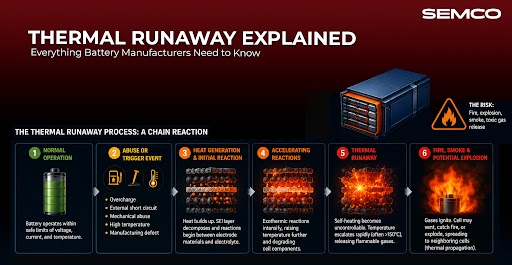
Thermal runaway is a chain reaction inside a battery cell where increasing temperature accelerates chemical reactions that generate even more heat. Once this self-sustaining process begins, it becomes extremely difficult to stop without proper containment.
During thermal runaway, temperatures can rise rapidly beyond safe operating limits, releasing flammable gases, causing electrolyte decomposition, and potentially resulting in fire or explosion.
Although thermal runaway can occur in different battery chemistries, lithium-ion batteries require particularly stringent manufacturing standards due to their high energy density.
How Does Thermal Runaway Occur?
Thermal runaway typically develops in several stages:
1. Initial Heat Generation
Heat may originate from:
- Internal short circuits
- External short circuits
- Overcharging
- Mechanical damage
- Manufacturing defects
- Excessive ambient temperatures
Initially, the battery’s cooling mechanisms may manage the heat.
2. Temperature Escalation
As temperature increases, internal battery components begin to degrade.
The separator may weaken, the electrolyte starts decomposing, and unwanted chemical reactions generate additional heat.
3. Self-Accelerating Reaction
Once critical temperatures are reached, the reactions become self-sustaining.
Heat generation exceeds heat dissipation, causing temperatures to rise rapidly.
4. Cell Failure
The battery may vent gases, ignite, or explode depending on the battery design and surrounding conditions.
If multiple cells are packed together, thermal propagation may cause neighboring cells to fail as well.
Common Causes of Thermal Runaway
Several factors contribute to thermal runaway.
Manufacturing Defects
Microscopic contamination, damaged separators, poor welding quality, or electrode misalignment can create internal short circuits.
Overcharging
Charging beyond the recommended voltage significantly increases internal heat generation.
Physical Damage
Crushing, puncturing, vibration, or impact can damage internal structures.
High Ambient Temperatures
Operating batteries beyond recommended temperature ranges increases thermal stress.
Poor Battery Management
Inadequate Battery Management Systems (BMS) fail to detect abnormal voltage or temperature conditions early.
Inferior Production Equipment
Low-precision manufacturing equipment increases variability, defects, and safety risks.
Why Battery Manufacturing Quality Matters
Thermal runaway prevention begins inside the factory—not after installation.
Modern battery production requires exceptional consistency across every manufacturing stage.
Critical quality processes include:
- Cell inspection
- Laser welding
- Precision stacking
- Busbar welding
- Automated assembly
- Leak testing
- End-of-line testing
- Traceability systems
- Vision inspection
- Intelligent quality monitoring
Even small inconsistencies can significantly impact long-term battery safety.
How Advanced Assembly Lines Reduce Thermal Runaway Risks
Automated battery assembly lines minimize human error while improving repeatability and process control.
Benefits include:
Precision Manufacturing
Automation maintains consistent tolerances across thousands of battery cells.
Intelligent Inspection
Vision systems identify defects before defective cells progress further.
Controlled Welding
High-quality welding minimizes electrical resistance and heat generation.
Real-Time Monitoring
Production data enables early detection of abnormalities.
Traceability
Each battery can be tracked throughout manufacturing for quality assurance.
These technologies significantly reduce manufacturing-related defects that may contribute to thermal runaway.
Thermal Runaway Prevention Best Practices
Manufacturers should implement a comprehensive safety strategy.
Use High-Quality Materials
Reliable cells, separators, electrolytes, and current collectors reduce failure risks.
Maintain Clean Production Environments
Dust and metallic particles are common sources of internal shorts.
Invest in Automated Inspection
Automated optical inspection detects defects invisible to manual operators.
Implement Strict Quality Control
Every production stage should undergo inspection before moving forward.
Optimize Battery Design
Proper spacing, cooling systems, and thermal barriers reduce propagation risks.
Validate Every Battery Pack
Electrical, thermal, and mechanical testing ensure compliance before shipment.
Why Semco Infratech is the Preferred Partner for Battery Assembly Lines
Battery safety begins with manufacturing excellence, and that’s where Semco Infratech delivers value.
Semco Infratech provides advanced battery manufacturing solutions designed for precision, scalability, and quality.
Key advantages include:
End-to-End Battery Assembly Solutions
From cell preparation to final pack assembly, complete manufacturing solutions are available under one roof.
Advanced Automation
Modern automation improves production efficiency while reducing manual errors.
High Precision Equipment
Accurate welding, assembly, testing, and inspection ensure consistent product quality.
Custom Engineering
Assembly lines can be tailored for:
- Lithium-ion batteries
- EV battery packs
- Energy Storage Systems (BESS)
- Industrial batteries
- Customized battery modules
Industry Expertise
The engineering team understands battery manufacturing challenges and develops practical production solutions aligned with evolving industry requirements.
Scalable Manufacturing
Whether building pilot production lines or large-scale gigafactory operations, solutions are designed for future expansion.
Reliable Technical Support
Installation, commissioning, operator training, and after-sales support help manufacturers maintain long-term productivity.
Applications Benefiting from Safe Battery Manufacturing
High-quality battery production supports numerous industries:
- Electric Vehicles (EV)
- Battery Energy Storage Systems (BESS)
- Solar Energy Storage
- Telecom Backup Systems
- Consumer Electronics
- Industrial Automation
- Medical Equipment
- Aerospace Applications
Across all sectors, manufacturing precision directly contributes to battery reliability and operational safety.
Future Trends in Battery Safety
The battery industry continues investing in technologies that reduce thermal runaway risks.
Emerging innovations include:
- AI-powered quality inspection
- Solid-state batteries
- Improved battery separators
- Smart Battery Management Systems
- Digital manufacturing
- Predictive maintenance
- Advanced thermal management
- Fully automated production lines
Companies adopting these technologies will be better positioned to meet increasing global safety standards.
Conclusion
Thermal runaway remains one of the most significant safety concerns in modern battery technology. However, the majority of manufacturing-related risks can be substantially reduced through precision engineering, automated quality control, advanced inspection systems, and reliable production equipment.
Investing in a high-quality battery assembly line is not simply about increasing production—it is about producing safer, more reliable batteries that meet the demands of today’s EV, energy storage, and industrial markets.
With advanced automation, precision manufacturing equipment, customized engineering solutions, and comprehensive technical support, Semco Infratech helps manufacturers build battery production facilities focused on quality, efficiency, and long-term reliability.
Frequently Asked Questions (FAQs)
What is thermal runaway in lithium-ion batteries?
Thermal runaway is a self-accelerating increase in battery temperature caused by internal chemical reactions that can lead to fire or explosion if uncontrolled.
Can thermal runaway be prevented?
Yes. Proper battery design, quality manufacturing, automated inspection, Battery Management Systems (BMS), and thermal management significantly reduce the risk.
What causes thermal runaway?
Common causes include internal short circuits, overcharging, physical damage, manufacturing defects, poor cooling, and excessive operating temperatures.
Why is battery assembly quality important?
Manufacturing quality directly affects battery safety, reliability, lifespan, and resistance to defects that may trigger thermal runaway.
Why choose Semco Infratech?
Semco Infratech provides advanced battery assembly line solutions featuring precision automation, intelligent inspection, scalable production, and engineering expertise to support high-quality battery manufacturing.
References
- National Fire Protection Association. Lithium-Ion Battery Safety Resources.
- UL Solutions. UL 9540A Test Method for Evaluating Thermal Runaway Fire Propagation in Battery Energy Storage Systems.
- International Electrotechnical Commission. IEC 62619: Safety requirements for secondary lithium cells and batteries.
- National Renewable Energy Laboratory. Research publications on lithium-ion battery safety and thermal management.
- United States Department of Energy. Battery safety research and energy storage guidance.
Ideation by Manpreet Singh