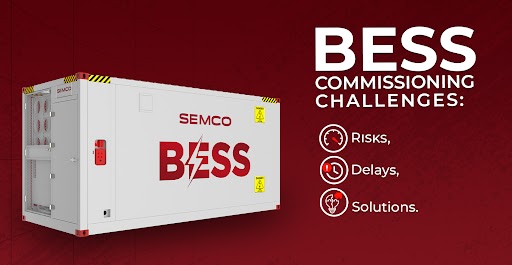
Battery Energy Storage Systems (BESS) have moved from pilot deployments to mission-critical infrastructure supporting grid stability, renewable integration, peak shaving, and energy arbitrage. Yet despite rapid market growth, many projects encounter serious operational setbacks during commissioning. Delays, failed acceptance testing, integration conflicts, thermal management problems, and software interoperability issues can significantly affect project timelines and financial performance.
Understanding BESS commissioning challenges is essential for developers, EPC contractors, utilities, investors, and industrial operators seeking predictable project outcomes. Commissioning is not simply a final validation phase; it is a multidisciplinary process involving electrical engineering, controls integration, cybersecurity, thermal performance verification, and safety compliance. When poorly managed, minor oversights during commissioning can evolve into long-term operational risks. This article examines the most significant challenges in battery energy storage commissioning and outlines practical strategies for reducing delays, technical failures, and performance uncertainty.
Why BESS Commissioning Is More Complex Than Conventional Power Systems
Traditional power infrastructure generally follows mature commissioning procedures with relatively predictable equipment interactions. BESS projects are fundamentally different because they combine electrochemical storage, power electronics, software-driven controls, fire safety systems, thermal management, and grid synchronization into one integrated environment.
A utility-scale battery system depends on seamless coordination between several subsystems, including:
- Battery Management System (BMS)
- Energy Management System (EMS)
- Power Conversion System (PCS)
- Supervisory Control and Data Acquisition (SCADA) platforms
- HVAC and thermal regulation systems
- Fire detection and suppression technologies
Commissioning complexity increases because these technologies often come from different vendors with different communication protocols and performance assumptions. A PCS may operate correctly independently, but fail under integrated dispatch scenarios due to software incompatibility.
For decision-makers, this means commissioning must begin during engineering design—not after equipment installation. Late-stage problem solving increases project risk and often causes avoidable cost overruns.
Integration and Interoperability Failures During System Testing
Among the most common battery energy storage commissioning issues are integration failures between software and hardware systems. BESS assets rely heavily on digital coordination, making interoperability testing essential before commercial operation.
One frequent challenge involves communication protocol mismatches between EMS, PCS, and grid operator interfaces. Improper mapping of operational signals can lead to incorrect dispatch behavior, delayed response times, or operational instability.
Common integration risks include:
- SCADA communication failures
- Incorrect inverter response behavior
- Synchronization issues with utility grid commands
- Data inconsistencies across monitoring systems
- Cybersecurity vulnerabilities in network architecture
These failures matter because commissioning delays often emerge only during full-system operational testing. Factory acceptance testing may validate individual equipment, but integrated site conditions reveal hidden weaknesses.
Project teams that adopt staged validation—moving from component testing to subsystem testing and finally full operational simulation—typically reduce commissioning disruption and improve reliability.
Thermal Management and Safety Validation Challenges
Thermal performance verification is one of the most critical yet underestimated aspects of BESS commissioning. Lithium-ion battery systems are highly sensitive to temperature fluctuations, making HVAC validation and heat dissipation testing indispensable.
Many commissioning failures originate from insufficient airflow modeling or improperly configured cooling systems. Even minor temperature inconsistencies across battery racks can accelerate degradation and reduce long-term system performance.
Safety validation also presents major challenges. Modern energy storage systems must comply with increasingly stringent fire protection and thermal runaway mitigation requirements. Testing typically includes:
- Emergency shutdown verification
- Smoke and gas detection performance
- Thermal runaway propagation controls
- Fire suppression system functionality
- Emergency communication protocols
These procedures are not regulatory formalities. Safety failures can delay project approvals, increase insurance costs, and create long-term operational liabilities.
Organizations that treat thermal validation as an engineering discipline rather than a compliance checklist generally experience fewer post-commissioning incidents and stronger system availability.
Grid Compliance and Performance Testing Difficulties
Grid integration is another major source of commissioning delays. Utilities increasingly require battery storage systems to demonstrate strict compliance with voltage regulation, frequency response, ramp-rate control, and reactive power requirements.
Problems often emerge when site-specific grid conditions differ from modeled assumptions used during project development. Unexpected harmonics, voltage instability, or delayed inverter response can trigger failed acceptance tests.
Commissioning teams must validate several performance metrics before commercial operation, including:
- Round-trip efficiency
- Power response speed
- Grid-forming or grid-following behavior
- Frequency regulation performance
- State-of-charge accuracy
These tests matter because poor performance directly affects project economics. Revenue opportunities in ancillary service markets depend on precise operational behavior. A battery system that responds too slowly or inconsistently may struggle to meet contractual obligations.
For developers and investors, early utility engagement and realistic grid simulation significantly reduce late-stage commissioning risks.
Documentation, Workforce Coordination, and Commissioning Delays
Technical problems are not the only obstacles in BESS deployment. Project execution failures frequently originate from documentation gaps, workforce coordination issues, and unclear responsibility structures between vendors.
Battery storage projects typically involve multiple stakeholders: OEMs, EPC contractors, utilities, software providers, safety consultants, and commissioning engineers. Without clear accountability, troubleshooting becomes fragmented and slow.
Common organizational challenges include:
- Missing commissioning procedures
- Incomplete equipment documentation
- Delayed firmware updates
- Poor communication between vendors
- Inconsistent test acceptance criteria
These operational inefficiencies matter because every commissioning delay extends the timeline to revenue generation. For utility-scale storage assets, even short delays can affect financial projections and contractual milestones.
Experienced project teams increasingly rely on digital commissioning workflows, centralized documentation systems, and predefined escalation frameworks to improve execution discipline.
Reducing BESS Commissioning Challenges Through Early Planning
The most effective way to minimize BESS commissioning challenges is to treat commissioning as a continuous process that begins at project design rather than a final project milestone. Successful battery energy storage deployment depends on early coordination between engineering, procurement, controls integration, safety compliance, and utility stakeholders.
Projects with strong commissioning performance generally share several characteristics: vendor interoperability testing begins early, thermal management systems are validated under realistic operating conditions, grid compliance testing reflects local network realities, and operational documentation is finalized before site energization.
As battery energy storage becomes increasingly central to grid modernization, commissioning quality will play a larger role in determining project profitability, reliability, and operational lifespan. Organizations that underestimate commissioning complexity often face delays and performance shortfalls. Those that approach it systematically tend to achieve faster deployment and more predictable long-term outcomes.
You have not enough Humanizer words left. Upgrade your Surfer plan.