India is rapidly becoming one of the world’s fastest-growing battery manufacturing markets. The increasing demand for electric vehicles (EVs), renewable energy storage systems, telecom backup solutions, UPS batteries, and industrial power storage has created enormous opportunities for entrepreneurs. Government initiatives encouraging domestic manufacturing, combined with rising investments in clean energy, have made 2026 an ideal time to enter the battery manufacturing industry. Recent government updates also show continued support for domestic Advanced Chemistry Cell (ACC) manufacturing under the Production Linked Incentive (PLI) scheme, although implementation has progressed more slowly than originally targeted.
Whether you plan to manufacture lithium-ion battery packs, energy storage systems (ESS), battery management systems (BMS), or complete battery assembly solutions, success depends on choosing the right manufacturing equipment and automation partner.
This comprehensive guide explains everything you need to know before starting a battery manufacturing business in India and why Semco Infratech has become a preferred choice for battery manufacturing assembly lines.
Why Battery Manufacturing is a Booming Industry in India
The Indian battery market is witnessing unprecedented growth due to several factors:
- Rapid EV adoption
- Expansion of solar energy projects
- Growing demand for Battery Energy Storage Systems (BESS)
- Government support for domestic battery manufacturing
- Increasing industrial automation
- Demand for telecom and UPS backup batteries
India is investing heavily in developing a domestic battery ecosystem to reduce import dependence and strengthen local manufacturing capabilities. Entrepreneurs entering the market today can benefit from long-term industry growth if they invest in quality manufacturing infrastructure.
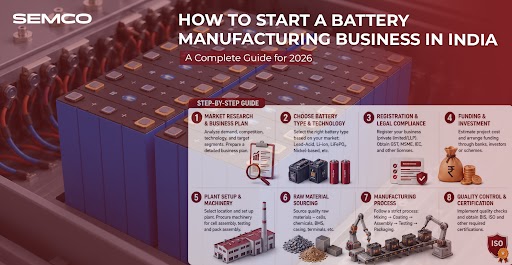
Step 1: Decide Which Battery You Want to Manufacture
Before investing in machinery, determine your target market.
Popular battery segments include:
Lithium-Ion Battery Packs
Ideal for:
- Electric Vehicles
- Solar Energy Storage
- Industrial Equipment
- Home Energy Storage
Lead Acid Batteries
Used in:
- UPS Systems
- Automotive Batteries
- Telecom Towers
Energy Storage Battery Systems (BESS)
One of the fastest-growing markets in India due to renewable energy adoption.
Selecting the correct product category helps determine machinery, workforce, certifications, and production capacity.
Step 2: Conduct Market Research
Understand your potential customers:
- EV manufacturers
- Solar EPC companies
- Industrial automation companies
- Telecom providers
- OEM battery brands
- Government projects
- Export buyers
Research competitors, pricing, manufacturing costs, and future demand before investing.
Step 3: Prepare a Business Plan
A professional business plan should include:
- Market analysis
- Investment estimation
- Manufacturing process
- Machinery requirements
- Staffing plan
- Financial projections
- Sales strategy
- ROI analysis
- Risk assessment
A detailed business plan also helps secure funding from banks and investors.
Step 4: Register Your Business
Choose an appropriate business structure such as:
- Private Limited Company
- LLP
- Partnership
- Proprietorship
Complete applicable registrations, including:
- GST Registration
- MSME Registration
- Factory License
- Pollution Control approvals (where applicable)
- BIS certifications (if required)
- Fire Safety approvals
Requirements vary depending on your products, production process, and state regulations.
Step 5: Choose the Right Manufacturing Facility
Your factory should provide:
- Adequate production space
- ESD-safe work areas
- Temperature-controlled environment
- Material storage
- Quality inspection zones
- Assembly section
- Testing laboratories
- Packaging area
Proper facility planning improves production efficiency while maintaining product quality.
Step 6: Invest in High-Quality Battery Manufacturing Machinery
This is the most critical investment.
A professional battery manufacturing line may include:
- Battery Cell Sorting Machine
- Automatic Spot Welding Machine
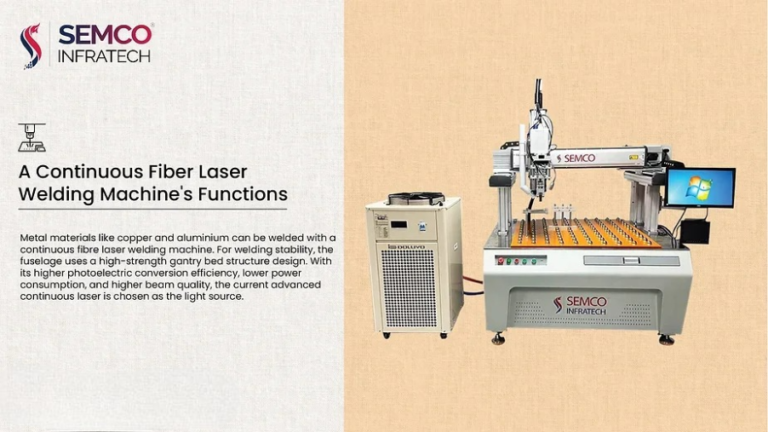
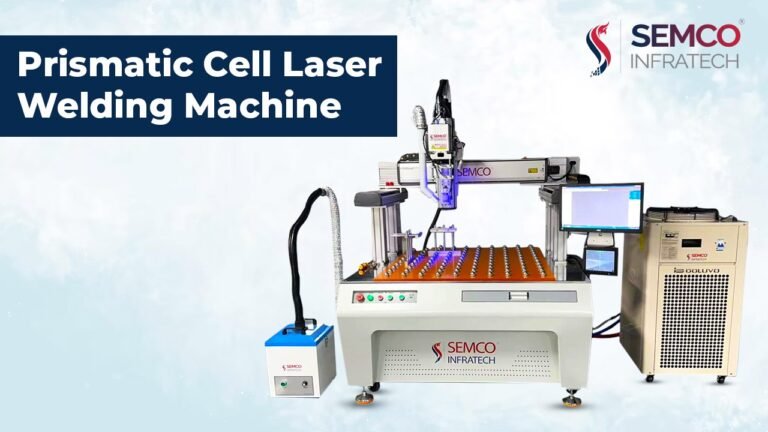
- Laser Welding Machine
- Battery Pack Assembly Line
- Battery Testing Equipment
- BMS Programming Station
- Cell Matching Equipment
- Insulation Testing Machine
- Battery Aging Machine
- End-of-Line Testing Systems
- Conveyor Automation
- Pack Inspection Equipment
Choosing reliable equipment reduces production errors, improves consistency, and lowers maintenance costs.
Why Choosing the Right Assembly Line Matters
Many new manufacturers focus only on battery cells while overlooking production automation.
An efficient assembly line provides:
- Higher production speed
- Lower labor costs
- Better weld quality
- Improved product consistency
- Reduced rejection rates
- Better quality control
- Easier scalability
- Higher profitability
This makes selecting the right equipment supplier a strategic business decision.
Why Semco Infratech is the Best Partner for Battery Assembly Lines
Building a successful battery manufacturing business requires more than just buying machines. It requires a technology partner that understands manufacturing workflows, automation, quality control, and future scalability.
Semco Infratech provides integrated battery manufacturing solutions designed for startups, MSMEs, and large-scale manufacturers.
Complete Manufacturing Solutions
Instead of sourcing machinery from multiple suppliers, businesses can establish an end-to-end production setup from a single partner.
Advanced Automation
Semco Infratech offers automated production systems that improve manufacturing efficiency while reducing manual intervention.
Customized Assembly Lines
Every manufacturer has unique production requirements. Semco designs customized assembly lines based on battery chemistry, pack configuration, production capacity, and available floor space.
High-Quality Equipment
Manufacturing equipment is engineered for precision, durability, and consistent production performance.
Technical Support
Installation assistance, operator training, commissioning support, and after-sales service help customers achieve faster production readiness.
Scalable Manufacturing
Whether starting with a pilot production line or planning for mass manufacturing, Semco solutions are designed to grow with business requirements.
Estimated Investment Required
Investment varies depending on:
| Business Size | Estimated Investment |
|---|---|
| Small Scale | ₹20 Lakhs – ₹75 Lakhs |
| Medium Scale | ₹75 Lakhs – ₹5 Crore |
| Large Automated Plant | ₹5 Crore+ |
Actual costs depend on land, machinery, automation level, testing equipment, certifications, utilities, and production capacity.
Challenges in Battery Manufacturing
New businesses commonly face:
- Raw material sourcing
- Quality consistency
- Skilled manpower
- Safety compliance
- Equipment maintenance
- Supply chain management
- Technology upgrades
Working with an experienced machinery supplier helps reduce these risks and shortens the learning curve.
Future of Battery Manufacturing in India
The future remains highly promising due to:
- Expansion of EV manufacturing
- Renewable energy growth
- Grid-scale energy storage
- Government manufacturing initiatives
- Increasing exports
- Industrial automation
- Demand for localized battery production
Businesses investing in quality equipment and scalable manufacturing today are well positioned to benefit from long-term industry growth.
Conclusion
Starting a battery manufacturing business in India in 2026 presents a significant opportunity, but long-term success depends on strategic planning, regulatory compliance, skilled operations, and investment in reliable manufacturing infrastructure. While demand for battery packs and energy storage systems continues to rise, manufacturers must focus on quality, automation, and operational efficiency to remain competitive.
Selecting the right battery assembly line is one of the most important decisions you will make. A dependable manufacturing partner can improve production efficiency, product consistency, and future scalability. With comprehensive battery manufacturing equipment, customized assembly line solutions, automation expertise, and technical support, Semco Infratech is well positioned to help businesses establish and expand modern battery manufacturing facilities.
Frequently Asked Questions (FAQs)
1. How much investment is required to start a battery manufacturing business in India?
A small-scale setup may require ₹20 lakh to ₹75 lakh, while automated facilities can require several crores depending on capacity and equipment.
2. Which battery business is most profitable in 2026?
Lithium-ion battery packs, BESS, and EV battery manufacturing are among the fastest-growing segments.
3. What machinery is required for battery manufacturing?
Typical equipment includes cell sorting machines, spot welding machines, laser welders, BMS programming systems, testing equipment, aging machines, and automated assembly lines.
4. Is battery manufacturing a profitable business in India?
It can be profitable with strong quality control, efficient production, and access to growing sectors such as EVs, renewable energy, and industrial power storage.
5. Why is automation important in battery manufacturing?
Automation improves consistency, reduces labor costs, minimizes defects, and enables higher production volumes.
6. Why choose Semco Infratech for a battery assembly line?
Semco Infratech offers integrated battery manufacturing solutions, customized automation, technical support, and scalable production systems designed for businesses of different sizes.
Article Citation
This article has been prepared using publicly available industry information and government resources, including:
- Ministry of Heavy Industries (India) – ACC Battery Storage PLI Scheme.
- IEEFA – Assessing India’s incentive scheme to enhance the battery manufacturing ecosystem.
- PV Magazine India – Coverage of India’s ACC battery manufacturing progress.