Battery Energy Storage Systems (BESS) are becoming central to grid modernization, renewable energy integration, industrial backup power, and peak load management. However, as deployment scales, safety concerns have become more complex and commercially significant. High energy density, lithium-ion chemistry risks, thermal runaway events, fire propagation, and electrical hazards make safety a board-level issue rather than an engineering afterthought.
The challenge is not merely preventing incidents but creating systems that remain stable under abnormal operating conditions. A poorly designed storage project can face insurance barriers, delayed approvals, operational shutdowns, and significant reputational damage. This makes compliance with BESS safety standards essential for developers, EPC contractors, utilities, industrial operators, and investors.
Effective safety management requires a combination of engineering design, thermal management, fire suppression systems, battery management systems (BMS), operational procedures, and regulatory compliance. Understanding how safety standards work together is critical for ensuring reliability, regulatory acceptance, and long-term asset performance.
Why BESS Safety Standards Have Become a Critical Requirement
The rapid deployment of energy storage systems has increased scrutiny from regulators, insurers, and project financiers. Unlike conventional electrical infrastructure, BESS installations introduce electrochemical risks that can escalate quickly if improperly managed.
One of the biggest concerns is thermal runaway, where overheating in one battery cell triggers an uncontrollable chain reaction across adjacent cells. These events can release flammable gases, create toxic smoke, and generate prolonged fires that are difficult to extinguish.
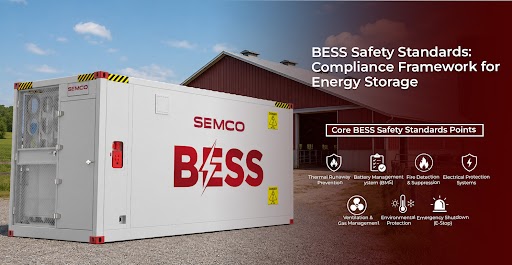
Modern BESS safety standards exist to minimize these risks through preventive and containment-focused approaches. They establish technical requirements for:
- Cell and module-level testing
- Fire detection and suppression systems
- Electrical protection mechanisms
- Thermal management design
- Ventilation and gas detection systems
- Emergency shutdown protocols
For project developers, compliance is no longer optional. Financial institutions increasingly assess safety compliance before funding projects, while insurers often require evidence of tested systems and validated risk mitigation measures before issuing coverage.
Core International BESS Safety Standards and Certifications
No single regulation governs battery storage safety globally. Instead, safety is built through a layered framework of international standards covering battery design, fire risk, transportation, and installation practices.
Among the most important standards is the industry framework for thermal runaway evaluation and fire propagation testing. This standard evaluates how battery systems behave under failure conditions and whether a thermal incident spreads beyond a defined containment area.
Another major benchmark focuses on electrical energy storage installation safety. It defines requirements for spacing, enclosure design, ventilation, emergency response planning, and electrical protection.
Battery cell and pack testing standards are equally important. These evaluate abuse conditions such as overcharging, overheating, vibration, mechanical shock, short circuits, and environmental exposure.
For decision-makers, the key consideration is interoperability. A compliant BESS project typically requires multiple certifications covering:
- Battery cells
- Battery modules and racks
- Fire suppression systems
- Power conversion systems
- Containerized enclosures
- Electrical infrastructure integration
Compliance gaps in even one subsystem can create approval and operational risks.
Thermal Runaway Prevention and Fire Protection Standards
Thermal runaway remains the defining safety risk in modern battery storage systems. Because lithium-ion batteries can generate self-sustaining heat under failure conditions, prevention strategies must operate at multiple system levels.
Effective BESS safety standards focus first on early fault detection. Sensors monitor voltage irregularities, temperature deviations, gas release, and abnormal current flow to identify issues before escalation.
Containment is equally important. Modern safety frameworks require compartmentalization strategies designed to prevent a single-cell failure from affecting the entire system.
Key fire safety measures commonly required include:
- Multi-layer temperature monitoring
- Smoke and combustible gas detection
- Automatic fire suppression systems
- Emergency ventilation mechanisms
- Thermal isolation between battery racks
- Explosion pressure relief systems
Fire suppression alone is not enough. In many documented failures, delayed incident detection allowed conditions to worsen long before intervention became possible.
Project operators increasingly recognize that prevention architecture delivers stronger risk reduction than relying solely on emergency response systems.
Battery Management Systems and Functional Safety Requirements
The Battery Management System (BMS) is often described as the intelligence layer of a BESS installation. However, from a safety perspective, it functions as the system’s primary risk control mechanism.
A well-designed BMS continuously monitors battery health and operational conditions. It prevents unsafe charging and discharging behavior while identifying abnormal patterns before they become critical.
Modern BESS safety standards place strong emphasis on BMS functionality because electrical failures often begin as small anomalies rather than catastrophic faults.
Critical BMS safety functions generally include:
- Cell voltage balancing
- Temperature monitoring across modules
- Overcurrent protection
- State-of-charge management
- Fault isolation mechanisms
- Emergency shutdown activation
Functional safety requirements also extend beyond software performance. Communication redundancy, cybersecurity protections, fail-safe logic, and emergency isolation capabilities are increasingly viewed as essential for grid-scale installations.
For industrial operators, selecting a low-cost battery system with weak BMS architecture often creates hidden operational risks that outweigh initial capital savings.
Site Design, Installation, and Operational Safety Considerations
Technical compliance does not guarantee operational safety. Many failures occur because of poor site planning, inadequate spacing, insufficient ventilation, or weak maintenance protocols.
Site-level BESS safety standards focus heavily on physical infrastructure and operational readiness. Container placement, emergency access routes, thermal separation distances, and environmental controls all influence project risk.
Installation quality also matters significantly. Improper cable management, inadequate grounding, poorly configured protection systems, and weak commissioning practices can undermine certified equipment performance.
Critical site safety considerations include:
- Adequate separation distances between containers
- Emergency responder accessibility
- Environmental monitoring systems
- Ventilation and cooling infrastructure
- Electrical isolation procedures
- Preventive maintenance scheduling
Operational safety becomes especially important for large utility-scale deployments where even minor failures can create cascading disruptions.
Organizations increasingly treat BESS projects as high-reliability infrastructure assets requiring structured inspection, predictive diagnostics, and ongoing compliance verification.
Regulatory Challenges and the Future of BESS Safety Standards
As battery storage deployment accelerates globally, regulations are evolving rapidly. One major challenge is the lack of complete harmonization between regions, creating compliance complexity for multinational developers and equipment suppliers.
Many jurisdictions are strengthening fire safety requirements after high-profile energy storage incidents. Authorities are increasingly demanding site-specific hazard assessments, emergency response plans, and validated thermal propagation testing before approval.
Another emerging trend involves integrating real-time monitoring requirements into safety frameworks. Continuous diagnostics, remote condition monitoring, and predictive analytics are expected to become more prominent in future compliance standards.
The growing use of higher-energy-density battery chemistries will likely increase regulatory scrutiny rather than reduce it.
For decision-makers, the implication is straightforward: designing projects only to meet minimum compliance thresholds creates long-term operational risk. Scalable energy storage projects increasingly require safety-by-design approaches aligned with evolving standards and insurer expectations.
Conclusion
BESS deployment is expanding faster than many regulatory systems originally anticipated, making safety governance more important than ever. The technical complexity of battery storage means that safety failures rarely result from a single issue; they typically emerge from multiple weaknesses across design, installation, monitoring, and operational management.
Strong adherence to BESS safety standards reduces fire risk, improves insurance acceptance, accelerates regulatory approvals, and protects long-term project economics. More importantly, it creates operational resilience in systems expected to function reliably for years under demanding conditions.
For utilities, industrial operators, and project developers, the practical question is no longer whether safety compliance matters. The real issue is whether current project designs are robust enough to meet increasingly demanding technical, regulatory, and operational expectations.
You have not enough Humanizer words left. Upgrade your Surfer plan.