Laser welding for battery manufacturing is an important joining technology used to create precise, repeatable connections between battery components. As electric vehicles, lithium-ion battery packs and battery energy storage systems (BESS) expand, manufacturers need welding processes that can support consistent quality, production efficiency and reliable electrical connections.
A suitable laser welding machine for batteries can help manufacturers join battery terminals, busbars, tabs and other compatible metal components. The right machine depends on the battery design, material combination, joint geometry, production volume and quality requirements.
Semco Infratech provides industrial laser welding equipment for battery manufacturing applications, including solutions for prismatic battery production. Businesses evaluating a laser welding machine can compare equipment configurations based on their application, automation requirements and production targets.
What Is Laser Welding for Batteries?
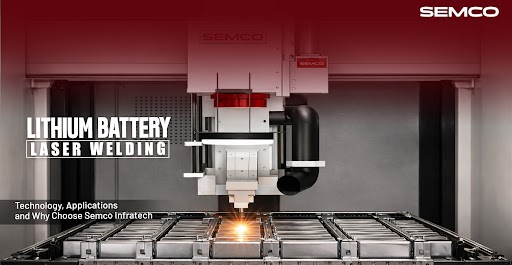
Laser welding is a joining process that uses a focused laser beam to heat and fuse materials at a specific location. In battery manufacturing, it can be used to create connections between compatible metal components while controlling the position and energy of the weld.
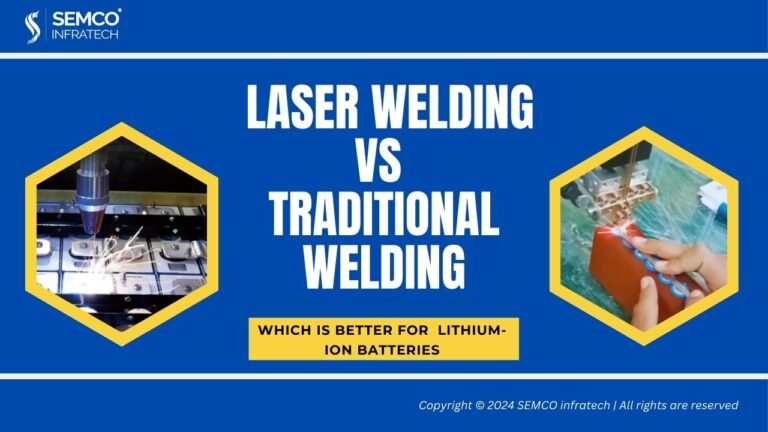
Unlike conventional welding methods that may use an electrode or a broader heat source, laser welding delivers energy to a concentrated area. When the parameters and joint design are correctly selected, this can support precise welding and limit unwanted heat transfer to surrounding areas.
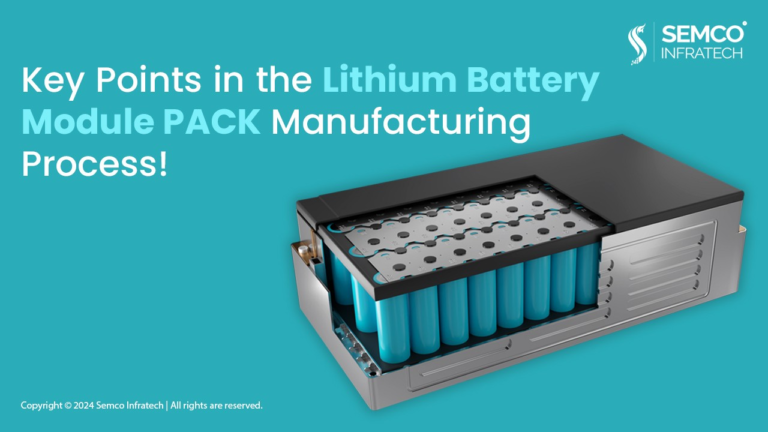
The process is used in different stages of lithium-ion battery production, including battery cell connections, module assembly and battery pack manufacturing.
However, not every battery component is suitable for every laser welding process. Material compatibility, surface condition, component thickness and joint geometry must be evaluated before choosing the equipment.
Applications of Laser Welding in Battery Manufacturing
1. Battery Terminal Welding
Laser welding can join compatible terminal components to conductors or other specified metal parts. The welding process must be designed around the terminal material, thickness, joint geometry and required electrical performance.
2. Battery Busbar Welding
Busbars carry electrical current between cells or modules. A suitable laser welding process can create controlled joints between compatible busbar materials and battery terminals.
For manufacturers, joint consistency, electrical resistance, mechanical strength and inspection requirements are important considerations when selecting a busbar welding machine.
3. Prismatic Battery Welding
Prismatic battery manufacturing may require welding operations for cell connections, terminal assemblies and module components. Laser welding equipment can be configured around the required joint design and production workflow.
Semco Infratech offers laser welding machines in its prismatic-cell equipment category. Manufacturers should confirm the exact machine configuration and application compatibility before purchasing.
4. EV Battery Pack Assembly
Electric vehicle battery packs contain multiple cells, electrical connections and structural components. Laser welding can be incorporated into suitable module and pack assembly processes to support repeatable joining.
The welding solution must be selected according to the battery architecture, material combination, throughput requirements and quality-control process.
5. Battery Energy Storage Systems (BESS)
Battery energy storage systems use battery modules and packs to store electrical energy for industrial, commercial and grid-related applications.
Laser welding may be used for suitable electrical connections during module or pack manufacturing. For automated production, the welding station can form part of a wider assembly line incorporating material handling, positioning, inspection and testing.
Explore Semco Infratech’s BESS assembly line solutions to understand how welding fits into a broader battery manufacturing workflow.
How Does a Battery Laser Welding Machine Work?
A typical industrial laser welding process follows these steps:
- Component positioning: The battery component, terminal or busbar is positioned in the required fixture.
- Surface preparation: The joint area is inspected and cleaned where necessary.
- Parameter selection: Suitable laser power, welding speed, focus position and other process parameters are established.
- Laser welding: The machine delivers the programmed laser energy along the required weld path.
- Quality inspection: The completed joint is inspected using appropriate visual, dimensional, electrical or mechanical testing methods.
- Process documentation: Where required, inspection results and process information are recorded for quality assurance and traceability.
The exact process varies by machine, material, joint design and production requirements. Process development and sample welding are valuable steps before finalizing equipment for production.
Benefits of Laser Welding for Battery Production
Precision and Repeatability
A properly configured laser welding machine can deliver controlled weld placement and repeatable results. This is especially useful when manufacturing battery assemblies with closely specified joint dimensions.
Production Efficiency
Laser welding can support rapid, localized joining in suitable applications. Actual production speed depends on the joint design, positioning time, handling system, inspection process and machine configuration.
Controlled Heat Input
The concentrated energy of laser welding can reduce the heat-affected area compared with some alternative processes. Results depend on the material combination and welding parameters.
Automation Integration
Industrial laser welding equipment can be integrated with fixtures, conveyors, robotic handling, machine vision and automated assembly systems where the application requires them.
Consistent Quality Control
When combined with appropriate inspection and process monitoring, laser welding can help manufacturers establish a more consistent production process. Welding alone does not guarantee joint quality; validation and inspection remain essential.
How to Choose the Right Laser Welding Machine for Batteries
Choosing a battery laser welding machine requires more than comparing the advertised laser power or purchase price. Evaluate the following factors before making a decision.
1. Battery Type and Application
Identify whether the equipment will be used for prismatic cells, cylindrical cells, pouch-cell assemblies, battery modules, battery packs or BESS production.
The machine configuration should match the actual component and joining application.
2. Material Compatibility
Battery manufacturing may involve materials such as aluminium, copper, nickel and steel. Their properties and combinations affect the welding process.
Ask the supplier to validate the proposed material combination and joint design through sample trials.
3. Laser Power and Welding Parameters
Laser power is an important specification, but higher power does not automatically mean better weld quality. The correct choice depends on material thickness, joint geometry, required penetration, welding speed and process stability.
Semco Infratech lists laser welding equipment in its prismatic-cell range, including 2000 W, 3000 W and 6000 W models. These are examples of available equipment options, not a recommendation that one power level suits every battery application.
4. Machine Configuration
Depending on the production requirement, manufacturers may evaluate a gantry-type system, a welding station, a portable machine or an automated production configuration.
Consider fixture design, loading and unloading, operator access, positioning accuracy and integration with the existing production line.
5. Vision and Inspection Requirements
Machine vision or positioning cameras may help locate the weld area and verify component positioning. Additional inspection systems may be needed to check weld appearance, dimensions, electrical performance or mechanical strength.
Confirm which features are included in the quoted configuration rather than assuming they are standard.
6. Safety and Operator Protection
Laser welding requires suitable laser-safety controls. Depending on the laser class and equipment design, these may include an enclosed welding area, interlocks, protective viewing windows, extraction systems and appropriate operating procedures.
The equipment must be assessed against applicable safety requirements before installation and operation.
7. Service, Installation and Spare Parts
Evaluate installation support, operator training, maintenance requirements, spare-parts availability and access to technical assistance.
These factors affect long-term equipment usability and should be considered alongside the initial machine price.
Why Consider Semco Infratech When Buying a Laser Welding Machine?
For battery manufacturers evaluating a laser welding machine in India, Semco Infratech is an option worth considering because its equipment portfolio includes battery assembly and testing solutions as well as laser welding machines.
Here are the main areas to evaluate when discussing a project with Semco.
Battery Manufacturing Equipment Portfolio
Semco Infratech lists laser welding equipment for prismatic-cell applications. Buyers can discuss their component design and production requirements to identify a suitable machine configuration.
Multiple Equipment Configurations
The listed portfolio includes 2000 W, 3000 W and 6000 W laser welding options, along with different machine configurations. Availability, specifications and suitability should be confirmed for the specific application.
Integration With Battery Assembly Lines
Where required, laser welding can be considered as part of a broader battery production workflow. Semco’s BESS assembly line offering includes welding among the manufacturing processes used in battery assembly.
This may be relevant to manufacturers planning a new production line or evaluating automation opportunities.
Application-Based Equipment Selection
Before purchasing, share the component drawings, material specifications, target production volume and expected weld quality. This helps the supplier assess the proposed configuration instead of relying on laser power alone.
Support and Project Requirements
Ask for a clear quotation covering the machine configuration, installation scope, commissioning, training, warranty terms, maintenance and spare parts. Confirm which services are included in the final commercial proposal.
Looking for a laser welding machine for lithium-ion battery manufacturing? Contact Semco Infratech to discuss your application and request an equipment recommendation based on your production requirements.
Browse the Semco Infratech laser welding machine range.
Frequently Asked Questions About Laser Welding for Batteries
What is laser welding for battery manufacturing?
Laser welding for battery manufacturing is a joining process that uses a focused laser beam to fuse compatible metal components. It can be used for suitable battery terminals, busbars, tabs and module or pack connections.
Which laser welding machine is suitable for lithium-ion batteries?
The right machine depends on the battery design, material combination, joint geometry, component thickness, production volume and quality requirements. Sample welding and application validation help determine a suitable configuration.
Can a laser welding machine weld copper and aluminium battery components?
Laser welding can be used for certain copper and aluminium applications, but these materials require careful process development. Reflectivity, thermal conductivity, joint design and material combination affect the result. The proposed application should be validated before production.
Is laser welding suitable for prismatic battery cells?
Laser welding is used in suitable prismatic battery manufacturing applications, including specified terminal, busbar and module connections. The machine and process must be selected according to the cell design and joining requirements.
What laser power is required for battery welding?
There is no single laser power suitable for every battery welding application. The required power depends on the material, thickness, joint geometry, welding speed and required weld characteristics. A supplier should assess the application before recommending a machine.
What is the price of a battery laser welding machine in India?
The price varies according to laser power, machine type, automation level, fixtures, vision systems, safety enclosure, integration requirements and after-sales scope. Request a quotation based on the intended application and required configuration.
Why consider Semco Infratech for a laser welding machine?
Semco Infratech offers laser welding equipment within its battery manufacturing equipment portfolio, including options for prismatic-cell applications. Buyers can discuss their requirements and confirm machine specifications, integration possibilities, service terms and pricing before purchasing.
Can laser welding be integrated into an automatic battery assembly line?
Yes, laser welding can be integrated into a suitable automated battery assembly line. The solution may include positioning fixtures, conveyors, robotic handling, machine vision and inspection systems, depending on the production process.
Request a Laser Welding Machine Consultation
Selecting the right laser welding machine can influence production efficiency, joint consistency and manufacturing quality. Before investing, validate the application, material compatibility, required throughput and inspection process.
Contact Semco Infratech to discuss your battery welding requirements, compare available machine configurations and request a quotation.
Website: https://www.semcoinfratech.com/
Laser welding equipment: https://www.semcoinfratech.com/product-category/for-prismatic-cell/welding-machines-for-prismatic-cell/
BESS assembly line: https://www.semcoinfratech.com/bess-assembly-line/
Final machine selection, technical specifications, availability, warranty and support are subject to confirmation by Semco Infratech.