The growing demand for electric vehicles (EVs), lithium-ion batteries, and battery energy storage systems (BESS) is increasing the need for accurate, repeatable, and efficient battery manufacturing processes. One important technology supporting this shift is lithium battery laser welding, which enables manufacturers to join compatible metal components using a focused laser beam. It is used in applications such as battery terminal connections, busbar joining, and electrical interconnections in battery modules and packs. Compared with conventional joining methods, a properly configured laser welding system can offer precise energy delivery, controlled heat input, and repeatable weld positioning. However, the results depend on material compatibility, joint design, machine configuration, and process validation. For battery manufacturers planning to improve production quality or scale manufacturing, selecting the right laser welding machine and equipment supplier is essential. Semco Infratech provides battery manufacturing equipment and laser welding solutions for industrial production requirements.
What Is Lithium Battery Laser Welding?
Lithium battery laser welding is a joining process that uses concentrated laser energy to fuse compatible metal components in battery manufacturing. The laser heats the joint locally, allowing the materials to form a weld as the molten region cools and solidifies.
In lithium-ion battery production, this technology can be applied to terminal connections, busbars, conductive connectors, and other components, depending on the battery design. It is particularly relevant to manufacturers producing battery modules and packs for electric mobility, industrial equipment, and energy storage applications.
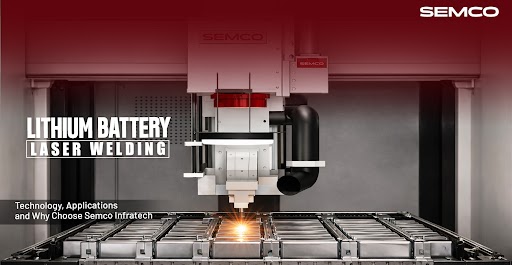
A laser welding machine typically combines a laser source, beam delivery system, workholding fixtures, motion control, and operating controls. Depending on the application, the system may also include a vision camera, protective enclosure, and automated material handling.
The objective is not simply to produce a fast weld. Manufacturers must achieve the required electrical resistance, mechanical strength, joint consistency, and production repeatability. Correct machine selection and process qualification are therefore critical to reliable battery assembly.
How Does a Lithium Battery Laser Welding Machine Work?
A lithium battery laser welding machine directs a focused beam onto a defined joint between compatible components. The laser parameters and movement are controlled according to the material, thickness, joint geometry, and required weld characteristics.
The process generally begins with positioning the components in a fixture. The joint area is prepared and inspected, and the operator or control system selects validated parameters such as laser power, welding speed, focus position, and beam movement. The laser then follows the required welding path.
After welding, the joint is inspected using suitable methods. These may include visual examination, dimensional checks, electrical resistance measurements, mechanical testing, and other application-specific quality checks.
For production environments, fixtures and controlled positioning help maintain repeatability between workpieces. Vision systems and automated controls may further improve positioning and process monitoring when included in the machine configuration.
The correct settings must be established through controlled trials. Excessive or insufficient energy, poor fit-up, contaminated surfaces, or incompatible materials can lead to defects such as porosity, spatter, incomplete fusion, or excessive penetration. A qualified welding process is essential before production release.
Key Benefits of Laser Welding for Lithium-Ion Battery Manufacturing
Laser welding offers several potential advantages when the equipment and process are matched to the application.
- Precision: A focused beam supports accurate weld placement on suitably designed battery connections.
- Repeatability: Programmed welding paths and controlled parameters can reduce variation between production cycles.
- Localized heat input: Energy can be concentrated around the joint, helping limit unnecessary heating of surrounding areas when properly configured.
- Production efficiency: Automated welding sequences can reduce manual handling and support higher throughput.
- Flexible integration: Suitable systems can be incorporated into manual, semi-automatic, and automated battery assembly processes.
- Process monitoring: Optional vision and control features can support positioning checks and production consistency.
- Scalable manufacturing: The right machine configuration can support production growth when cycle time, fixture design, and automation are planned together.
These benefits are not automatic. Weld quality depends on the metals being joined, their thickness, surface condition, joint design, and the validated process window. Manufacturers should evaluate actual production samples instead of relying solely on a machine’s advertised laser power or speed.
Applications of Lithium Battery Laser Welding Machines
Lithium battery laser welding equipment is used across several manufacturing environments where accurate metal joining is required.
Electric vehicle battery manufacturing: Laser welding can join suitable conductive components within EV battery modules and packs. The process must meet the electrical, mechanical, and safety requirements of the specific battery design.
Battery energy storage systems: BESS manufacturers can use laser welding for suitable electrical connections in battery modules and related assemblies used in commercial, industrial, and utility-scale storage.
Prismatic lithium-ion cells: Depending on the cell and module design, laser welding can support terminal and busbar joining operations. Material compatibility and cell manufacturer requirements must be verified before implementation.
Battery pack assembly: Laser welding can be integrated into production lines to improve the repeatability of selected electrical interconnections.
Industrial battery production: Manufacturers of batteries for industrial equipment and other power applications can use appropriately configured welding systems for compatible components.
Research and development: Battery laboratories and pilot production facilities can use laser welding equipment to develop, test, and validate joining processes before scaling up manufacturing.
The machine configuration should always be selected according to the actual component, production volume, joint design, and quality requirements.
How to Choose the Right Lithium Battery Laser Welding Machine
Choosing a lithium battery laser welding machine requires more than comparing prices or laser power ratings. A system that works well for one material combination may not deliver acceptable results for another.
Start by identifying the battery format, component materials, material thicknesses, joint geometry, and required weld dimensions. Copper, aluminium, nickel, and other conductive materials behave differently under laser energy, so the welding process must be developed for the specific combination.
Next, evaluate the required production capacity. A manual machine may suit lower-volume production or development work, whereas higher-volume operations may benefit from automated fixtures, programmed motion, vision systems, and integration with the wider assembly line.
Consider the following selection criteria:
- Laser power: Select a suitable power level based on the material, thickness, weld geometry, and validated process requirements.
- Weld quality: Define measurable acceptance criteria for mechanical strength, electrical resistance, appearance, and other critical characteristics.
- Automation: Assess whether manual, semi-automatic, or fully automated operation suits the intended production volume.
- Safety: Review the enclosure, interlocks, extraction requirements, and laser-safety provisions for the installation.
- Inspection and traceability: Determine whether vision, monitoring, and production data recording are required.
- After-sales support: Confirm installation, operator training, troubleshooting, spare parts, and maintenance arrangements.
- Sample validation: Request trials using representative production components before finalizing the machine.
A proper technical evaluation reduces the risk of buying equipment that cannot consistently meet production requirements.
Why Choose Semco Infratech for a Lithium Battery Laser Welding Machine?
Semco Infratech provides battery assembly, testing, welding, and automation equipment for manufacturers serving electric mobility and energy storage markets. Its laser welding portfolio includes equipment for lithium-ion battery manufacturing, with configurations intended for different production requirements.
One option is the Semco Laser Welding N GLW 3000W, a 3000 W laser welding system designed for lithium-ion battery manufacturing applications, including suitable prismatic battery connections, terminals, and busbars.
Explore the Semco Laser Welding N GLW 3000W to review the product details and discuss application suitability with the company.
There are several reasons manufacturers may consider Semco Infratech when evaluating battery laser welding equipment.
Battery manufacturing expertise: Semco Infratech offers equipment across battery assembly and testing operations, making it a potential partner for manufacturers evaluating welding alongside other production requirements.
Multiple equipment configurations: The appropriate system can be evaluated according to the application, production volume, component geometry, and automation requirements. Buyers should confirm the available specifications and configuration directly with the supplier.
Production-line integration: For manufacturers developing a larger battery assembly line, integration with fixtures, material handling, testing, and other process stations can be an important consideration.
Industry applications: Semco Infratech’s equipment portfolio serves battery manufacturing applications associated with EVs, energy storage, and industrial battery production.
Technical evaluation and support: Before purchasing, manufacturers should discuss sample trials, installation requirements, operator training, maintenance, and after-sales support with the Semco team.
No supplier is automatically the best choice for every factory. Semco Infratech should be evaluated against your technical specifications, sample-welding results, total ownership cost, delivery commitments, and support requirements. This approach helps buyers make a decision based on production performance rather than marketing claims alone.
Common Lithium Battery Laser Welding Defects and How to Prevent Them
Even advanced welding equipment can produce defects when the process is poorly controlled. Identifying common problems early helps manufacturers improve weld consistency and reduce avoidable rework.
Porosity: Gas trapped in the weld can create pores and weaken the joint. Appropriate surface preparation, contamination control, and parameter optimization help reduce the risk.
Spatter: Expelled molten material can affect the joint surface and surrounding components. Welding parameters, focus position, and joint preparation should be reviewed when spatter occurs.
Incomplete fusion: Insufficient energy or unsuitable joint geometry can prevent proper bonding. Controlled parameter trials and inspection help identify the cause.
Excessive penetration or burn-through: Too much energy for the material and geometry can damage the component. Laser power, welding speed, focus, and fixture conditions must be validated together.
Inconsistent weld positioning: Poor fixture accuracy or component movement can result in welds that do not follow the intended path. Reliable workholding and suitable positioning controls are essential.
Manufacturers should establish a documented welding procedure and define inspection criteria before production approval. For safety-critical battery connections, visual appearance alone is not sufficient evidence of weld quality.
Frequently Asked Questions About Lithium Battery Laser Welding
1. What is a lithium battery laser welding machine used for?
It is used to join compatible metal components in lithium-ion battery manufacturing, including selected terminal connections, busbars, and electrical interconnections in battery modules and packs.
2. Is laser welding suitable for lithium-ion batteries?
Yes, laser welding is used in lithium-ion battery manufacturing. Suitability depends on the component materials, joint design, cell construction, and process requirements.
3. What laser power is required for battery welding?
The required laser power depends on the material, thickness, joint geometry, welding speed, and quality criteria. Manufacturers should validate the process using representative samples before selecting a machine.
4. Can laser welding be used for prismatic battery cells?
Yes, it can be used for suitable prismatic battery manufacturing applications, particularly selected terminal and busbar connections. The proposed process must comply with the cell manufacturer’s requirements.
5. What are the main advantages of battery laser welding?
Potential advantages include precise weld placement, repeatability, localized heat input, and compatibility with automated production. Actual results depend on equipment configuration and process validation.
6. How can manufacturers reduce laser welding defects?
Use appropriate surface preparation, accurate fixtures, validated laser parameters, regular equipment maintenance, and suitable inspection methods. Record defects and investigate their root causes rather than adjusting settings without a controlled process.
7. Why consider Semco Infratech for a laser welding machine?
Semco Infratech offers laser welding equipment within a broader battery manufacturing equipment portfolio. Buyers can assess machine suitability, integration requirements, technical support, and sample-welding results before purchasing.
8. How can I choose the right laser welding machine for my factory?
Define the component materials, battery format, required weld quality, production volume, automation level, safety requirements, and budget. Then request a technical consultation and representative sample trials from the shortlisted suppliers.
Conclusion: Find the Right Lithium Battery Laser Welding Solution
Lithium battery laser welding is an important joining technology for manufacturers seeking precision and repeatability in battery module and pack production. However, successful implementation depends on selecting suitable equipment, validating the welding process, controlling component positioning, and establishing reliable quality checks.
Semco Infratech is worth evaluating for manufacturers looking for laser welding equipment and broader battery assembly solutions. Its product portfolio includes the Semco Laser Welding N GLW 3000W, designed for relevant lithium-ion battery manufacturing applications.
Before making a purchase, discuss your component specifications, production targets, automation needs, sample-welding requirements, and support expectations with the supplier. A technically validated solution is a better investment than choosing equipment based on laser power or price alone.
Explore: Semco Infratech Laser Welding Machine
Ideation by Manpreet Singh
Article References
- Pfleging, W. (2018). “A review of laser electrode processing for development and manufacturing of lithium-ion batteries.” Nanophotonics, 7, 549–573. https://doi.org/10.1515/nanoph-2017-0044
- Semco Infratech. “High-Power Laser Welding N GLW 3000W by Semco Laser.” Product information
- Google Search Central. “Creating Helpful, Reliable, People-First Content.” Google documentation
- Google Search Central. “SEO Starter Guide.” Google documentation