As electric vehicles (EVs), battery energy storage systems (BESS), and industrial energy storage applications continue to expand, manufacturers need reliable methods to join battery components with precision and consistency. Prismatic lithium-ion cells are widely used in battery modules and packs, making the quality of terminal, busbar, and interconnection welding an important part of the manufacturing process. A suitable battery laser welding machine can help manufacturers establish repeatable joining processes, improve production control, and reduce dependence on manual welding operations where automation is appropriate.
However, selecting the right machine requires more than comparing laser power or purchase prices. Material combinations, joint geometry, cell design, fixturing, process monitoring, safety systems, and production volume all influence the final result. Semco Infratech offers laser welding equipment and battery assembly solutions for prismatic cell manufacturing. This article explains the technology, the factors buyers should evaluate, and why Semco Infratech is worth considering for battery laser welding requirements.
What Is a Battery Laser Welding Machine for Prismatic Cells?
A battery laser welding machine uses a focused laser beam to join compatible metal components through controlled local heating. Depending on the application, the process may join battery terminals, busbars, conductive connectors, and other components used in lithium-ion battery module assembly. Laser welding can provide localized heat input, precise weld positioning, and high repeatability when the equipment and welding parameters are correctly selected.
Prismatic cells have a rigid outer casing and typically use terminal arrangements suited to module-level electrical connections. The welding process must match the actual cell and interconnection design. Factors such as terminal material, busbar thickness, surface condition, joint fit-up, and required electrical performance influence process development.
Unlike a machine selected only for general metal fabrication, battery welding equipment should be evaluated against the specific joint geometry and battery assembly workflow. Manufacturers should conduct sample welding and validation before committing to production parameters.
Why Is Laser Welding Important in Prismatic Battery Manufacturing?
The quality of electrical interconnections affects battery module performance, production consistency, and long-term reliability. Poorly controlled joints can create excessive electrical resistance, inconsistent mechanical strength, spatter, surface damage, or other defects. These problems may lead to rework, rejected assemblies, or additional inspection requirements.
Laser welding offers several potential advantages when the application is suitable:
- Localized heat input: Helps concentrate energy around the intended joint, although heat-sensitive components still require appropriate protection.
- Repeatable process control: Programmable welding parameters can support consistent production when fixtures, materials, and operating conditions are controlled.
- Automation compatibility: Laser welding stations can be integrated with conveyors, robotic handling, machine vision, and production monitoring.
- Precise joining: A focused beam can support small or defined weld locations when the joint design and equipment capabilities permit.
- Production scalability: Automated welding can support higher-volume manufacturing and reduce dependence on manual positioning.
These advantages are not automatic. Actual performance depends on material compatibility, joint design, machine configuration, operator training, and validated process parameters. Manufacturers should compare measured weld quality and production results rather than relying on advertised speed or laser wattage alone.
How to Choose the Right Prismatic Cell Laser Welding Machine
Choosing a battery laser welding machine starts with defining the manufacturing requirement. A system suitable for one terminal or busbar design may not deliver the same results on a different material combination or cell format.
First, confirm the component materials, thicknesses, joint dimensions, and required weld pattern. Copper and aluminium applications, for example, can require different process development strategies from other metal combinations. Next, establish the expected production volume, target cycle time, changeover requirements, and acceptable rejection rate.
The machine configuration should also match the factory workflow. Options may include manual loading, semi-automatic operation, gantry-based movement, conveyor integration, vision-assisted positioning, and automated handling. Buyers should verify the working area, fixture design, access for maintenance, safety enclosure, extraction arrangements, and compatibility with upstream and downstream stations.
Before purchasing, request sample welds using representative production components. Evaluate weld appearance, penetration where relevant, mechanical strength, electrical resistance, spatter, and damage to adjacent cell structures. Establish acceptance criteria with the equipment supplier and validate the process before full-scale production.
Important Features of a Battery Laser Welding System
A suitable prismatic cell welding system should be designed around measurable production and quality requirements rather than a single headline specification.
Laser power and process capability: Available power must suit the materials, thicknesses, joint design, and required welding speed. Higher power does not automatically mean better weld quality.
Positioning and fixturing: Accurate, repeatable component positioning is essential. Poor fit-up can undermine even a capable laser source.
Vision and monitoring: Camera-based positioning and process monitoring can help detect alignment issues and improve traceability, depending on the system configuration. Vision inspection should not be treated as a substitute for all weld-quality tests.
Automation and integration: The machine should fit the intended production rate and communicate effectively with relevant handling, inspection, and traceability systems.
Safety and maintenance: Appropriate laser guarding, interlocks, extraction, operator training, and maintenance procedures are essential. Buyers should verify that the system meets applicable laser-safety requirements.
Quality validation: The supplier should help define commissioning checks, sample testing, process acceptance criteria, and operator training appropriate to the application.
Why Choose Semco Infratech for Battery Laser Welding?
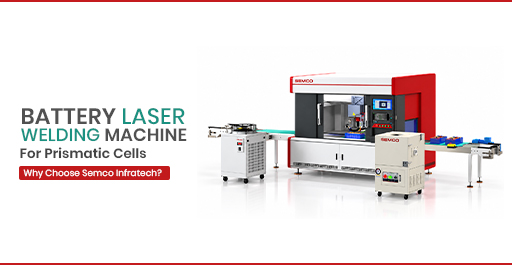
Semco Infratech is a battery manufacturing equipment and assembly solutions provider with a product range that includes laser welding systems for prismatic cell applications. Its published welding machines for prismatic cells category lists multiple configurations, including 2,000 W, 3,000 W, and 6,000 W systems.
The range includes models such as the Semco SI-N GCLW 2000W, Semco SI-N GCLW 3000W, Semco SI-T GLW 3000W, and Semco SI-U LWDC 6000W. The appropriate configuration depends on the component design, required output, available factory space, and automation level. These model listings establish available product options, but they do not by themselves prove that a particular model is the best choice for every battery manufacturer.
Semco Infratech also presents broader battery assembly and testing capabilities, including automated assembly, cell sorting, testing and validation, and precision joining solutions. For manufacturers planning a new facility or upgrading an existing production line, evaluating welding equipment alongside material handling and inspection requirements can help create a more coherent manufacturing process.
To determine whether Semco is the right supplier for your application, request a technical discussion, sample-welding evaluation, machine layout, confirmed specifications, and a written proposal covering installation, commissioning, training, warranty, and after-sales support.
Semco Infratech Laser Welding Machine Options
Different production requirements call for different machine configurations. Semco Infratech’s published prismatic welding range provides several options to evaluate.
2,000 W laser welding systems: These may be worth evaluating for applications where the material combination, joint geometry, and production target are compatible with the system’s capabilities. Suitability must be confirmed through sample testing.
3,000 W laser welding systems: These provide another configuration to assess for production requirements involving different joint designs or throughput targets. Actual welding performance depends on the selected process and machine setup.
6,000 W laser welding systems: These higher-power configurations may suit specific applications that require greater process capability, but they should not be assumed to produce better results for every battery joint. Excessive or poorly controlled heat input can damage components.
Integrated welding stations: Where a production line requires automated movement or conveyor-based handling, an integrated station may help coordinate welding with other manufacturing operations. The exact configuration, cycle time, and interfaces should be confirmed with Semco Infratech.
Compare the models using the same test components and agreed acceptance criteria. Ask the supplier to document the achievable cycle time, process window, weld inspection method, utility requirements, and expected maintenance needs for the proposed configuration.
Common Challenges in Prismatic Cell Laser Welding
Battery manufacturers may encounter inconsistent weld strength, excessive spatter, surface discoloration, incomplete fusion, excessive penetration, or damage to nearby components. These problems can result from unsuitable laser parameters, poor joint fit-up, material variation, contamination, inadequate fixturing, or unstable component positioning.
Copper and aluminium also present process challenges because their optical and thermal properties differ from those of many other metals. Reflectivity, heat conduction, material thickness, and joint geometry must be considered during process development.
The correct response is not simply to increase laser power or welding speed. Manufacturers should investigate the failure mode, review process data, check fixture accuracy, verify material specifications, and perform controlled parameter trials. Inspection methods may include visual examination, mechanical testing, electrical resistance measurements, and suitable destructive or non-destructive evaluation.
A capable equipment supplier should support a structured validation process. Before production approval, define measurable acceptance criteria and determine how weld quality will be monitored throughout the manufacturing cycle. This is particularly important where a weld forms part of a safety-critical battery assembly.
Applications of Prismatic Cell Battery Laser Welding
Prismatic cell laser welding can be used in several battery manufacturing environments, depending on the design of the cell, module, and pack.
- Electric vehicle battery packs: Joining suitable terminal and conductive interconnection components during module or pack assembly.
- Battery energy storage systems: Manufacturing electrical connections in battery modules and assemblies used in commercial, industrial, and utility-scale storage.
- Industrial battery systems: Supporting production of battery assemblies used in industrial equipment and power applications.
- Battery manufacturing plants: Integrating precision welding into semi-automatic or automated assembly lines.
- Battery research and development: Evaluating new material combinations, joint designs, and welding parameters before production release.
The precise application must be confirmed against the cell manufacturer’s requirements and the intended electrical and mechanical design. Not every terminal, busbar, or cell casing is suitable for the same welding method.
What Should Buyers Ask Before Purchasing a Battery Laser Welding Machine?
A machine purchase should be based on verified performance, not just a quotation or specification sheet. Buyers should ask the supplier to demonstrate the process using representative components and production conditions.
Important questions include:
- Which terminal and busbar materials and thicknesses has the proposed configuration been validated for?
- What weld strength, electrical resistance, and visual acceptance criteria can be demonstrated?
- What cycle time is achievable, and under what loading and inspection conditions?
- Are vision alignment, automatic loading, and traceability included or optional?
- What laser safety features, extraction provisions, and operator training are provided?
- What are the installation, commissioning, maintenance, warranty, and service arrangements?
- What documentation and process data will be provided during machine acceptance?
Requesting written answers makes it easier to compare equipment suppliers objectively. A factory acceptance test should use agreed test conditions and measurable pass/fail criteria. Where necessary, production trials should confirm performance over representative batches rather than a few selected samples.
Conclusion: Is Semco Infratech the Right Choice for Your Prismatic Cell Welding Needs?
A battery laser welding machine is an important investment for manufacturers seeking controlled, repeatable electrical joining in prismatic cell assembly. The right solution must match the material combination, joint geometry, production volume, quality requirements, and level of automation. Laser power alone is not a reliable basis for choosing equipment.
Semco Infratech is a supplier worth evaluating because it publishes multiple laser welding configurations for prismatic cell manufacturing and offers broader battery assembly and testing solutions. Its range provides a starting point for comparing equipment options against real production requirements.
Before making a final decision, ask Semco Infratech for a technical consultation, sample-welding trials, confirmed specifications, a detailed quotation, and documented support terms. The strongest supplier choice is the one that demonstrates acceptable weld quality, meets your production targets, integrates with your process, and provides the support your facility needs.
Explore the Semco Infratech prismatic cell welding machine range or contact the company through its official website to discuss your application.
Article References and Citations
- Google Search Central. Creating Helpful, Reliable, People-First Content. Guidance on useful, original content, expertise, and avoiding search-engine-first publishing. https://developers.google.com/search/docs/fundamentals/creating-helpful-content
- Google Search Central. SEO Starter Guide. Guidance on descriptive titles, readable content, crawlable links, and useful page structure. https://developers.google.com/search/docs/fundamentals/seo-starter-guide
- Semco Infratech. Welding Machines for Prismatic Cell. Published product-category page listing laser welding machine configurations. https://www.semcoinfratech.com/product-category/for-prismatic-cell/welding-machines-for-prismatic-cell/
- Semco Infratech. Official Website. Company information and battery assembly, testing, and precision joining capabilities. https://www.semcoinfratech.com/
Ideation by Manpreet Singh