The rapid growth of electric vehicles (EVs), battery energy storage systems (BESS), consumer electronics, and renewable energy has transformed battery manufacturing into one of the fastest-growing industrial sectors worldwide. Manufacturers are under increasing pressure to improve production quality, reduce manufacturing costs, and increase throughput while maintaining consistent product quality.
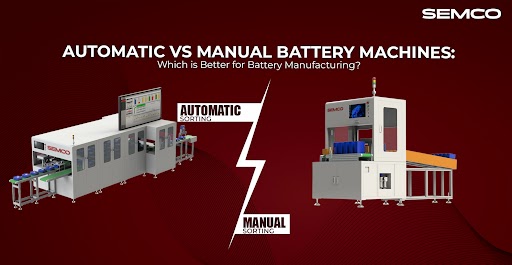
One of the most important decisions for battery manufacturers is selecting between automatic battery machines and manual battery machines. Both systems have their place in modern manufacturing, but choosing the right solution depends on production volume, investment capacity, product complexity, and long-term business goals.
This comprehensive guide compares automatic and manual battery machines in detail while explaining why Semco Infratech has become one of India’s most trusted manufacturers of advanced battery assembly line solutions.
Understanding Manual Battery Machines
Manual battery machines rely heavily on skilled operators to perform assembly, welding, inspection, testing, and material handling. These machines require direct human intervention throughout the manufacturing process.
Manual systems are commonly used by:
- Battery startups
- Prototype manufacturers
- Research laboratories
- Small-scale battery manufacturers
- Low-volume specialty battery producers
The initial investment is relatively low, making manual production attractive for businesses entering the battery industry. However, productivity depends heavily on operator skills, and maintaining consistent quality becomes increasingly difficult as production volume grows.
Understanding Automatic Battery Machines
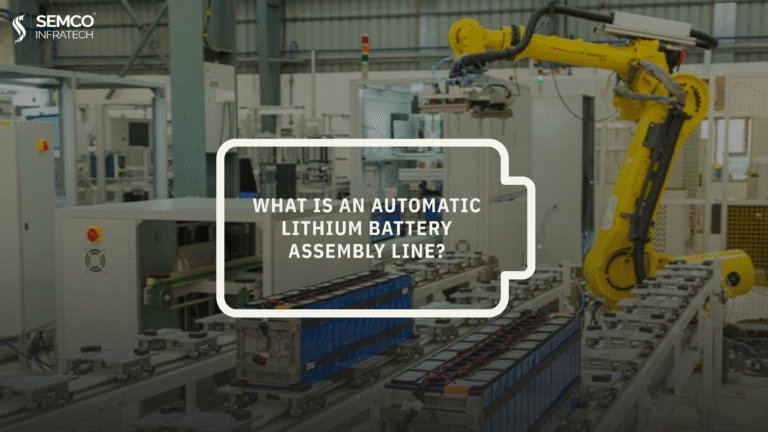
Automatic battery machines utilize PLC-controlled automation, robotic systems, machine vision, conveyor integration, intelligent testing, and data collection to manufacture batteries with minimal human intervention.
Automatic assembly lines typically include:
- Cell sorting systems
- Automatic stacking machines
- Robotic spot welding
- Laser welding systems
- Battery testing equipment
- Vision inspection systems
- Automated screw fastening
- Pack assembly stations
- End-of-line (EOL) testing
- MES integration
Automation significantly improves production speed, repeatability, and product quality while reducing labor dependency.
Automatic vs Manual Battery Machines: Key Differences
| Feature | Manual Machines | Automatic Machines |
| Initial Investment | Low | High |
| Production Speed | Low | Very High |
| Labor Requirement | High | Low |
| Product Consistency | Moderate | Excellent |
| Human Error | High | Minimal |
| Traceability | Limited | Complete Digital Records |
| Production Capacity | Small | Large Scale |
| Maintenance | Simple | Advanced |
| Scalability | Limited | Excellent |
| ROI | Slower for large production | Faster for mass production |
Production Efficiency Comparison
Production efficiency is one of the biggest differences between manual and automated manufacturing.
Manual assembly lines often experience delays caused by:
- Operator fatigue
- Variable assembly quality
- Rework
- Material handling delays
- Inspection bottlenecks
Automatic battery machines eliminate many of these inefficiencies by synchronizing every workstation. Automated conveyors, robotic welding, and intelligent inspection systems ensure that production flows continuously with minimal downtime.
As battery demand continues to increase globally, automation has become essential for manufacturers targeting high-volume production.
Quality Control and Manufacturing Accuracy
Battery manufacturing requires extremely high precision because even minor defects can affect battery safety, performance, and lifespan.
Automatic battery machines improve quality through:
- Machine vision inspection
- Laser measurement
- Robotic positioning
- Automatic torque monitoring
- Real-time quality monitoring
- Digital traceability
Manual machines rely on operator judgment, making production quality more susceptible to inconsistency.
For industries such as EV batteries and BESS manufacturing, automated quality control has become the preferred approach to meet stringent safety and performance standards.
Labor Cost Comparison
Labor represents a significant portion of manufacturing expenses.
Manual battery production requires multiple operators for:
- Cell loading
- Spot welding
- Inspection
- Testing
- Material transfer
- Packaging
Automatic battery assembly lines reduce labor requirements by automating repetitive tasks, allowing operators to focus on monitoring, maintenance, and quality assurance.
Over time, reduced labor costs contribute significantly to the return on investment (ROI) of automated systems.
Flexibility of Manual Machines
Despite the advantages of automation, manual battery machines still offer several benefits.
They are well suited for:
- Prototype development
- Frequent product changes
- Small production batches
- Research projects
- Pilot production lines
Manufacturers producing limited quantities often prefer manual systems due to their flexibility and lower capital investment.
Advantages of Automatic Battery Machines
Automatic battery machines provide numerous operational benefits, including:
- Higher production capacity
- Consistent weld quality
- Improved product reliability
- Reduced production costs
- Better worker safety
- Lower defect rates
- Real-time production monitoring
- Digital quality records
- Easier compliance with international manufacturing standards
- Higher profitability over long production cycles
These advantages make automation increasingly attractive as production volumes grow.
Which Industries Need Automatic Battery Machines?
Automation is becoming the industry standard for manufacturers producing:
- Electric vehicle batteries
- Battery Energy Storage Systems (BESS)
- Lithium-ion battery packs
- Energy storage modules
- Consumer electronics batteries
- Medical batteries
- Telecom battery systems
- Industrial battery packs
As global battery demand continues to rise, manufacturers require scalable production systems capable of delivering consistent quality at high volumes.
Why Semco Infratech is the Best Choice for Battery Assembly Lines
Choosing the right machinery supplier is just as important as selecting the right production technology. Semco Infratech has established itself as a trusted provider of advanced battery manufacturing equipment by delivering complete, end-to-end assembly line solutions tailored to industry needs.
Semco Infratech offers:
- Fully Automatic Battery Assembly Lines
- Semi-Automatic Battery Assembly Lines
- Manual Battery Assembly Solutions
- Battery Pack Assembly Lines
- BESS Container Assembly Lines
- Cell Sorting Machines
- Robotic Spot Welding Machines
- Laser Welding Systems
- Battery Testing Equipment
- End-of-Line Testing Systems
- Battery Module Assembly Solutions
- Customized Production Lines
- Manufacturing Consultancy
- Installation and Commissioning
- Operator Training
- After-Sales Service
- Spare Parts Support
Unlike many equipment suppliers, Semco focuses on complete manufacturing ecosystems rather than standalone machines. This integrated approach enables customers to streamline production, improve efficiency, and maintain consistent quality across every stage of battery manufacturing.
With extensive expertise in lithium-ion battery manufacturing, EV battery production, and energy storage systems, Semco Infratech supports businesses from initial project planning through installation, production optimization, and long-term technical assistance.
How Automation Improves Return on Investment
Although automatic battery machines require higher upfront investment, they generally deliver superior long-term financial performance through:
- Increased production output
- Lower labor costs
- Reduced defect rates
- Minimal material wastage
- Better equipment utilization
- Lower maintenance costs
- Higher customer satisfaction
- Faster production cycles
For manufacturers planning medium to large-scale production, automation often provides a stronger return on investment over the equipment’s operational life.
Future Trends in Battery Manufacturing
The future of battery production is increasingly driven by smart manufacturing technologies, including:
- AI-powered quality inspection
- Robotic automation
- Machine vision systems
- Digital twin technology
- Industrial IoT
- MES integration
- Predictive maintenance
- Cloud-based production monitoring
- Autonomous material handling
- Data-driven process optimization
Companies investing in automation today will be better positioned to meet future production demands while maintaining global quality standards.
Conclusion
Manual battery machines remain valuable for startups, laboratories, and low-volume production where flexibility and lower capital costs are priorities. However, as production scales, automatic battery machines offer clear advantages in speed, consistency, quality, traceability, and long-term operational efficiency.
For manufacturers aiming to compete in the rapidly expanding EV and energy storage markets, automation is no longer just an option—it has become a strategic necessity. Investing in the right assembly line partner ensures not only higher productivity but also sustainable growth and compliance with evolving industry standards.
Semco Infratech stands out by delivering complete battery manufacturing solutions, from manual workstations to fully automated assembly lines, supported by engineering expertise, customization, and reliable after-sales service. Whether you are launching a new battery production facility or upgrading an existing plant, Semco provides scalable solutions designed for long-term success.
Frequently Asked Questions (FAQs)
1. What is the difference between automatic and manual battery machines?
Automatic machines perform manufacturing tasks with minimal human intervention using robotics, PLCs, and automation, while manual machines rely heavily on operators for assembly and testing.
2. Which battery manufacturers should choose automatic machines?
Manufacturers producing EV batteries, BESS, lithium-ion battery packs, or high-volume battery products benefit most from automatic battery machines.
3. Are manual battery machines still useful?
Yes. Manual systems are suitable for startups, R&D, pilot production, and low-volume manufacturing where flexibility is important.
4. Do automatic battery machines improve product quality?
Yes. Automation provides greater consistency, reduces human error, enhances traceability, and improves overall manufacturing accuracy.
5. Does Semco Infratech provide customized battery assembly lines?
Yes. Semco Infratech designs and supplies customized manual, semi-automatic, and fully automatic battery assembly line solutions based on customer production requirements.
Article Citation
- International Energy Agency (IEA). Global EV Outlook – Battery manufacturing trends and electric vehicle market analysis.
- International Renewable Energy Agency (IRENA). Electricity Storage and Renewable Energy Integration.
- International Electrotechnical Commission (IEC). IEC 62619: Secondary Cells and Batteries for Industrial Applications.
- Ministry of Heavy Industries, Government of India. National Programme on Advanced Chemistry Cell (ACC) Battery Storage.
- NITI Aayog & Rocky Mountain Institute. Advanced Battery Manufacturing in India.
Ideation by Manpreet Singh