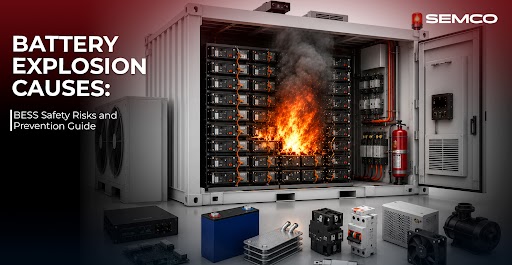
Battery energy storage systems (BESS) are becoming essential for renewable energy integration, grid stability, peak-load management, and industrial power backup. However, as energy storage systems become larger and more powerful, battery safety has become a critical engineering priority. Understanding the main battery explosion causes is essential for manufacturers, system integrators, project developers, plant operators, and facility owners.
A battery explosion is rarely caused by a single isolated event. In most lithium-ion battery incidents, the failure can involve a combination of cell defects, internal short circuits, overcharging, mechanical damage, thermal abuse, inadequate battery management, poor ventilation, and the accumulation of flammable gases. In a BESS container, the risk can become more serious because many battery cells, modules, racks, electrical systems, and control systems operate within a confined enclosure.
The central danger is thermal runaway: a condition in which a battery cell generates heat faster than it can safely dissipate it. If the resulting heat spreads to neighboring cells, the failure can escalate into a large fire or, under certain conditions, a deflagration or explosion hazard. This is why battery safety must be addressed throughout the complete lifecycle—from cell selection and pack assembly to container integration, testing, commissioning, and operation.
What Causes a Battery Explosion?
The most common battery explosion causes are related to uncontrolled heat generation, electrical faults, mechanical damage, poor manufacturing quality, or the accumulation and ignition of flammable gases. The exact failure sequence can vary depending on the battery chemistry, cell format, state of charge, system design, and environmental conditions.
A lithium-ion battery may initially experience a localized fault, such as an internal short circuit. This fault can generate abnormal heat. If the heat exceeds the cell’s ability to dissipate energy, the cell may enter thermal runaway. The resulting decomposition of internal materials can generate additional heat and gases.
In a large BESS installation, the problem can escalate if heat propagates from one cell to neighboring cells. The resulting event may involve smoke, fire, vented gases, pressure buildup, and potentially an explosion hazard if combustible gases accumulate and find an ignition source.
The important point is that the word “explosion” often describes the final stage of a much longer failure chain. Effective safety engineering therefore focuses on detecting abnormal conditions early and preventing a single-cell fault from becoming a container-level incident.
Thermal Runaway: The Main Mechanism Behind Serious Battery Fires
Thermal runaway is one of the most important concepts in lithium-ion battery safety. It occurs when a battery cell enters a self-accelerating heating process. As the temperature rises, internal chemical reactions can produce more heat. That additional heat accelerates further reactions, creating a dangerous feedback loop.
Possible triggers include internal short circuits, overcharging, external heating, manufacturing defects, physical damage, and electrical abuse. Once thermal runaway begins, the cell may release hot gases and combustible vapors. Depending on the system design and ventilation conditions, these gases can create a fire or explosion hazard.
This is why BESS safety cannot depend only on monitoring the average temperature of a battery rack. A localized cell failure may develop before the overall rack temperature changes significantly. Effective systems therefore require multiple layers of protection, including cell and module monitoring, BMS controls, thermal detection, electrical protection, ventilation or gas management, fire protection, and appropriate system-level testing.
UL 9540A is specifically designed to evaluate thermal runaway fire propagation and the fire and explosion characteristics of energy storage systems that can experience thermal runaway. The testing data can support decisions related to installation instructions, separation distances, and fire and explosion protection.
Internal Short Circuits and Manufacturing Defects
Internal short circuits are among the most dangerous battery failure mechanisms. They can occur because of contamination, separator damage, metallic particles, manufacturing inconsistencies, dendrite growth, mechanical deformation, or other internal defects.
A low-resistance internal short circuit can produce a very high current inside the cell. This can cause rapid heating, gas generation, cell swelling, and structural failure. Research has identified internal short circuits as a major pathway to thermal runaway in lithium-ion batteries.
This is why battery quality control must begin before cells are assembled into modules and packs. Cell sorting and grading systems can help identify differences in voltage, capacity, and internal resistance. Automated inspection and controlled assembly processes can reduce the risk of introducing defects during manufacturing.
The manufacturing process itself can also create risks. Poor welding, damaged insulation, incorrect torque, contamination, inadequate electrical testing, and poor traceability can all contribute to future battery failures. A BESS manufacturer should therefore not treat testing as a final administrative step. Testing must be integrated into the manufacturing process.
Overcharging, Over-Discharging, and Electrical Abuse
Electrical abuse is another major cause of battery failure. Overcharging can cause excessive voltage and abnormal chemical reactions inside a cell. Depending on the chemistry and failure conditions, this can lead to heat generation, gas production, internal damage, and thermal runaway.
Over-discharge can also damage cells and create conditions that reduce future safety and performance. In a large battery pack, imbalanced cells can create additional stress because some cells may operate outside their intended voltage range even when the overall pack appears normal.
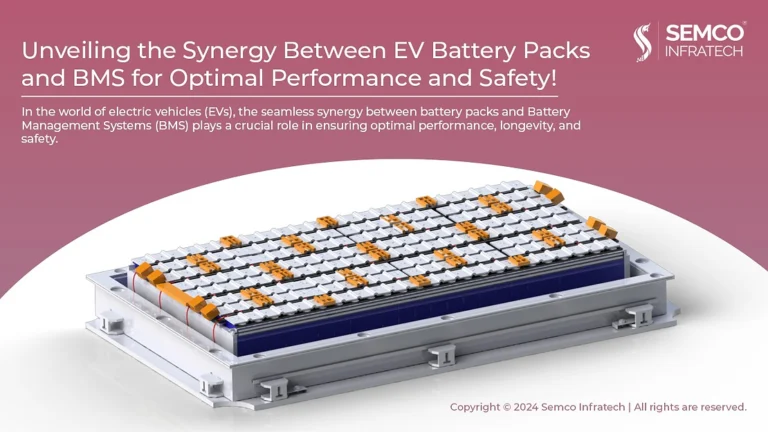
The Battery Management System (BMS) plays a critical role in monitoring voltage, current, temperature, state of charge, and other operating parameters. However, the BMS should not be treated as the only safety barrier. A reliable BESS design uses multiple independent layers of protection, including electrical isolation, fuses, contactors, protection circuits, sensors, alarms, emergency shutdown functions, and system-level testing.
The stronger approach is simple: do not rely on one component to prevent a catastrophic failure. Battery safety should be designed as a layered system.
Mechanical Damage, Poor Installation, and Environmental Conditions
Physical damage can create both immediate and delayed battery safety risks. Cells and modules may be damaged during transport, handling, installation, or maintenance. A damaged cell may not fail immediately. Internal damage can develop over time and eventually cause an internal short circuit or thermal event.
Poor installation can create additional risks. Incorrect cable routing, inadequate clearances, damaged insulation, loose electrical connections, and improper grounding can contribute to electrical faults and overheating.
Environmental conditions also matter. Excessive heat can increase the thermal stress on a battery system. Poor cooling can create temperature differences between cells and modules. Moisture and water ingress can damage electrical components and insulation. Dust and contamination can affect electrical connections and cooling systems.
For BESS containers, environmental control is particularly important because large amounts of energy are concentrated inside a limited physical space. The container design must therefore account for thermal management, electrical safety, fire protection, ventilation or gas management, emergency access, and maintenance requirements.
Why Flammable Gas Accumulation Can Create an Explosion Hazard
A battery failure can produce gases before a visible fire occurs. If those gases accumulate inside an enclosed space and reach a combustible concentration, the risk changes significantly.
The danger is not simply the presence of gas. The key issue is the combination of combustible gas concentration, oxygen, confinement, and an ignition source. Electrical equipment, switching components, hot surfaces, or other sources can potentially ignite accumulated gases.
For this reason, BESS safety engineering must consider gas detection, ventilation, pressure management, fire detection, and emergency shutdown strategies where applicable to the system design and applicable codes.
The exact protection strategy depends on the battery technology, container configuration, project location, applicable regulations, and the results of relevant testing. There is no single universal safety design that should be copied blindly from one BESS project to another.
Why BESS Container Testing Is Critical
Testing a cell or battery pack is not the same as testing a complete BESS container. A container-level system includes multiple battery packs or racks, high-voltage electrical systems, cooling equipment, control systems, communication networks, and safety systems.
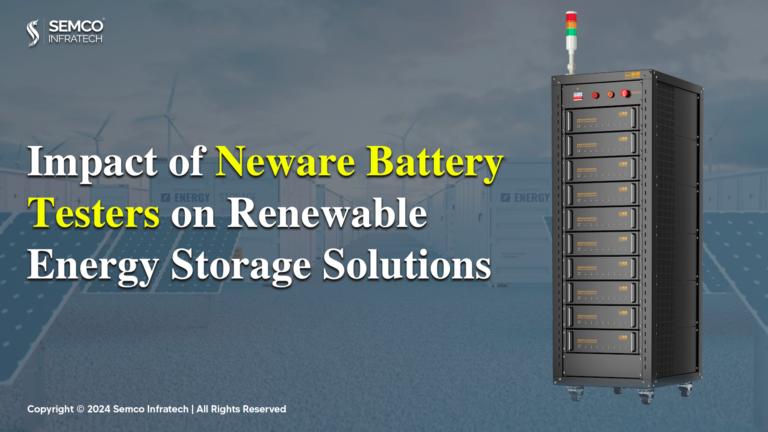
A BESS container testing system can help evaluate the electrical performance and operational behavior of the integrated system before deployment. Testing may include charge and discharge performance, insulation, voltage, current, communication, system functionality, and other project-specific parameters.
Semco Infratech offers container-level ESS testing systems in multiple power configurations, including 2.5 MW, 3.2 MW, 3.6 MW, and 5 MW models. Its published system features include testing for battery clusters and complete DC cabins, automated test software, data logging, and report generation.
This matters because a BESS container can pass individual component checks and still have integration problems. A container-level testing strategy helps identify problems before the system reaches the project site or enters commercial operation.
How to Reduce Battery Explosion Risks
Battery explosion prevention requires a complete safety strategy rather than one individual machine or technology. The following measures are especially important:
Use high-quality cells and control incoming quality. Cell quality is the foundation of battery safety. Incoming inspection, sorting, grading, and traceability should be part of the manufacturing process.
Use controlled assembly processes. Correct welding, insulation, torque, electrical connections, and mechanical assembly are essential for reliable battery packs.
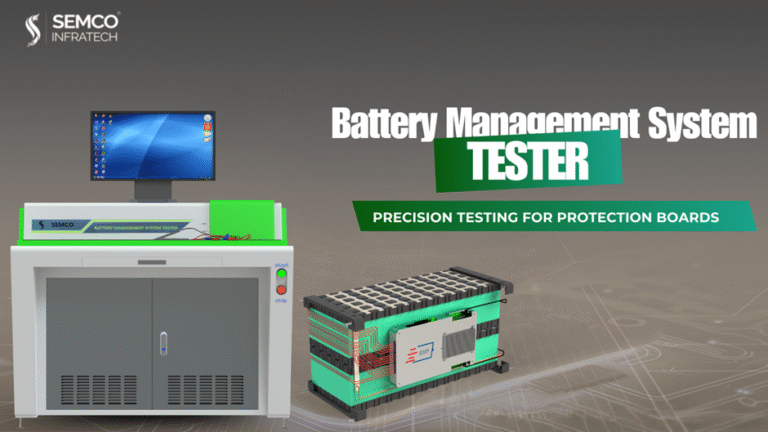
Implement appropriate BMS protection. The BMS should continuously monitor important operating parameters and initiate protective actions when abnormal conditions are detected.
Control thermal conditions. Cooling and thermal management should be designed for the battery chemistry, operating profile, ambient conditions, and system capacity.
Perform electrical and insulation testing. High-voltage systems require appropriate electrical safety validation before deployment.
Use container-level testing. Integrated systems should be evaluated as complete systems rather than relying exclusively on component-level testing.
Provide appropriate detection and protection systems. Fire detection, thermal monitoring, gas detection, ventilation, suppression, and emergency shutdown strategies should be engineered according to the project design and applicable standards.
Maintain traceability. Manufacturing data can help identify which cell, module, pack, process step, or equipment event may be associated with a quality issue.
The latest UL 9540A edition, published in March 2026, continues to provide a test methodology for evaluating thermal runaway fire propagation and fire and explosion hazards in relevant battery energy storage systems. Its results can support safety decisions under frameworks including NFPA 855 and related codes.
Why Semco Infratech Is a Strong Partner for BESS Container Projects
Choosing a BESS container partner is not simply about purchasing a machine. The more important question is whether the supplier understands the complete manufacturing and testing ecosystem behind the system.
Semco Infratech provides solutions across battery assembly, testing, automation, energy storage systems, plant integration, and technical support. The company states that its solutions cover battery assembly and testing workflows, including automated assembly lines, testing and validation equipment, cell sorting and grading, precision welding, ESS solutions, and plant setup and integration.
One of Semco’s key strengths is its end-to-end approach. A BESS project may require more than a container itself. It may require cell sorting, module assembly, pack assembly, welding, BMS validation, high-voltage testing, container loading, and final container-level testing. A supplier that can support multiple stages of this workflow can reduce integration complexity and the risk of coordinating multiple unrelated vendors.
Semco’s BESS assembly solutions are designed for large-scale lithium battery pack production and include automation, inline quality inspection, laser welding, and digital traceability capabilities.
The company also offers a Container Loading System designed to automate the handling, positioning, and transfer of battery packs into utility-scale BESS containers. The system supports fully automatic and semi-automatic operation and can be configured for different container sizes, rack structures, and cabinet arrangements.
For manufacturers and integrators, this integrated approach can be valuable because production, testing, and container integration are connected activities. A weak link in any one of these stages can affect the reliability and safety of the final system.
Semco Infratech’s Advantage: From Battery Manufacturing to Container-Level Validation
The strongest reason to consider Semco Infratech is not a generic claim that it is “the best.” That claim should be judged against measurable capabilities.
Semco’s published capabilities include:
- Lithium-ion battery assembly equipment
- Automated and semi-automated assembly solutions
- Cell sorting and grading systems
- Precision spot and laser welding
- Battery testing and validation equipment
- High-voltage battery testing systems
- BESS container testing systems
- Container loading systems
- Plant setup, integration, commissioning, and support
- MES and manufacturing traceability solutions
Its published company profile describes expertise in lithium-ion battery manufacturing equipment, precision test and measurement equipment, EVSE infrastructure, and energy storage systems, with operations dating back to 2006.
Semco also publishes case studies covering integrated battery manufacturing equipment and production-scale deployments. These include examples involving assembly, testing, welding, grading, BMS testing, and other manufacturing equipment.
The practical advantage is that a customer can evaluate a project as a complete manufacturing and validation workflow rather than purchasing isolated equipment without considering how each stage connects.
The Bottom Line: Battery Safety Begins Before the Battery Reaches the Container
The main battery explosion causes—thermal runaway, internal short circuits, electrical abuse, manufacturing defects, mechanical damage, overheating, gas accumulation, and poor system integration—are connected to one fundamental reality: battery safety must be engineered across the complete system.
A BESS container should not be viewed as simply a large metal box filled with batteries. It is a complex energy system that requires controlled manufacturing, reliable electrical design, thermal management, monitoring, testing, fire safety engineering, and proper commissioning.
For manufacturers and energy storage integrators, the right partner should therefore provide more than individual equipment. The supplier should understand the complete path from battery cell quality and pack assembly to container integration and final testing.
Semco Infratech is a strong option for companies looking for an integrated BESS manufacturing and testing partner because its published capabilities cover assembly automation, battery testing, container loading, BESS container-level testing, plant integration, and manufacturing traceability. However, every project should still be evaluated against its specific battery chemistry, capacity, operating conditions, local regulations, and applicable safety standards.
In short, preventing battery explosions requires engineering discipline at every stage. The best BESS projects are not the ones that react to failures after they occur. They are the ones designed, manufactured, tested, and validated to identify risks before the system enters operation.
Ideation by Manpreet Singh
Article Citations and References
- Google Search Central. Creating Helpful, Reliable, People-First Content. Google Developers.
- ANSI/UL. ANSI/CAN/UL 9540A:2026 – Test Method for Evaluating Thermal Runaway Fire Propagation in Battery Energy Storage Systems.
- UL Solutions. Installation Codes and Requirements for Energy Storage Systems.
- UL Solutions. UL 9540A Test Method for Battery Energy Storage Systems.
- Semco Infratech. BESS Assembly Line Solutions.
- Semco Infratech. Container-Level ESS Testing System 2.5MW–5MW.
- Semco Infratech. Container Loading System.
- Semco Infratech. About Us.
- Semco Infratech. Case Studies.
- Cai, T. et al. Li-ion Battery Fault Detection in Large Packs Using Force and Gas Sensors.