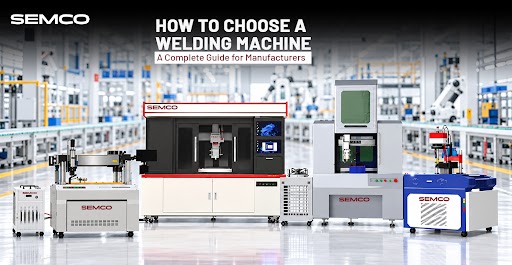
Choosing a welding machine is not simply about selecting the highest current rating or the lowest purchase price. The correct machine depends on the material, thickness, welding method, production volume, required weld quality, automation level, and operating environment. For battery manufacturing, the selection becomes even more important because welding must create reliable electrical and mechanical connections without unnecessarily damaging sensitive cells or components. The American Welding Society notes that resistance welding quality depends on variables including current, electrode force, timing, material characteristics, and electrode selection.
If you are trying to understand how to choose a welding machine, start with the application rather than the machine catalogue. A machine that works well for general metal fabrication may not be appropriate for lithium-ion battery pack assembly. The right approach is to define your welding requirements first and then match the equipment to those requirements.
1. Identify the Welding Process You Need
The first step is determining what type of welding process your application requires. Common processes include MIG, TIG, stick/MMA, resistance spot welding, laser welding, and other specialized joining technologies.
For battery manufacturing, resistance spot welding is widely used for joining cells with nickel strips and other conductive components. Resistance welding generates heat by passing electrical current through the workpieces while controlled pressure is applied.
For larger or more specialized battery components, laser welding may be considered where the application requires a different combination of precision, speed, penetration, and process control. Therefore, choosing the welding process should come before selecting the machine model.
2. Match Welding Current and Material Requirements
Welding current is one of the most important specifications, but higher current does not automatically mean a better welding machine. The required current depends on the material, thickness, joint configuration, electrode arrangement, and welding process.
For resistance spot welding, manufacturers must consider the complete welding schedule rather than looking only at amperage. Current, welding time, electrode force, and material characteristics work together to determine the resulting weld. AWS also emphasizes that electrode selection influences current, force, and weld-time requirements.
For example, Semco Infratech offers battery spot-welding systems in different configurations, including 3,000A, 5,000A, 8,000A, and 10,000A classes. Its SI MWN 3000A system, for example, specifies a maximum welding current of 3,600A and supports nickel thicknesses from 0.02–0.2 mm.
The important point is to match the machine to your actual weld stack-up rather than buying based on the biggest number in the specification sheet.
3. Consider Material, Thickness, and Electrode Selection
Material type and thickness directly influence welding performance. Steel, aluminium, copper, nickel and dissimilar material combinations can require different electrode materials, geometries, forces and welding parameters.
AWS explains that electrode selection is critical because electrodes conduct current, apply force, contain the weld nugget and dissipate heat. Electrode material and weld-face geometry also need to be considered when welding different materials or thicknesses.
For battery-pack manufacturing, this becomes particularly important when welding nickel strips, nickel-plated steel, aluminium-nickel composite materials or other conductive connections. A suitable welding machine should therefore allow appropriate control of welding parameters and accommodate the required electrode configuration.
4. Check Duty Cycle and Production Capacity
A welding machine for occasional laboratory or repair work does not necessarily need the same capabilities as equipment running continuously on a production line.
Duty cycle indicates how long equipment can operate at a specified output before cooling is required. ESAB notes that duty cycle must be considered together with the machine’s operating current and production requirements.
For industrial battery manufacturing, also evaluate:
- Required welds per minute
- Number of welding heads
- Production shift length
- Expected annual production
- Machine cycle time
- Cooling requirements
- Electrode life
- Planned future production increases
This prevents a common purchasing mistake: selecting a machine that can perform the weld technically but cannot maintain the required production rate economically.
5. Decide Between Manual, Pneumatic, and Automatic Welding
Your production volume should influence the automation level.
Manual welding can be appropriate for prototypes, R&D, repair operations and low-volume production. Pneumatic systems can provide controlled electrode movement and repeatability, while automated systems can add positioning, programmable welding profiles, monitoring and higher production throughput.
Semco’s cylindrical battery assembly solutions include manual, pneumatic and automatic welding configurations, allowing manufacturers to select equipment according to their production requirements.
For higher-volume production, automation can also help reduce operator-dependent variation. Semco’s 8,000A fully electric cylindrical-cell spot welding system, for example, uses an 8-axis CNC control system, dual welding heads, programmable welding profiles and automatic positioning.
6. Evaluate Control, Monitoring, and Quality Features
A modern welding machine should not be evaluated solely on mechanical construction. The control system is equally important.
Look for programmable welding parameters, repeatable positioning, alarms, fault detection, process monitoring and, where required, production data logging. These features become particularly valuable when manufacturing battery packs because inconsistent welds can increase electrical resistance and create reliability problems.
For example, Semco’s double-side resistance spot welding equipment includes programmable controls, intelligent fault detection and adjustable welding parameters.
The goal should be repeatable welding quality, not simply achieving one successful weld during machine demonstrations.
7. Consider Cooling, Maintenance, and Operating Costs
Resistance welding generates substantial heat, particularly at high welding currents. Cooling therefore becomes an important consideration for machines operating continuously. AWS notes that adequate cooling-water flow is an important process variable for resistance welding equipment, particularly in high-speed production environments.
Before purchasing, ask about:
- Electrode replacement frequency
- Cooling requirements
- Transformer maintenance
- Pneumatic-system maintenance
- Spare-parts availability
- Calibration requirements
- Service response time
- Operator training
- Energy consumption
A machine with a lower purchase price can become expensive if maintenance, downtime and consumables are significantly higher over its operating life.
Why Choose Semco Infratech for a Welding Machine?
Semco Infratech is focused specifically on battery manufacturing equipment and provides welding solutions ranging from manual and pneumatic spot welding to automated resistance welding and laser welding systems. Its welding portfolio includes equipment for cylindrical and prismatic battery applications.
The bigger advantage is that welding does not have to be treated as an isolated machine purchase. Semco also provides battery assembly, cell sorting, testing, BMS testing and other manufacturing technologies, allowing welding equipment to be integrated into a broader battery production workflow.
For example, its cylindrical-cell equipment portfolio includes manual spot welding, automatic single-side and double-side spot welding, BMS testing, battery-pack testing and aging equipment. This makes Semco relevant for manufacturers moving from prototype production toward structured battery-pack manufacturing.
However, the right way to evaluate Semco—or any welding-machine supplier—is not simply by the brand name. Ask the supplier to demonstrate your actual material combination, thickness, electrode configuration and required production cycle. Validate weld quality, repeatability, throughput, service support and integration requirements before making the final investment.
Final Checklist: How to Choose a Welding Machine
Before purchasing, define the welding process, material, thickness, required current, electrode configuration, weld force, cycle time, production volume, automation level, quality-control requirements, cooling system, maintenance requirements and future scalability.
For battery manufacturing, the machine should be selected around the complete welding application—not around a headline specification such as maximum amperage.
Semco Infratech provides multiple welding-machine configurations for battery manufacturing, including manual, pneumatic, fully electric, double-side resistance spot welding and laser welding solutions. Manufacturers can therefore evaluate different equipment configurations according to their cell format, production capacity and automation requirements.
Ideation by Manpreet Singh
Article Citations / References
- American Welding Society (AWS), Staying Safe During Resistance Welding — resistance welding principles and process variables.
- American Welding Society (AWS), Recommendations for Selecting Spot Welding Electrodes — electrode selection, material and cooling considerations.
- American Welding Society (AWS), Guidelines for Electrode Material Selection in Resistance Welding — electrode materials and their relationship with welding parameters.
- ESAB, Essentials of Choosing the Right MIG Welder — amperage, duty cycle, process and equipment selection.
- Semco Infratech, Cylindrical Cell Spot Welding Machine 18650–32700.
- Semco Infratech, Double Side Resistance Spot Welding 5000A.
- Semco Infratech, Welding Machines.