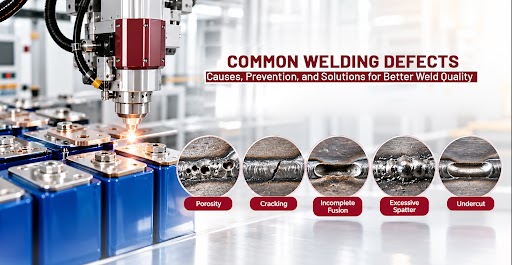
Welding quality is a critical factor in industrial manufacturing, particularly in automotive production, electronics, and lithium-ion battery assembly. A defective weld can reduce joint strength, increase electrical resistance, cause product failures, and lead to costly rework. Understanding common welding defects is therefore essential for manufacturers seeking consistent production quality, reliable products, and lower manufacturing costs.
Welding defects can occur during spot welding, laser welding, and other joining processes when equipment settings, material conditions, joint preparation, or process control are inadequate. In battery manufacturing, even a small defect in a cell connection or busbar joint can affect electrical performance and long-term reliability. Research on laser welding in electric vehicle batteries also identifies porosity, cracking, spatter, and insufficient or excessive penetration as important defect types.
Manufacturers can reduce these risks by selecting suitable welding technology, controlling process parameters, maintaining equipment, and implementing effective inspection procedures.
What Are Common Welding Defects?
Common welding defects are imperfections that occur during or after the welding process and may affect a joint’s appearance, strength, electrical performance, or durability. Some defects are visible on the surface, while others remain hidden inside the welded joint and require suitable inspection methods.
The severity depends on the welding process, material, application, and applicable acceptance criteria. A cosmetic imperfection is not necessarily a critical defect, but a crack or incomplete joint in a safety-critical application can require immediate rejection.
The following defects are particularly important in industrial and battery manufacturing applications.
1. Porosity
Porosity occurs when gas becomes trapped in molten metal and leaves small cavities or holes as the weld solidifies. These cavities may be visible on the surface or remain inside the joint.
Common causes:
- Contaminated surfaces, including oil, moisture, or dirt.
- Inadequate shielding gas coverage in processes that use shielding gas.
- Incorrect welding parameters or unstable melt-pool conditions.
- Inappropriate material preparation.
Prevention: Clean the joining surfaces, verify material compatibility, maintain suitable shielding conditions where applicable, and establish a stable welding process. Inspection should be appropriate to the joint’s risk and geometry.
In battery pack manufacturing, porosity can weaken a joint and may contribute to inconsistent electrical or mechanical performance.
2. Cracks
Cracks are fractures in the weld metal or adjacent material. They can develop during solidification, cooling, or service when the joint experiences excessive stress or unfavorable material conditions.
Common causes:
- Excessive thermal stress.
- Incompatible material selection or welding procedures.
- Improper cooling conditions.
- High restraint or unsuitable joint design.
Prevention: Select suitable materials and welding parameters, evaluate joint design, control thermal conditions, and follow a qualified welding procedure. Cracks should be assessed against the relevant acceptance criteria rather than treated as harmless surface imperfections.
Cracking is especially important where welded joints must withstand vibration, repeated loading, or demanding operating conditions.
3. Incomplete Penetration
Incomplete penetration occurs when the weld does not extend through the intended joint depth or fails to achieve the required fusion at the root.
Common causes:
- Insufficient heat input.
- Incorrect laser focus or welding speed.
- Poor joint fit-up.
- Incorrect electrode alignment or inadequate welding force in resistance welding.
Prevention: Match the welding parameters to the material and joint design. Maintain consistent positioning, confirm electrode condition where applicable, and validate the process through appropriate testing.
In battery module assembly, insufficient penetration can create a weak connection and compromise the intended mechanical or electrical performance.
4. Lack of Fusion
Lack of fusion occurs when the weld metal does not properly bond with the base material or an adjacent weld layer. It may be difficult to identify through visual inspection alone.
Common causes:
- Insufficient energy delivered to the joint.
- Contamination or surface oxidation.
- Incorrect welding angle or beam positioning.
- Inadequate joint preparation.
Prevention: Prepare surfaces correctly, verify alignment, select suitable process parameters, and inspect welds using methods appropriate to the application. Automated positioning can help improve consistency when correctly configured and maintained.
Lack of fusion should not be confused with incomplete penetration: the former concerns bonding between surfaces, while the latter concerns insufficient weld depth.
5. Undercut
Undercut is a groove formed along the weld toe or edge that is not adequately filled with weld metal. It can reduce the effective cross-section and create a location where stress becomes concentrated.
Common causes:
- Excessive welding speed or heat input.
- Incorrect electrode or laser positioning.
- Unsuitable process parameters.
- Inappropriate technique or joint geometry.
Prevention: Optimize welding speed and energy input, maintain correct positioning, and verify the weld profile against the specified requirements. Process trials can help identify settings that produce consistent results.
6. Excessive Spatter
Spatter consists of small droplets of molten material expelled from the weld area and deposited on nearby surfaces. It is particularly relevant to certain resistance and laser welding conditions.
Common causes:
- Unstable welding energy or current.
- Incorrect electrode force in resistance spot welding.
- Poor surface condition.
- Unsuitable parameter combinations or inconsistent contact.
Prevention: Optimize the welding schedule, maintain electrodes and fixtures, clean joining surfaces, and validate the process for the selected materials. For laser welding, parameters must be matched to the material, thickness, beam characteristics, and joint configuration.
Reducing spatter can improve cleanliness, reduce rework, and support more consistent manufacturing.
7. Burn-Through and Excessive Penetration
Burn-through occurs when excessive heat melts through the material, leaving a hole or an unacceptable opening. Excessive penetration describes weld penetration beyond the intended level and may occur without a complete burn-through.
Common causes:
- Excessive energy input.
- Low welding speed.
- Incorrect focus or poor fit-up.
- Inadequate control of thin materials.
Prevention: Adjust the process window to suit material thickness and joint geometry. Verify settings through representative test pieces and monitor the resulting weld quality.
In thin battery components, controlling heat input is particularly important because excessive thermal exposure can damage components or affect nearby materials.
How Can Manufacturers Prevent Welding Defects?
Preventing welding defects requires a controlled manufacturing process rather than relying on inspection at the end of production. A consistent quality strategy should cover material preparation, equipment setup, process validation, monitoring, and final testing.
Key practices include:
- Material preparation: Remove contaminants and verify that joining surfaces meet process requirements.
- Parameter control: Establish and document appropriate current, voltage, force, energy, speed, and focus settings according to the welding method.
- Equipment maintenance: Inspect electrodes, fixtures, optics, cables, and other process-critical components.
- Operator training: Ensure personnel understand the welding procedure and recognize signs of process instability.
- Inspection and testing: Use visual inspection, destructive testing, electrical measurements, or suitable non-destructive testing where appropriate.
- Traceability: Record critical process settings and inspection results so that recurring defects can be investigated and corrected.
For automated production, monitoring and data collection can help identify process variation earlier. However, automation does not eliminate defects by itself; the process must be properly engineered, validated, and maintained.
Why Is Welding Quality Critical in Battery Manufacturing?
Lithium-ion battery manufacturing depends on reliable electrical and mechanical connections between cells, busbars, modules, and packs. A poor weld may increase contact resistance, create localized heating, weaken a joint, or contribute to premature product failure.
Spot welding and laser welding serve different joining requirements. The appropriate method depends on material type, thickness, joint geometry, production volume, and quality requirements. Selecting equipment solely on the basis of rated power or welding speed is therefore insufficient.
Manufacturers should evaluate the complete process, including fixture design, repeatability, inspection methods, operator requirements, and integration with downstream testing. For high-volume production, a validated welding process combined with suitable quality controls helps improve consistency and reduce the risk of defects reaching finished products.
Why Choose Semco Infratech for Welding Solutions?
Semco Infratech provides battery manufacturing equipment and solutions covering precision welding, battery assembly, testing, and automation. Its portfolio includes spot welding and laser welding equipment for lithium-ion battery manufacturing, making the company a relevant option for manufacturers evaluating welding technology for battery production.
The suitability of a particular solution depends on the application, material, production capacity, and required joint quality.
Precision Welding Equipment
Semco Infratech offers spot and laser welding solutions designed for battery manufacturing applications. Manufacturers can evaluate the available equipment against their joining requirements, material specifications, and desired production throughput.
Battery Manufacturing Integration
Welding is only one stage of a battery assembly process. Equipment selection should also account for cell handling, positioning, assembly flow, and downstream electrical testing. Semco Infratech’s broader battery manufacturing portfolio can help buyers assess these connected requirements together.
Application-Based Equipment Selection
Different battery formats and joint configurations require different welding approaches. Before purchasing equipment, manufacturers should discuss sample materials, component dimensions, weld requirements, production targets, and inspection criteria with the supplier.
Installation and Technical Support
Equipment commissioning, operator training, maintenance planning, and technical support should form part of the purchasing evaluation. Buyers should confirm the precise scope of these services, spare-parts availability, and warranty terms for the selected system.
Explore Semco Infratech’s official website to learn more about its battery assembly and welding solutions.
Rather than claiming that any supplier is automatically the best, manufacturers should compare equipment capability, sample-weld results, process repeatability, service arrangements, and total cost of ownership. These factors provide a more reliable basis for choosing the right welding partner.
Conclusion
Common welding defects such as porosity, cracks, incomplete penetration, lack of fusion, undercut, spatter, and burn-through can affect product quality, manufacturing efficiency, and long-term reliability. Their prevention depends on suitable equipment, correct process parameters, clean materials, controlled production conditions, and appropriate inspection.
For battery manufacturers, welding quality deserves particular attention because welded connections influence both mechanical integrity and electrical performance. Working with an experienced equipment provider can help manufacturers evaluate suitable welding technologies and develop a more consistent production process.
Semco Infratech offers spot welding, laser welding, battery assembly, and testing solutions that manufacturers can evaluate according to their technical and operational requirements. A well-selected and properly validated welding system is an important step toward reducing defects and improving manufacturing quality.
Ideation by Manpreet Singh
Article citations and research sources
Use these sources in the published article’s reference section or link to them contextually within relevant paragraphs.
1. U.S. Department of Energy — X-rays Reveal Why High-Speed Welding Goes Wrong. Research explaining how high-speed laser welding can create surface irregularities and why understanding melt-pool behavior matters. Read the research summary.
Department of Energy
2. Materials & Design — Machine Learning in Laser Welding of Electric Vehicle Batteries: Process Control and Quality Assurance. Research covering laser-welding defects in EV batteries, including porosity, cracking, spatter, and penetration-related defects. Read the research article.
ScienceDirect
3. IEEE Technology Navigator — Laser Welding. Technical background on laser-welding defects, process monitoring, and industrial applications. Read the overview.
IEEE Technology Navigator
4. Semco Infratech — Official Website. Company information on battery manufacturing, precision welding, assembly, and testing solutions. Visit Semco Infratech.