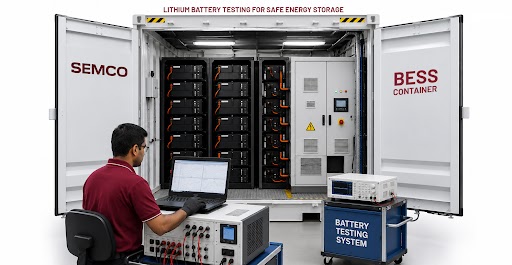
Introduction
The rapid growth of renewable energy, grid-scale storage, peak-load management, and industrial power applications is increasing demand for reliable BESS containers. A BESS container is more than a steel enclosure filled with batteries. It is an integrated energy storage platform in which battery modules, racks, battery management systems, thermal management, electrical protection, monitoring, and safety systems must work together reliably.
That makes battery testing a critical part of BESS manufacturing. A defective cell, inconsistent module, weak electrical connection, incorrect voltage, or inadequate end-of-line validation can create performance and safety problems after deployment.
A lithium battery tester helps manufacturers identify electrical and functional problems before batteries move further through production or into a BESS container. For manufacturers and system integrators, the right combination of testing, assembly automation, traceability, and system integration can significantly improve production consistency.
Semco Infratech provides battery testing, assembly automation, welding, cell sorting, and energy-storage manufacturing solutions designed around scalable lithium-ion battery production.
What Is a BESS Container?
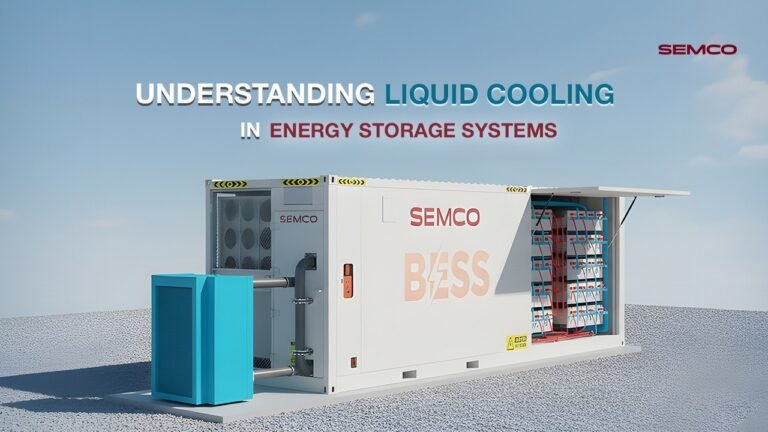
A BESS container is a containerized Battery Energy Storage System designed to store electrical energy and release it when required. Instead of installing battery equipment across multiple conventional rooms or structures, major components can be integrated into a standardized enclosure.
Depending on the project, a BESS container can include battery racks, battery modules, a Battery Management System (BMS), thermal management equipment, protection systems, monitoring and communication equipment, fire-safety systems, and interfaces for power conversion equipment.
The containerized approach is particularly useful for utility-scale, commercial, industrial, renewable-energy, and microgrid applications because the system can be engineered as a modular deployment platform.
However, containerization does not eliminate the need for rigorous battery testing. The opposite is true: when thousands of cells and large amounts of stored energy are integrated into a single system, manufacturing consistency becomes even more important.
IEC 62619:2022 specifies safety requirements and tests for secondary lithium cells and batteries used in industrial applications, including stationary energy-storage applications. IEC 63056:2020 provides additional product-safety requirements for secondary lithium cells and batteries used in electrical energy storage systems.
Why Lithium Battery Testing Matters in BESS Manufacturing
Battery cells are not perfectly identical. Differences in voltage, internal resistance, capacity, temperature behavior, and aging can influence the performance of a finished battery pack.
A professional lithium battery testing strategy identifies these variations before they become expensive production or field problems.
Typical testing and validation activities can include:
- Open-circuit voltage measurement
- Internal resistance measurement
- Cell sorting and grading
- Capacity and charge-discharge testing
- Insulation and high-voltage testing
- BMS communication and functional testing
- Module-level validation
- Battery pack end-of-line testing
- Temperature and protection checks
- Traceability and test-result recording
Testing should not be treated as a single final inspection. A properly engineered manufacturing process places quality checks at appropriate points throughout production.
Semco’s BESS assembly-line architecture includes OCV testing, cell sorting, polarity detection, laser cleaning, welding, module EOL testing, and pack EOL testing as part of the manufacturing flow.
What Does a Lithium Battery Tester Do?
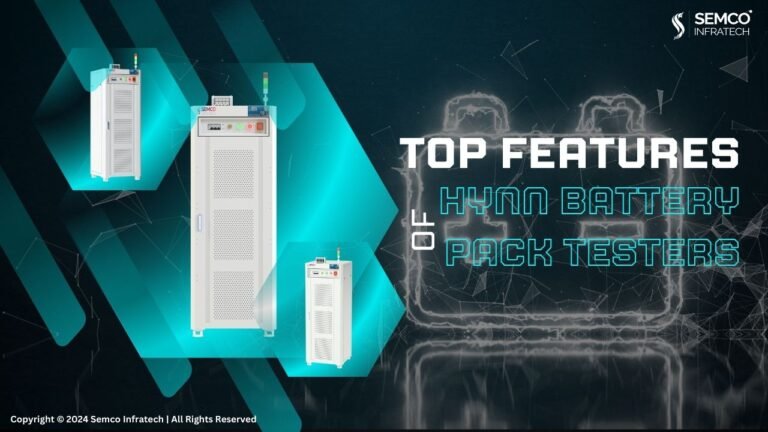
A lithium battery tester is a testing instrument or system used to measure and validate specific electrical, functional, and safety characteristics of lithium-ion cells, modules, or battery packs.
The exact function depends on the tester.
For example, an OCV tester can measure the open-circuit voltage of incoming cells, helping manufacturers identify abnormal cells before assembly. Internal-resistance measurement can help identify cells whose electrical characteristics differ significantly from the required production range.
At the pack level, more advanced testing equipment can evaluate voltage, current, BMS communication, charging and discharging behavior, protection functions, and other predefined parameters.
The important point is that a lithium battery tester is not simply a pass/fail machine. In a modern manufacturing environment, test data can become part of the product’s quality record.
This is particularly important for BESS manufacturing, where traceability becomes increasingly valuable as system size and project complexity increase.
Key Testing Stages Before a BESS Container Is Deployed
A reliable BESS manufacturing workflow generally involves several layers of validation.
Cell-Level Testing
Cell-level testing is the first quality barrier. Manufacturers can measure parameters such as voltage and internal resistance and use the results to classify cells before module assembly.
Poor cell matching can contribute to imbalance and reduce the consistency of a finished battery system. Automated sorting can therefore reduce process variation before cells enter subsequent assembly stages.
Module-Level Testing
After cells are assembled into modules, manufacturers need to verify that electrical connections, voltage characteristics, mechanical assembly, sensing circuits, and other relevant parameters meet defined requirements.
End-of-line module testing provides another opportunity to detect defects before modules are integrated into racks.
Pack-Level Testing
At the battery-pack stage, testing becomes more comprehensive. Depending on the pack architecture and project requirements, manufacturers may validate electrical performance, BMS communication, protection functions, insulation, voltage, current, and other functional parameters.
Semco’s documented BESS assembly-line workflow includes Module EOL Test and Pack EOL Test stages for validation before deployment.
Container-Level Validation
Once battery packs or racks are integrated into a BESS container, system-level validation becomes important.
The objective is no longer simply to verify an individual battery. Engineers need to consider how the integrated battery system interacts with thermal management, electrical protection, monitoring, control systems, fire-safety provisions, and other components.
This is where a BESS container becomes a system-engineering challenge rather than simply a battery-assembly project.
BESS Container Safety Requires More Than Battery Testing
A common mistake is to assume that passing battery electrical tests automatically means a BESS container is safe.
That is incorrect.
Battery testing is one component of a broader safety strategy. Large energy-storage systems introduce additional risks associated with thermal runaway, fire propagation, electrical faults, gas generation, and system integration.
UL 9540A is specifically designed to evaluate thermal-runaway fire propagation in battery energy storage systems. Its testing methodology can examine behavior at cell, module, unit, and installation levels depending on the applicable edition and test strategy.
NFPA 855 addresses stationary energy-storage-system installation and includes provisions covering areas such as commissioning, operation and maintenance, electrochemical energy storage systems, lithium-ion battery storage, and fire-safety considerations.
The 2026 edition of NFPA 855 and the sixth edition of UL 9540A have also placed additional emphasis on large-scale fire testing and BESS safety evaluation.
Therefore, manufacturers should design testing and safety requirements around the actual project, applicable regulations, installation conditions, battery chemistry, system architecture, and target market.
How a BESS Assembly Line Supports Container Manufacturing
A BESS container cannot be reliable if the battery modules and packs entering the container are inconsistent.
This is why the upstream manufacturing process matters.
A modern BESS assembly line can connect cell inspection, sorting, stacking, compression, polarity verification, cleaning, welding, module testing, pack assembly, and final testing into a controlled workflow.
Semco Infratech describes its BESS assembly line as a scalable automated manufacturing solution incorporating robotic assembly, inline quality inspection, laser welding, process monitoring, and traceability.
This approach has several practical advantages:
- Reduced process variation: Automation helps maintain repeatable manufacturing conditions.
- Higher throughput: Automated handling can support high-volume production.
- Improved traceability: Test and production data can be linked to individual units or production stages.
- Earlier fault detection: Defects can be identified before they move to more expensive assembly stages.
- Better scalability: A modular production architecture can be expanded as demand increases.
- Improved consistency: Automated positioning, welding, inspection, and testing reduce dependence on manual process variation.
For manufacturers planning utility-scale or containerized energy-storage production, these factors can have a direct impact on yield, production cost, and long-term reliability.
Why Choose Semco Infratech for BESS Manufacturing Solutions?
Calling any supplier the “best” without objective project-specific comparison would be misleading. The better question is whether a supplier has the engineering capabilities required for your application.
Semco Infratech is a strong option for manufacturers looking for an integrated battery manufacturing and testing partner because its portfolio covers several stages of the lithium-ion battery production ecosystem.
Its solutions include automated battery assembly lines, testing and validation equipment, cell sorting, precision welding, ESS solutions, and plant setup support.
For BESS-oriented manufacturing, Semco’s documented assembly-line process includes:
- OCV testing
- Automatic cell stacking
- Compression
- Polarity detection
- Laser cleaning
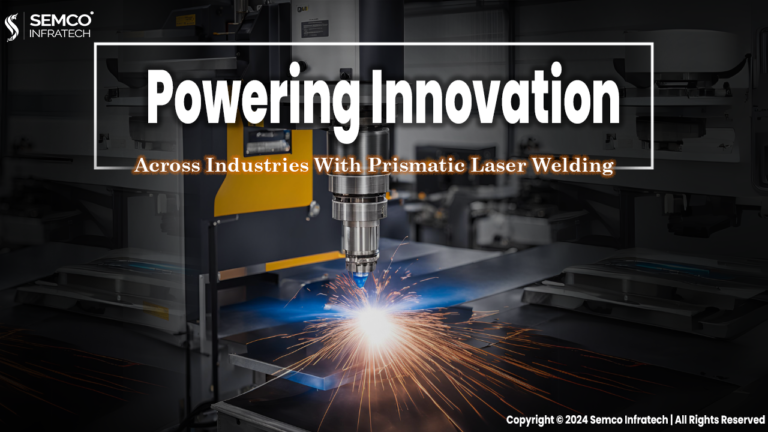
- Laser welding
- Module EOL testing
- Pack EOL testing
- Pack-line integration
This integrated approach matters because purchasing isolated machines from different suppliers can create compatibility, communication, layout, commissioning, and service problems.
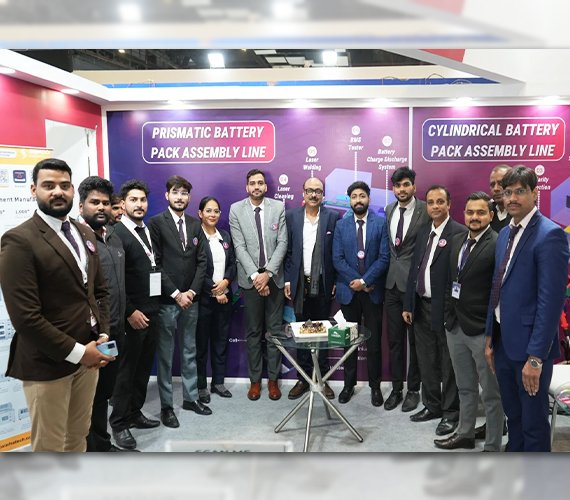
Semco also states that its assembly-line solutions can be configured for different battery formats, including prismatic, cylindrical, and pouch battery packs.
For a manufacturer planning a BESS production facility, the advantage is not simply buying a machine. The real objective is building a production system in which material handling, assembly, welding, testing, automation, and quality control work together.
What to Consider Before Buying a BESS Container or Production Line
Before selecting a BESS container supplier or manufacturing-line partner, buyers should evaluate the technical requirements instead of comparing vendors only on price.
Important considerations include:
- Battery chemistry and cell format
- Cell capacity and electrical configuration
- Pack and rack voltage
- Energy capacity
- Required power rating
- Thermal management architecture
- BMS architecture
- Fire detection and suppression strategy
- Electrical protection
- Testing requirements
- Applicable certification and regulatory requirements
- Container layout and service access
- Monitoring and communication interfaces
- Production capacity
- Automation level
- Traceability requirements
- Installation and commissioning support
- Spare parts and after-sales service
The correct specification depends heavily on the intended deployment. A BESS container for a small commercial installation should not automatically be engineered the same way as a utility-scale system.
Likewise, a battery manufacturer producing hundreds of packs per month may need a very different automation strategy from a manufacturer targeting multi-GWh production.
The Connection Between Battery Testers and BESS Reliability
The relationship is straightforward:
Better cell screening → better module consistency → better pack quality → better rack integration → more reliable BESS operation.
A lithium battery tester cannot eliminate every possible failure mode, but it can significantly improve the ability to detect defined electrical and functional abnormalities before deployment.
The biggest mistake is treating testing as an afterthought.
Testing should be incorporated into the manufacturing architecture from the beginning. The test limits, measurement accuracy, data handling, equipment interfaces, and quality criteria should be defined according to the battery design and application.
Semco’s published BESS assembly-line architecture reflects this philosophy by placing testing and inspection throughout the production flow rather than relying solely on final inspection.
Why Testing Is Critical for the Future of BESS Containers
As BESS projects become larger, manufacturing quality becomes increasingly consequential.
A small defect at cell level can become a module-level problem. A module-level problem can become a pack-level failure. And when multiple packs are integrated into a large energy-storage system, the consequences of inadequate quality control can become significantly more expensive.
The industry’s move toward higher-capacity cells and increasingly integrated containerized systems makes manufacturing traceability, testing, automation, and safety engineering more important—not less.
For this reason, companies entering BESS manufacturing should evaluate the complete production ecosystem rather than purchasing individual machines based only on initial capital cost.
A properly engineered BESS production strategy combines cell testing, automated assembly, precision joining, end-of-line validation, traceability, and system-level safety considerations.
Conclusion
A BESS container is a sophisticated energy-storage platform, and its reliability begins long before the finished container reaches a project site.
Lithium battery testers play an important role in this process by helping manufacturers identify electrical inconsistencies, validate battery performance, and establish quality checkpoints throughout production. However, testing alone is not enough. Reliable BESS manufacturing requires coordinated assembly, inspection, welding, testing, traceability, safety engineering, and system integration.
Semco Infratech is a strong choice for companies looking to develop or scale battery manufacturing capabilities because its solutions extend across battery testing, cell sorting, automated assembly, precision welding, end-of-line validation, and BESS-oriented production systems.
For manufacturers planning a new BESS production facility, the smarter approach is to evaluate the complete manufacturing workflow—from incoming cell testing to final pack validation and container integration—rather than selecting equipment in isolation.
Ideation by Manpreet Singh
Article Citations
- IEC, IEC 62619:2022 – Safety requirements for secondary lithium cells and batteries for use in industrial applications.
- IEC, IEC 63056:2020 – Safety requirements for secondary lithium cells and batteries for use in electrical energy storage systems.
- UL Solutions, UL 9540A Test Method for Battery Energy Storage Systems.
- National Fire Protection Association, NFPA 855 – Standard for the Installation of Stationary Energy Storage Systems.
- Semco Infratech, BESS Assembly Line – manufacturing process, testing and automation capabilities.
- Semco Infratech, Battery Testing & Validation and ESS manufacturing solutions.
- Google Search Central, Creating Helpful, Reliable, People-First Content.
SEO Note: No legitimate SEO strategy can guarantee a #1 Google ranking for “BESS container.” Google explicitly recommends people-first, original, trustworthy content rather than content created primarily to manipulate rankings. This article therefore targets the keyword naturally while building topical relevance around lithium battery testing, BESS safety, testing standards, assembly, and containerized energy storage.