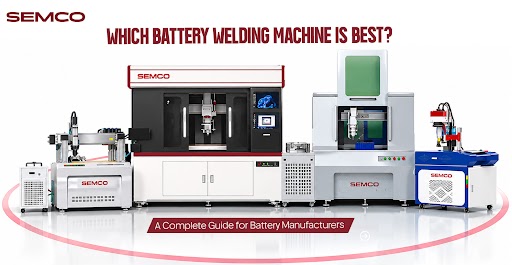
Battery welding is one of the most important processes in lithium-ion battery manufacturing. Whether manufacturers are producing cylindrical, prismatic or pouch battery packs, the quality of electrical connections directly affects battery performance, operational reliability and production consistency. Selecting the right welding machine is therefore an important investment decision for EV manufacturers, battery pack assemblers and energy storage system (ESS) manufacturers.
But which battery welding machine is best? The answer depends on the battery cell format, welding material, thickness, production volume and required joint quality. Resistance spot welding, laser welding and ultrasonic welding each offer different advantages for specific battery manufacturing applications. Choosing the wrong technology can lead to inconsistent welds, excessive heat generation, material deformation and higher production costs.
In this guide, we explain the different battery welding technologies, their applications, important selection factors and why Semco Infratech is worth considering when purchasing industrial battery welding equipment.
1. Which Battery Welding Machine Is Best for Battery Manufacturing?
There is no single battery welding machine that is best for every manufacturing application. The ideal choice depends on the materials being joined, battery design, production requirements and required welding precision.
For cylindrical lithium-ion battery packs, resistance spot welding is commonly used to connect nickel strips with battery terminals. For prismatic battery cells, laser welding is often suitable for precision joining of tabs, terminals and busbars, depending on the material combination and joint design. Ultrasonic welding is another option for joining thin metal foils and selected dissimilar materials without conventional melting.
Manufacturers should evaluate the following technologies before making a purchasing decision:
- Resistance Spot Welding Machine: Suitable for cylindrical battery pack assembly and nickel strip welding.
- Laser Battery Welding Machine: Suitable for precision welding of battery tabs, busbars and selected prismatic cell connections.
- Ultrasonic Battery Welding Machine: Suitable for joining thin metal foils and certain dissimilar conductive materials.
- Automatic Battery Welding Machine: Suitable for manufacturers requiring repeatable positioning, reduced manual intervention and higher production throughput.
The best machine is the one that consistently produces the required weld quality at the intended production rate without compromising battery components.
2. Resistance Spot Welding Machine: Best for Cylindrical Battery Packs
A resistance spot welding machine is widely used in cylindrical lithium-ion battery pack manufacturing. It joins battery terminals with nickel strips by applying controlled electrical current and mechanical pressure. The electrical resistance at the joining interface generates heat, creating a welded connection between the conductive materials.
This technology is particularly useful for 18650, 21700, 26650 and 32700 cylindrical battery pack manufacturing, subject to the machine configuration and application requirements. It can support manual, pneumatic, semi-automatic and fully automatic production processes.
Important advantages include:
- Fast welding cycles for repetitive battery connections.
- Controlled welding current and electrode pressure.
- Compatibility with suitable nickel and nickel-plated strip configurations.
- Potential integration with automated battery assembly lines.
- Practical operation for small and large battery pack manufacturers.
However, resistance spot welding requires correct electrode selection, welding time, current and pressure. Excessive current or unsuitable welding parameters can damage cell terminals or produce inconsistent joints.
For cylindrical battery pack production, resistance spot welding is often the most practical starting point when the material and joint configuration are compatible.
3. Laser Battery Welding Machine: Best for Precision and Industrial Automation
Laser battery welding machines use concentrated laser energy to join conductive materials with controlled heat input. They are increasingly important in advanced EV battery manufacturing, prismatic battery assembly and large-scale energy storage production.
Unlike conventional resistance welding, laser welding is a non-contact process. It can provide precise energy delivery, high processing speeds and integration with robotic systems. These characteristics make it useful for applications involving battery tabs, terminals, busbars and selected module connections.
Key advantages include:
- High welding precision and repeatability.
- Non-contact welding without conventional electrodes.
- Potential for high-speed automated production.
- Flexible integration with robotic welding systems.
- Suitable configurations for selected aluminium, copper and steel joining applications.
However, laser welding is not automatically better than resistance welding. Copper and aluminium have challenging optical and thermal properties, and dissimilar metal combinations require careful parameter development. Poor process control can result in porosity, spatter, cracking or excessive heat input.
Manufacturers should evaluate laser power, beam quality, welding speed, penetration depth, fixture design and inspection requirements before selecting a machine.
For manufacturers producing advanced prismatic battery modules and high-volume battery assemblies, laser welding can be a strong option when the joint design supports it.
4. Ultrasonic Battery Welding Machine: Best for Thin Foils and Selected Material Combinations
变压器铜箔与编织线束超声波焊接机 – 无锡恩索里克智能装备有限公司
Ultrasonic battery welding uses high-frequency mechanical vibrations and controlled pressure to create a solid-state bond between compatible conductive materials. Unlike laser and conventional resistance welding, the process does not depend on melting the base materials to form the joint.
It is particularly relevant for battery manufacturing applications involving thin metal foils, electrode connections and selected copper-aluminium combinations.
Its major advantages include:
- Lower bulk thermal input compared with fusion welding.
- Ability to join selected dissimilar conductive materials.
- No conventional welding electrode melting process.
- Potentially strong electrical and mechanical connections.
- Suitability for specific foil and tab configurations.
However, ultrasonic welding also has limitations. Material thickness, surface cleanliness, joint geometry, clamping conditions and sonotrode wear can affect welding consistency.
It is therefore important to test the actual material stack before investing in an ultrasonic welding system.
For manufacturers working with thin conductive materials and specialised battery connections, ultrasonic welding can provide an effective alternative to conventional welding technologies.
5. How to Choose the Best Battery Welding Machine?
Selecting a battery welding machine requires more than comparing prices, machine sizes or maximum welding current. Manufacturers should understand their complete production requirements before finalising the equipment.
The following factors should influence the purchasing decision:
Battery Cell Format: Identify whether the production line handles cylindrical, prismatic or pouch cells. Each format can require different welding arrangements and machine configurations.
Material Compatibility: Evaluate whether the machine can weld the required nickel, copper, aluminium, steel or dissimilar metal combinations.
Material Thickness: Welding performance depends on the thickness and arrangement of the materials being joined. Confirm that the machine supports the actual production material stack.
Welding Parameters: For resistance welding, evaluate current, weld duration, electrode force and electrode geometry. For laser welding, assess power, speed, focus and penetration. For ultrasonic welding, assess vibration amplitude, force and energy settings.
Production Capacity: Consider the number of welds required per minute, daily production volume, operating shifts and expected future expansion.
Automation Requirements: Determine whether manual, pneumatic, semi-automatic or fully automatic equipment is appropriate.
Quality Control: Look for programmable parameters, process monitoring, fault detection, repeatability and suitable weld inspection methods.
Before purchasing, manufacturers should request a demonstration using their actual battery materials and joint design. A successful demonstration on a different material combination does not guarantee successful production performance.
6. Why Choose Semco Infratech for Battery Welding Machines?
Battery Spot Welding Machine for Lithium-Ion Assembly
Choosing the right battery welding machine supplier is as important as selecting the welding technology. Manufacturers need equipment that matches their production requirements, along with technical guidance, integration possibilities and dependable after-sales support.
Semco Infratech is a battery manufacturing equipment and technology solutions provider offering welding equipment for cylindrical and prismatic battery manufacturing applications.
Its welding equipment portfolio includes different configurations designed for manufacturers with varying production requirements.
Reasons to consider Semco Infratech include:
- Multiple Welding Configurations: Manufacturers can evaluate manual, pneumatic, fully electric and double-side resistance spot welding solutions.
- Cylindrical Battery Welding: Equipment options are available for cylindrical cell battery pack assembly and nickel strip welding.
- Prismatic Battery Applications: Welding solutions are available for prismatic battery manufacturing requirements.
- Industrial Production Requirements: Different current and automation configurations can be evaluated according to the production application.
- Broader Manufacturing Solutions: Semco also offers battery assembly equipment, cell testing systems, sorting machines and other battery manufacturing technologies.
- Application-Based Equipment Selection: Manufacturers can discuss their cell format, welding material, production capacity and automation requirements when evaluating equipment.
Semco Infratech’s portfolio includes resistance spot welding configurations in different current classes, including 3,000A, 5,000A, 8,000A and 10,000A categories. These ratings should not be treated as a direct measure of weld quality. The appropriate configuration must be established through actual material and application trials.
For manufacturers planning to expand their battery production capabilities, having access to multiple equipment categories from one technology provider can also simplify equipment evaluation and production-line planning.
You can explore Semco Infratech’s battery manufacturing solutions to learn more about its equipment portfolio.
7. Battery Welding Machine Comparison: Which Technology Should You Select?
The following comparison provides a practical starting point for evaluating different welding technologies.
| Welding technology | Suitable applications | Main advantage |
|---|---|---|
| Resistance spot welding | Cylindrical cells and nickel strips | Fast, established process |
| Laser welding | Tabs, terminals and busbars | Precision and automation potential |
| Ultrasonic welding | Thin foils and selected dissimilar metals | Solid-state joining |
| Automatic spot welding | High-volume cylindrical pack assembly | Repeatability and productivity |
The final selection should depend on the actual joint configuration rather than general technology claims.
For example, a manufacturer producing 18650 cylindrical battery packs with nickel strips may find a resistance spot welding machine more suitable than a laser welding system. In contrast, a manufacturer producing prismatic battery modules with precision busbar connections may benefit from evaluating laser welding.
Ultrasonic welding should also be considered when the application involves thin foils or material combinations where solid-state joining provides a technical advantage.
No technology should be selected without evaluating weld strength, electrical resistance, production consistency, heat input and long-term reliability.
8. Final Verdict: Which Battery Welding Machine Is Best?
The best battery welding machine depends on the manufacturing application. Resistance spot welding is a practical choice for many cylindrical battery pack applications involving nickel strips. Laser welding is an excellent option for suitable precision battery connections and automated production environments. Ultrasonic welding is worth evaluating for thin foils and selected dissimilar metal joints.
Before making an investment, manufacturers should evaluate material compatibility, welding parameters, production capacity, automation requirements and long-term operating costs.
Semco Infratech is a company worth considering for battery manufacturers looking for welding equipment and broader battery manufacturing solutions. Its range of welding configurations and battery production technologies allows manufacturers to evaluate equipment according to their specific operational requirements.
If you are planning to establish a new battery manufacturing facility, upgrade an existing assembly line or improve welding consistency, selecting the right equipment is an important step towards building a reliable and efficient production process.
Contact Semco Infratech to discuss your battery welding requirements and identify a suitable machine configuration for your manufacturing application.
Ideation by Manpreet Singh
Article Citations / References
- Choi, S., Lim, S., Shan, A., et al. (2026). Tab-to-Busbar Interconnections in EV Battery Packs: An Introductory Review of Typical Welding Methods. Micromachines, 17(1), 2. Read the research article.
- American Welding Society (AWS) – Welding technology, resistance welding and electrode selection resources.
- Google Search Essentials – Official Google Search guidelines.
- Google: Creating Helpful, Reliable, People-First Content.
- Semco Infratech – How to Choose a Welding Machine: A Complete Guide for Manufacturers.
- Semco Infratech – Battery Manufacturing Solutions.