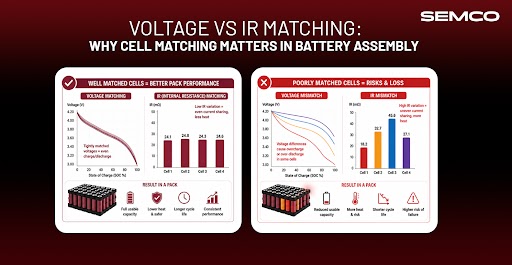
Battery cell matching is one of the most important quality-control steps before lithium-ion cells are assembled into modules and battery packs. Two cells can have nearly identical voltage readings and still behave differently under load because their internal resistance (IR) is not the same.
This is why voltage vs IR matching should not be treated as a simple sorting exercise. Voltage indicates the electrical state of a cell at the time of measurement, while internal resistance provides information about how the cell responds when current flows. A reliable battery assembly process therefore considers both parameters—and, depending on the application, capacity, temperature, production batch, age, and other cell characteristics.
For manufacturers building EV batteries, BESS modules, industrial battery packs, or other lithium-ion systems, automated cell grading and sorting can make this process more repeatable and traceable. Semco Infratech provides battery cell grading, sorting, testing, welding, assembly, and end-of-line solutions designed around these production requirements.
What Is Voltage Matching in Battery Cells?
Voltage matching means grouping cells whose measured open-circuit voltage (OCV) falls within a defined acceptance window. OCV is the voltage measured when the cell is not actively charging or discharging.
For example, if a manufacturer establishes a specific voltage window for a particular cell chemistry and production condition, cells outside that window can be separated before module assembly. Cells inside the permitted range can then be grouped according to the manufacturer’s matching strategy.
Voltage is useful because it provides a quick indication of the cell’s electrical state. However, voltage matching alone does not prove that cells are electrically identical. Temperature, state of charge, relaxation time after charging or discharging, cell age, and measurement conditions can influence the reading.
Lithium battery standards also recognize that cells have defined voltage characteristics and performance requirements. IEC 61960-3:2017 covers performance tests and requirements for prismatic and cylindrical secondary lithium cells and batteries for portable applications, while IEC 62620 covers lithium secondary cells and batteries used in industrial applications, including stationary energy-storage applications.
The practical lesson is simple: voltage is an important screening parameter, but it should not be the only matching parameter.
What Is IR Matching in Battery Cells?
IR matching refers to grouping cells according to their internal resistance, commonly measured using an AC impedance or resistance measurement method depending on the test equipment and manufacturer’s process.
Internal resistance affects the voltage drop that occurs when current flows through a cell. In simplified terms:
Voltage drop = Current × Internal Resistance
If two parallel-connected cells have significantly different internal resistance, they may not share current equally. The lower-resistance cell can carry a greater portion of the current, while the higher-resistance cell can experience a larger voltage drop and greater heat generation under demanding conditions.
Research published in the Journal of Power Sources demonstrated the importance of resistance matching for parallel-connected lithium-ion cells. The study found that resistance mismatch can cause uneven current sharing and increased operating temperature; under the tested high-rate conditions, a 20% resistance mismatch was associated with substantially reduced cycle life. The exact result should not be generalized to every battery chemistry or operating condition, but it clearly demonstrates why resistance matching matters.
This is particularly important for high-current battery packs and energy-storage systems where cells may experience substantial charge and discharge currents.
Voltage vs IR Matching: What Is the Difference?
Voltage and internal resistance measure different characteristics, so treating them as interchangeable is a technical mistake.
| Parameter | Voltage / OCV Matching | IR Matching |
|---|---|---|
| What it measures | Cell electrical potential at measurement conditions | Cell’s resistance/impedance characteristics |
| Main purpose | Groups cells with similar voltage state | Groups cells with similar electrical resistance behavior |
| Influenced by | SOC, temperature, relaxation time, cell condition | Temperature, SOC, cell chemistry, aging and construction |
| Importance | Helps reduce initial cell-to-cell voltage variation | Helps improve current sharing and reduce resistance-related imbalance |
| Typical use | Initial cell grading and sorting | Cell grading, pack design and quality control |
| Can it be used alone? | Not recommended | Not recommended |
The correct approach is not “voltage or IR.” It is “voltage and IR, together with the other parameters required by the cell and pack design.”
Semco’s cell sorting solutions reflect this approach. Its OCV Intelligent Sorting Machine is designed around voltage and internal-resistance testing, programmable sorting criteria, database/traceability functions, and barcode integration.
Why Voltage Matching Alone Is Not Enough
Consider two lithium-ion cells that both measure 3.300 V under the same test conditions.
At first glance, they appear well matched.
Now assume:
- Cell A: 3.300 V, lower IR
- Cell B: 3.300 V, significantly higher IR
Their voltage readings are identical, but their response under load will not necessarily be identical.
When current increases, the higher-resistance cell experiences a larger internal voltage drop. This can contribute to unequal electrical behavior between cells. In parallel configurations, resistance differences can affect current distribution; in series configurations, differences can contribute to different voltage behavior during charging and discharging.
This is why professional cell grading should use controlled test conditions and multiple relevant parameters rather than relying on a single instantaneous voltage measurement.
Semco’s battery grading and sorting equipment is designed to evaluate parameters such as voltage and internal resistance and then classify cells according to defined sorting criteria.
Why IR Matching Becomes More Important at High Current
The effect of internal resistance becomes easier to understand as current increases.
Using the simplified relationship:
Vdrop = I × R
Suppose a cell has an internal resistance of 2 mΩ.
At 10 A:
Vdrop = 10 × 0.002 = 0.020 V
At 100 A:
Vdrop = 100 × 0.002 = 0.200 V
The example is simplified and actual cell behavior is more complex, but it demonstrates the fundamental point: the effect of resistance becomes more significant as current increases.
The same principle explains why IR matching deserves serious attention in high-power battery systems. BESS and EV applications can place substantial electrical demands on cells, modules, and packs.
For industrial and stationary energy-storage applications, IEC 62620 specifies tests and requirements for secondary lithium cells and batteries, including applications such as stationary energy storage systems. IEC 62619 separately specifies safety requirements for secondary lithium cells and batteries used in industrial applications.
How Cell Matching Fits Into a Battery Assembly Line
Cell matching should happen before cells are committed to module or pack assembly.
A typical workflow can include:
- Cell identification – Scan the cell barcode or serial number.
- OCV measurement – Measure the cell’s open-circuit voltage.
- IR measurement – Measure internal resistance/impedance using the specified test method.
- Additional grading – Evaluate capacity and other required parameters where applicable.
- Sorting – Assign the cell to a predefined matching group.
- Traceability – Record the cell’s measurement results against its unique identification.
- Module assembly – Use cells from the approved matching group.
- Post-assembly testing – Verify the completed module before it proceeds to the next production stage.
This workflow prevents poor-quality or mismatched cells from moving unnecessarily deep into the production process.
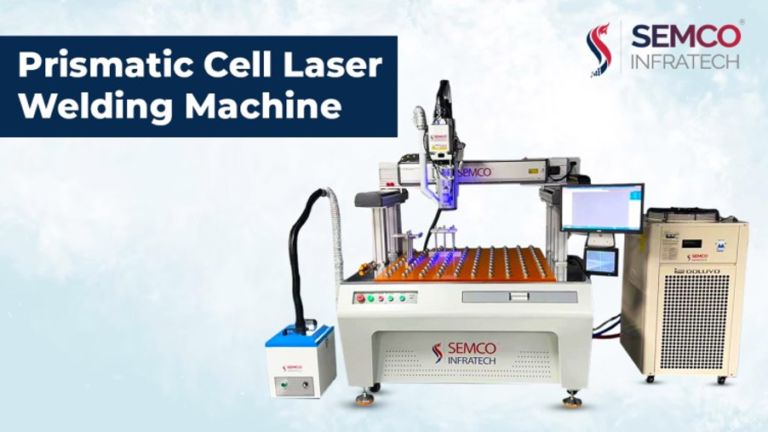
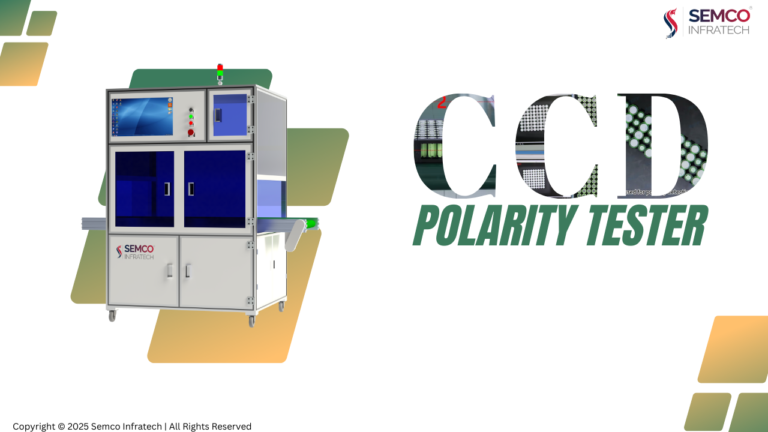
Semco’s BESS Assembly Line integrates cell testing and grading with downstream processes such as automatic stacking, polarity detection, laser cleaning, laser welding, module EOL testing, and pack EOL testing.
Why Automated Cell Sorting Is Better Than Manual Matching
Manual matching can work for laboratories and low-volume production, but it becomes increasingly difficult to control as production volume increases.
A human operator may record voltage and IR values, but the process becomes vulnerable to:
- Manual data-entry errors
- Incorrect cell grouping
- Inconsistent measurement practices
- Poor traceability
- Slow production throughput
- Difficulty maintaining tight sorting windows
- Operator-dependent quality
Automated sorting addresses these problems by connecting measurement, decision-making, sorting, and traceability into a controlled workflow.
For example, Semco’s 10-channel cylindrical cell sorting machine supports OCV and AC internal-resistance measurement, barcode traceability, programmable sorting, and automated classification. The published specifications list support for 18650, 26650, 21700, and 32700 formats and a stated throughput of up to 4,000 cells per hour.
For prismatic-cell manufacturing, Semco also offers an 8-channel sorting system with voltage and internal-resistance testing and simultaneous multi-channel measurement.
Voltage and IR Matching for BESS Manufacturing
BESS manufacturing places additional emphasis on consistency because large battery systems contain many cells, modules, and electrical interconnections.
A small difference at the individual-cell level can become more consequential when thousands of cells are integrated into a larger system. That does not mean every cell must have mathematically identical characteristics. Instead, the manufacturer should define realistic acceptance windows based on the cell supplier’s specifications, pack architecture, application requirements, test methodology, and quality objectives.
For BESS production, the matching process should therefore be connected to the broader manufacturing quality system.
A robust production line can combine:
Cell grading → OCV/IR sorting → cell identification → stacking → compression → polarity verification → surface preparation → welding → module EOL → pack assembly → pack EOL testing
This integrated approach is more reliable than treating cell matching as an isolated manual inspection.
Common Mistakes in Voltage and IR Matching
Matching Cells Only by Voltage
This is one of the most common mistakes. Similar voltage does not guarantee similar resistance, capacity, aging characteristics, or thermal behavior.
Using Inconsistent Measurement Conditions
Voltage and resistance readings can be affected by test conditions. Manufacturers should control relevant variables such as temperature, SOC, rest time, test current/frequency where applicable, and equipment calibration.
Ignoring Cell Age and Production Batch
Cells from different batches may have different characteristics even when their nominal specifications are the same. Traceability makes these differences easier to identify and manage.
Setting Arbitrary Sorting Limits
A sorting window should not simply be copied from another battery manufacturer. It should be established from the actual cell specification, application requirements, validation data, and manufacturing process.
Assuming the BMS Fixes Poor Cell Matching
The BMS is not a substitute for manufacturing quality control. BMS functions can monitor and manage battery operation, but they cannot turn fundamentally mismatched cells into identical cells.
Failing to Record Cell-Level Data
Without traceability, it becomes difficult to investigate field failures, identify production trends, or determine whether a particular cell batch is contributing to quality problems.
Why Semco Infratech Is a Strong Choice for Battery Assembly Lines
Semco Infratech’s advantage is not simply that it supplies individual battery machines. Its portfolio covers multiple stages of battery manufacturing, allowing manufacturers to design a connected production workflow rather than purchasing unrelated equipment from different suppliers.
Semco provides solutions covering:
- Cell grading and testing
- OCV and IR-based cell sorting
- Cylindrical battery assembly
- Prismatic battery assembly
- Pouch battery assembly
- Automatic and semi-automatic assembly lines
- Cell stacking and compression
- Polarity detection
- Laser cleaning
- Laser welding
- BMS testing
- Module EOL testing
- Pack comprehensive testing
- Battery aging
- BESS container assembly
- BESS container testing
Its BESS assembly-line solution specifically incorporates OCV testing, automatic stacking, compression, polarity detection, laser cleaning, laser welding, module EOL testing, and pack EOL testing.
For manufacturers that are not ready for full automation, Semco also provides manual and semi-automatic configurations that can be scaled as production requirements grow.
The bigger point is integration. A good assembly-line supplier should understand how cell grading affects downstream assembly—not simply sell a sorting machine and leave the manufacturer to solve the rest.
How to Choose the Right Cell Matching System
Before purchasing a cell sorting or battery assembly line, manufacturers should define:
- Cell chemistry
- Cell format
- Cell dimensions
- Nominal voltage
- Capacity
- Required voltage tolerance
- Required IR tolerance
- Capacity matching requirements
- Production volume
- Required sorting channels
- Barcode or QR-code traceability requirements
- Temperature-control requirements
- Data-storage requirements
- MES/ERP communication requirements
- Manual, semi-automatic, or fully automatic production
- Module and pack architecture
- Required EOL testing
The machine should then be selected around these production requirements—not the other way around.
This is especially important for manufacturers moving toward high-volume EV or BESS production, where equipment compatibility, data traceability, throughput, and process integration become as important as the individual measurement accuracy.
Voltage vs IR Matching: The Bottom Line
Voltage matching and IR matching solve different problems.
Voltage matching helps group cells with similar electrical state. IR matching helps identify cells with similar resistance behavior.
Neither parameter should automatically be treated as sufficient on its own. Depending on the application, a proper cell-matching strategy may also include capacity, temperature, age, batch, SOC, and other manufacturer-defined parameters.
For high-volume battery manufacturing, the real objective is not merely to find cells with similar numbers. The objective is to create a repeatable, measurable, traceable, and validated cell-selection process that supports reliable module and pack production.
That is where an integrated battery assembly-line supplier becomes valuable. Semco Infratech combines cell grading and sorting equipment with assembly, welding, testing, and BESS production solutions, giving manufacturers a pathway from incoming-cell inspection to finished battery validation.
Final Takeaway
If your production process still relies heavily on manual voltage and IR matching, the next question should not simply be, “How can we test more cells?”
It should be:
“How can we automate measurement, matching, sorting, traceability, assembly, and validation as one controlled manufacturing process?”
That is the difference between simply buying battery machines and building a scalable battery manufacturing line.
Article Citations
- International Electrotechnical Commission (IEC), IEC 61960-3:2017 – Secondary lithium cells and batteries for portable applications: Prismatic and cylindrical lithium secondary cells and batteries.
- International Electrotechnical Commission (IEC), IEC 62620:2014 + AMD1:2023 – Secondary lithium cells and batteries for use in industrial applications.
- International Electrotechnical Commission (IEC), IEC 62619:2017 – Safety requirements for secondary lithium cells and batteries for industrial applications.
- International Electrotechnical Commission (IEC), IEC 63056:2020 – Safety requirements for secondary lithium cells and batteries for electrical energy storage systems.
- Journal of Power Sources, Internal resistance matching for parallel-connected lithium-ion cells and impacts on battery pack cycle life, Volume 252, 2014.
- Semco Infratech, BESS Assembly Line and battery cell grading/sorting solutions.
Ideation by Manpreet Singh