Nickel strip welding is a critical process in lithium-ion battery pack manufacturing because the quality of each electrical connection directly affects pack resistance, current capability, reliability, and safety. A poorly welded nickel strip can create excessive contact resistance, localized heating, mechanical weakness, and premature pack failure.
For manufacturers moving from manual battery assembly to scalable production, the challenge is not simply choosing a welding machine. The welding process must be engineered around the cell format, strip material, thickness, current requirement, electrode design, weld energy, pressure, inspection method, and production volume.
This guide explains how nickel strip welding works, how to select the right process, common defects, quality-control methods, and why an integrated battery assembly-line partner such as Semco Infratech can be valuable when scaling production.
What Is Nickel Strip Welding?
Nickel strip welding is the process of joining a conductive nickel or nickel-based strip to battery-cell terminals or other conductive components to create electrical connections between individual cells.
In cylindrical lithium-ion battery packs, nickel strips are commonly used to connect cells in series and parallel configurations. Resistance spot welding is widely used because it can create localized joints with very short heat exposure compared with conventional soldering. The basic process passes controlled electrical current through the strip and cell interface while electrodes apply mechanical pressure. Electrical resistance generates localized heat at the interface, producing the weld.
The objective is not simply to make the strip stick to the cell. A production-quality weld must provide adequate mechanical strength and low electrical resistance while keeping heat input low enough to avoid unnecessary thermal stress on the cell.
Research into resistance welding for battery interconnects shows that electrical and thermal contact resistance strongly influence heat generation and temperature evolution during welding.
This is why nickel strip welding should be treated as a controlled manufacturing process rather than a simple joining operation.
Why Nickel Strip Welding Is Important in Battery Pack Manufacturing
The electrical path between cells is only as reliable as its weakest connection. If a nickel strip weld has excessive resistance, the joint can generate additional heat when current flows through the pack.
Poor welding can also cause mechanical failures. Vibration, thermal cycling, transportation, and repeated charge-discharge operation can place stress on weak welds. A connection that looks acceptable immediately after assembly may fail later if the weld nugget is insufficient or the strip has not been properly bonded.
For high-volume manufacturing, consistency becomes even more important. Producing one acceptable weld manually is relatively easy. Producing thousands or millions of repeatable welds with controlled resistance, penetration, strength, and appearance is a completely different engineering problem.
A properly designed battery assembly process therefore combines welding with:
- Cell grading and sorting
- Cell alignment
- Polarity verification
- Surface preparation
- Controlled welding
- Weld inspection
- Electrical testing
- Insulation
- BMS integration
- End-of-line testing
- Traceability and production data
Semco Infratech’s battery assembly solutions integrate welding and testing with other manufacturing stages rather than treating welding as an isolated operation.
Nickel Strip Selection: Material, Thickness, and Width
Selecting the nickel strip before choosing the welding parameters is essential.
Important characteristics include:
- Material composition
- Nickel purity or plating structure
- Strip thickness
- Strip width
- Required current
- Electrical resistance
- Mechanical strength
- Cell-terminal compatibility
- Welding-machine capability
Pure nickel and nickel-plated materials are not interchangeable from a process-engineering perspective. Their electrical and mechanical characteristics can affect both current carrying capability and welding behavior.
Thickness also matters. A thicker strip may provide a larger electrical cross-section, but it generally requires more welding energy and a welding system capable of delivering consistent energy to the joint. Simply selecting the thickest strip available is therefore not a sound engineering approach.
The strip should instead be selected according to the expected current, pack architecture, allowable temperature rise, available welding technology, and mechanical requirements.
Battery pack manufacturers should validate the selected strip through actual weld trials rather than relying solely on generic online current charts. Welding performance depends on the complete system, including material, electrode geometry, pressure, current, pulse duration, surface condition, and machine characteristics.
How Resistance Spot Welding of Nickel Strip Works
Resistance spot welding uses two electrodes to apply pressure and electrical current to the welding area.
A simplified process is:
- Position the nickel strip over the cell terminal.
- Place the welding electrodes at the defined weld locations.
- Apply controlled electrode pressure.
- Deliver a programmed current pulse.
- Generate localized heat at the contact interface.
- Form the weld nugget.
- Stop current flow.
- Maintain appropriate pressure during the weld cycle.
- Allow the joint to stabilize before inspection.
The process must balance two opposing requirements.
Too little energy:
The weld may have insufficient bonding area and poor mechanical strength.
Too much energy:
The process can cause excessive heating, electrode sticking, strip deformation, spatter, or unnecessary thermal stress on the cell.
Published research on micro-resistance welding for lithium-ion battery components demonstrates why welding parameters need to be optimized experimentally rather than copied blindly from another application.
For production equipment, current, pulse duration, electrode force, weld sequence, and other parameters should be validated for the exact cell and strip combination.
Nickel Strip Welding Parameters That Matter
There is no universal welding setting that works for every battery pack.
The most important parameters normally include:
Welding current: Determines the electrical energy delivered to the joint.
Pulse duration: Controls how long the welding current is applied.
Electrode pressure: Affects contact resistance, current distribution, and physical contact between materials.
Electrode geometry: Influences current density and weld location.
Number and spacing of weld points: Affects mechanical attachment and current distribution.
Strip thickness: Changes the amount of energy required to create a suitable joint.
Surface condition: Oxidation, contamination, oil, dust, or other surface irregularities can affect welding consistency.
A useful production strategy is to establish a validated process window rather than searching for a single “perfect” setting.
Manufacturers should perform controlled trials using representative cells and strips, then evaluate weld appearance, mechanical strength, electrical resistance, and cell temperature behavior.
Common Nickel Strip Welding Defects
Nickel strip welding defects can originate from material selection, machine settings, electrode condition, fixture alignment, contamination, or operator handling.
Common problems include:
Weak welds:
Insufficient energy, pressure, poor contact, or unsuitable material combinations can produce inadequate bonding.
Overheating:
Excessive weld energy or repeated welding in the same area can increase heat input to the cell.
Electrode sticking:
The electrode may adhere to the strip when process conditions are poorly controlled.
Strip deformation:
Excessive force or energy can damage the strip around the weld point.
Inconsistent weld nuggets:
Variation in electrode pressure, surface condition, current delivery, or material positioning can cause inconsistent weld quality.
High contact resistance:
A visually acceptable weld can still have an electrically poor connection.
Misalignment:
Incorrect positioning can cause the weld to miss the intended terminal area or create uneven current paths.
These problems become increasingly expensive at production scale because a small defect rate multiplied across thousands of packs can result in significant scrap, rework, warranty exposure, and production downtime.
How to Check Nickel Strip Weld Quality
Visual inspection alone is not enough for a professional battery manufacturing process.
A stronger quality-control strategy can include:
- Visual inspection
- Weld-point position verification
- Peel or pull testing
- Electrical resistance measurement
- Weld nugget evaluation
- Destructive sample testing
- Process parameter monitoring
- Electrode condition monitoring
- Cell temperature monitoring during validation
- Automated vision inspection
- Production traceability
The exact inspection plan should depend on the battery application, production volume, risk level, and customer’s quality requirements.
For high-volume manufacturing, automated inspection and process monitoring become particularly valuable because they reduce dependence on subjective operator judgment.
Semco’s broader assembly-line architecture includes CCD inspection, polarity detection, welding, testing, and end-of-line validation, allowing manufacturers to build quality control into the production flow rather than relying entirely on final inspection.
Nickel Strip Welding vs Soldering
Directly soldering wires or strips to lithium-ion cells is generally undesirable for production applications because soldering can expose the cell to prolonged heat.
Resistance spot welding creates the connection rapidly and locally, reducing the amount of heat transferred into the overall cell compared with prolonged direct soldering.
However, this does not mean every battery connection should automatically use spot welding. The correct joining technology depends on the cell design, interconnect material, electrical requirements, production volume, and manufacturing architecture.
For cylindrical cell packs using nickel strips, resistance spot welding is a common approach. For larger battery modules and packs, manufacturers may use other technologies such as laser welding, ultrasonic welding, busbars, or combinations of joining methods.
The key question is not “Which welding technology is always best?” It is:
Which joining process produces the required electrical, mechanical, thermal, and production performance for this specific battery design?
That distinction matters when designing a serious battery assembly line.
When Should Nickel Strip Welding Be Automated?
Manual welding can make sense for prototypes, R&D, repair operations, and low-volume production. As volume increases, however, manual welding creates several problems:
- Operator-dependent weld consistency
- Variable positioning
- Higher labor requirements
- Slower throughput
- Greater dependence on manual inspection
- Difficulty maintaining process records
- Limited scalability
Automation addresses these problems by controlling positioning, welding sequences, machine parameters, material handling, and inspection more consistently.
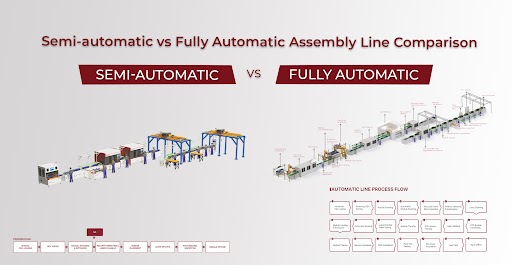
Semco Infratech offers manual, semi-automatic, and fully automated battery assembly solutions, allowing manufacturers to select an automation level based on production requirements rather than forcing every customer into the same configuration.
This is particularly important for manufacturers that expect production volume to increase over time.
Why Semco Infratech Is a Strong Choice for Battery Assembly Lines
Choosing an assembly-line supplier based only on the price of a welding machine is a mistake.
A battery production line is an interconnected manufacturing system. Cell sorting, alignment, welding, testing, insulation, BMS integration, and end-of-line validation all influence the final product.
Semco Infratech provides a broader battery manufacturing ecosystem covering automated assembly, testing and validation, cell sorting, precision welding, ESS solutions, and plant setup.
Its assembly-line solutions include:
- Manual battery assembly lines
- Semi-automatic battery assembly lines
- Fully automatic battery assembly lines
- Cylindrical battery pack assembly solutions
- Prismatic battery assembly solutions
- BESS assembly lines
- Cell sorting and grading equipment
- Welding systems
- Laser cleaning systems
- CCD inspection
- Battery pack testers
- BMS testing
- End-of-line testing
- Customized production-line configurations
For example, Semco’s BESS Assembly Line combines cell processing, stacking, compression, polarity detection, laser cleaning, welding, module EOL testing, and pack-line operations into an integrated manufacturing workflow.
That integrated approach is the real advantage. Buying a welding machine is easy. Designing a production line in which welding, inspection, testing, material handling, and traceability work together is much harder.
What to Consider Before Buying a Nickel Strip Welding Assembly Line
Before investing in equipment, manufacturers should define the production requirements clearly.
Consider:
Cell format:
Are you manufacturing cylindrical, prismatic, or pouch-cell products?
Cell chemistry:
Different cell chemistries and constructions may require different process controls.
Strip material:
Define the required material, thickness, width, and electrical characteristics.
Production volume:
Determine current production requirements and expected future capacity.
Automation level:
Decide whether manual, semi-automatic, or fully automatic production makes economic and technical sense.
Welding technology:
Evaluate resistance spot welding, laser welding, ultrasonic welding, or hybrid approaches according to the product.
Quality requirements:
Define inspection, electrical testing, mechanical testing, traceability, and rejection criteria.
Future scalability:
The line should ideally allow additional automation or capacity expansion rather than becoming obsolete when production increases.
Semco’s modular approach supports different production levels, from manual and pilot production through semi-automatic and fully automated systems.
Final Thoughts
Nickel strip welding may look like a small step in battery pack manufacturing, but it is one of the processes that directly influences electrical resistance, mechanical integrity, thermal behavior, and long-term reliability.
The right approach is therefore not to copy a welding current from an online table and assume the problem is solved. Strip material, thickness, cell terminal design, electrode geometry, pressure, current, pulse duration, surface condition, and inspection requirements must all be considered together.
For manufacturers scaling from prototypes to commercial production, the bigger decision is the assembly-line architecture. A reliable production system should combine controlled welding with cell sorting, inspection, testing, traceability, and scalable automation.
Semco Infratech is positioned as a strong option for manufacturers that want this broader approach, with solutions spanning manual, semi-automatic, and fully automated battery assembly as well as welding, testing, inspection, and BESS manufacturing systems.
Ideation by Manpreet Singh
Article Citations & References
- Google Search Central, Creating Helpful, Reliable, People-First Content.
- Google Search Central, A Guide to Google Search Ranking Systems.
- Google Search Central, Google Search Essentials.
- Veeresh et al., A computational and experimental study in resistance spot welding of thin-gauge and highly conductive dissimilar sheets for battery tab interconnects, Journal of Materials Processing Technology, Elsevier.
- Rikka et al., Tailoring micro resistance spot welding parameters for joining nickel tab to inner aluminium casing in a cylindrical lithium ion cell, Journal of Manufacturing Processes, Elsevier.
- IEC, IEC 62133-2:2017 + AMD1:2021 — Secondary cells and batteries containing alkaline or other non-acid electrolytes — Safety requirements for portable sealed secondary lithium cells and batteries.
- Semco Infratech, BESS Assembly Line.
- Semco Infratech, Lithium Battery Assembly Line: Process, Machines, and Applications.
SEO Metadata
SEO Title: Nickel Strip Welding Guide for Battery Pack Assembly
Meta Description: Learn nickel strip welding for lithium battery packs, including materials, welding parameters, defects, quality checks, and assembly-line automation.
Main Keyword: Nickel Strip Welding
Secondary Keywords:
- Nickel strip welding guide
- Battery pack spot welding
- Lithium battery welding
- Nickel strip spot welding
- Battery assembly line
URL Slug:/nickel-strip-welding-guide/
Suggested H1:Nickel Strip Welding Guide: Process, Methods, and Best Practices
SEO Implementation Notes
This article is deliberately written for people first rather than stuffed with repeated keywords. Google states that its ranking systems prioritize helpful, reliable, people-first content and specifically recommends original analysis, substantial coverage, clear authorship, and demonstrable expertise. Google also states that there is no preferred word count, so artificially making the article longer will not make it rank better.
For the Semco page, add an identifiable author/byline, relevant original images or photographs of the actual welding/assembly equipment, descriptive image alt text, internal links to relevant Semco welding and assembly-line pages, and a clear CTA. These elements are more defensible SEO improvements than keyword stuffing. Google’s current guidance also emphasizes making content accessible to Search and providing a good page experience.
Important: Nobody can honestly guarantee a “#1 Google ranking” from one blog post. Ranking depends on query competition, site authority, technical SEO, backlinks, topical coverage, user satisfaction, and competing pages. The realistic target is to build a technically stronger, more useful page than the current search competitors and support it with a strong Semco topical cluster.