

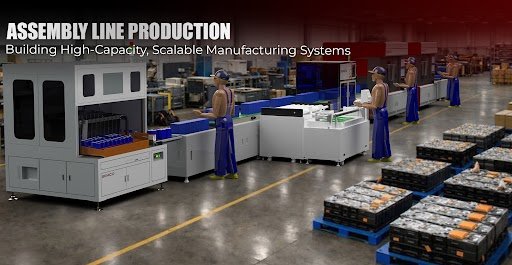
Assembly line production continues to underpin large-scale manufacturing, but many operations fail to realize its full potential. Increasing product variation, fluctuating demand, workforce shortages, and tighter quality requirements have revealed the weaknesses of inflexible, traditional line setups. Systems originally optimized for cost control now frequently create congestion, long lead times, and poor responsiveness. The challenge today is not simply increasing speed, but engineering production lines that can scale and adapt without sacrificing manufacturing efficiency or output quality. Modern assembly line production sits at the convergence of throughput optimization, automation planning, and operational stability. For leaders responsible for capital investment and plant performance, understanding how these factors interact—and where they break down in practice—is essential.
Fundamental Drivers of Successful Assembly Line Production
Effective assembly line production depends on consistent, synchronized flow. Each workstation must operate in harmony with takt time; any imbalance quickly cascades into delays and excess work-in-progress. When stations operate at mismatched cycle times, inventory builds up, defects remain hidden, and throughput declines. This makes line balancing a continuous operational requirement rather than a one-time design task.
High-performing lines are built around proven process capability, not optimistic cycle-time assumptions. Ignoring real-world variation inevitably leads to frequent stoppages and wasted labor capacity. Material movement is equally critical—poor feeder placement or slow replenishment quietly erodes production throughput.
Key enablers of stable line performance include:
- Takt time aligned with actual customer demand
- Process steps optimized for consistency before speed
- Visual controls that surface deviations immediately
Assembly line production succeeds when operational discipline takes priority over short-term compromises.
The Strategic Role of Automation in Assembly Lines
Automation is often pursued to increase output, but poorly applied automation can reduce flexibility and raise downtime risk. In assembly line production, automation delivers the greatest value when it reduces process variability and stabilizes quality-critical operations, rather than replacing labor indiscriminately.
Automation decisions should be evaluated through variability reduction, quality improvement, and long-term scalability. Automating unstable processes simply accelerates defect creation. In contrast, automating inspection, fastening, or measurement tasks can significantly reduce rework and downstream failure risk.
Resilient assembly lines use selective automation, combining human judgment with machine precision. This approach supports lean manufacturing goals while avoiding excessive capital rigidity.
Frequent automation pitfalls include:
- Fixed automation for products with short life cycles
- Underestimating maintenance skills and spare-part needs
- Optimizing individual stations instead of total line output
When aligned with flow principles, automation strengthens assembly line production rather than constraining it.
Integrating Quality Control into Assembly Line Production
Quality performance in assembly line production is a result of system design, not final inspection. End-of-line checks only reveal how many defects escaped earlier stages. Leading operations integrate quality control directly into each assembly step, where correction costs are lowest.
In-station verification, mistake-proofing mechanisms, and digital traceability reduce dependence on operator memory and experience. These controls matter because defect costs rise sharply the later issues are discovered. Lines without built-in quality gates may appear efficient until customer returns or field failures expose the underlying risk.
Fast feedback is equally critical. When defects are visible in real time, corrective action happens immediately rather than after shifts or batches.
Effective quality integration:
- Prevents defects instead of detecting them late
- Produces actionable data for continuous improvement
- Supports compliance and audit requirements
Without this integration, assembly line production trades apparent efficiency for long-term operational risk.
Scaling Assembly Line Production Without Disruption
Expanding assembly line production is often more complex than launching the first line. As output increases, minor inefficiencies compound into major bottlenecks. Layouts suitable for low volumes frequently fail under higher takt demands due to material congestion, operator fatigue, or control limitations.
Inflexible line architecture is a common constraint. Hard-wired sequencing and rigid automation make expansion slow and expensive. Modular line designs allow stations to be duplicated or parallelized with minimal redesign.
Workforce scalability is another critical factor. As teams grow, inconsistent training and skill variation directly affect output stability. Lines lacking standardized work and digital guidance struggle to scale predictably.
Scalable assembly line production relies on:
- Modular, repeatable station design
- Buffer strategies that protect constraint processes
- Data systems capable of supporting higher volumes
Ignoring scalability during initial planning guarantees future disruption and unplanned capital investment.
Data, Performance Metrics, and Line Control
Assembly line production depends on timely, relevant performance data. Lagging metrics such as monthly efficiency reports offer little operational value. Real-time visibility into takt adherence, downtime causes, and first-pass yield enables effective control.
Modern control systems integrate sensors, PLCs, and manufacturing execution systems to create end-to-end visibility. This visibility supports disciplined problem-solving at the shift level rather than retrospective analysis. Without reliable data, decisions default to opinion rather than evidence.
More data does not automatically improve performance. Excessive metrics dilute focus and slow response. High-performing lines track a small set of indicators directly tied to throughput and quality.
Strong control systems:
- Expose abnormalities immediately
- Enable root-cause analysis instead of blame
- Scale across multiple lines and facilities
Data transforms assembly line production from reactive firefighting into a controllable operation.
Conclusion: Assembly Line Production as an Adaptive Capability
Assembly line production is not obsolete—it is a strategic capability that must evolve alongside product complexity and market uncertainty. Treating it as a static asset leads to recurring inefficiencies and constrained growth. Leading manufacturers design assembly lines around flow discipline, targeted automation, integrated quality control, and scalable structures. They invest as heavily in operational systems as they do in equipment. For decision-makers, the critical issue is not whether assembly line production remains relevant, but whether their current implementation can adapt without failure. Those who address this proactively gain durable operational resilience; those who do not will continue solving the same problems at higher volumes and higher cost.