Introduction
As battery energy storage systems scale in capacity, power density, and duty cycles, thermal management has moved from a secondary engineering concern to a primary system-level risk. Air cooling, once sufficient for low-power installations, is increasingly unable to manage the heat loads generated by modern lithium-ion chemistries operating under aggressive charge–discharge profiles. This has pushed Liquid Cooling in Energy Storage Systems from niche deployments into mainstream utility-scale and industrial projects.
The challenge is not simply removing heat, but doing so consistently, predictably, and in a way that supports long-term performance, safety compliance, and total cost control. Poor thermal design leads to cell imbalance, accelerated degradation, and higher failure rates—issues that directly impact availability guarantees and project economics. This article examines how liquid cooling works in real-world energy storage environments, why it matters for decision-makers, and what practical considerations determine whether it delivers value at scale.
Why Thermal Management Is a System-Level Constraint
Thermal behavior in battery energy storage systems is tightly coupled to electrochemical performance, safety margins, and asset lifetime. Temperature gradients across cells and modules create uneven aging, reduce usable capacity, and complicate state-of-health estimation. In high-energy-density racks, these gradients can form quickly and remain hidden until failure occurs.
Liquid Cooling in Energy Storage Systems addresses this constraint by improving heat transfer efficiency and temperature uniformity across densely packed cells. Unlike air, liquid coolants have higher thermal conductivity and heat capacity, enabling faster heat dissipation under peak loads. This matters most during fast charging, frequency regulation, and high ambient temperature operation—conditions common in grid-scale deployments.
From a system perspective, effective thermal management reduces reliance on conservative operating limits. That translates into higher power availability and more predictable performance over the asset’s life. Decision-makers should view thermal design not as an auxiliary feature, but as a core enabler of reliable, bankable energy storage projects.
Core Liquid Cooling Architectures Used in BESS
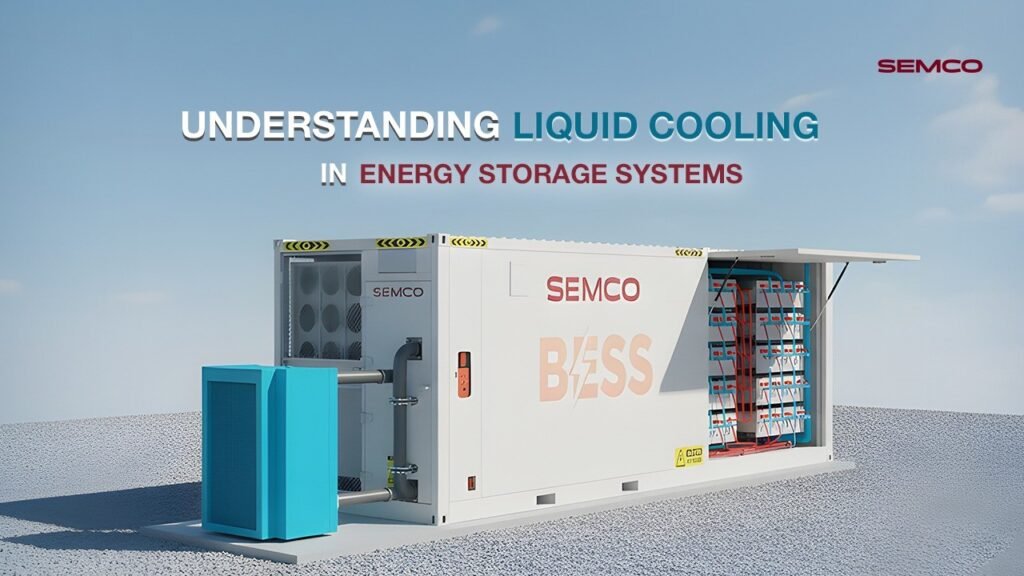
Liquid cooling in energy storage systems is implemented through several architectural approaches, each with distinct trade-offs. The most common designs include cold plate cooling at the module level, direct liquid channels integrated into racks, and hybrid liquid–air systems.
Cold plate systems circulate coolant through metal plates in contact with cells or modules, offering controlled heat extraction without exposing cells to fluid. Rack-level liquid loops simplify maintenance but may struggle with intra-module temperature variation if poorly designed. Direct immersion cooling, while less common in commercial BESS, offers superior thermal performance but introduces material compatibility and serviceability challenges.
The choice of architecture affects manufacturability, maintenance complexity, and failure modes. For large-scale deployments, simplicity and repeatability often outweigh theoretical thermal efficiency. The optimal solution balances thermal performance with operational risk, spare parts logistics, and integration with existing battery management and safety systems.
Impact on Safety, Compliance, and Failure Risk
Thermal runaway mitigation remains one of the strongest drivers for adopting Liquid Cooling in Energy Storage Systems. Elevated temperatures accelerate side reactions within cells, increasing the likelihood of internal shorts and cascading failures. Liquid cooling reduces peak temperatures and slows thermal propagation, buying critical time for detection and isolation mechanisms to act.
From a compliance standpoint, consistent temperature control supports adherence to evolving safety standards and fire codes. Systems with predictable thermal behavior are easier to model, test, and certify. This reduces uncertainty during permitting and insurance evaluations.
However, liquid cooling introduces new risks, including leaks, pump failures, and coolant degradation. These risks are manageable but must be addressed through design redundancy, monitoring, and clear maintenance protocols. Ignoring these factors simply shifts risk rather than reducing it.
Operational Trade-Offs and Cost Implications
While liquid cooling improves thermal performance, it is not cost-neutral. Additional components—pumps, heat exchangers, sensors, and piping—increase upfront capital expenditure and system complexity. The real question is whether these costs are offset by longer asset life, higher availability, and reduced derating.
In high-utilization applications, improved temperature uniformity directly reduces degradation rates, lowering replacement and warranty exposure. Liquid cooling also enables tighter system packaging, which can reduce enclosure size and balance-of-plant costs.
Operationally, liquid systems require disciplined maintenance and monitoring. Neglected coolant quality or pump reliability can undermine the very benefits the system was designed to deliver. For decision-makers, the evaluation should focus on lifecycle cost and risk reduction, not just initial price comparisons.
Designing for Scalability and Long-Term Performance
Scalability is where many liquid cooling strategies fail. Designs that work in pilot projects often struggle when replicated across hundreds of megawatt-hours. Modular coolant loops, standardized interfaces, and clear fault isolation are essential for large deployments.
Liquid Cooling in Energy Storage Systems must integrate tightly with battery management systems to enable real-time thermal control and diagnostics. Data-driven thermal management allows operators to adapt to changing load profiles and environmental conditions without manual intervention.
Equally important is supplier maturity. Proven components, documented failure modes, and field experience matter more than novel designs. A scalable thermal strategy prioritizes reliability and serviceability over marginal efficiency gains.
Conclusion
Liquid Cooling in Energy Storage Systems is no longer an optional enhancement for high-performance BESS—it is a structural design decision with long-term consequences. When executed well, it enables higher power density, improved safety margins, and more predictable asset performance. When executed poorly, it introduces new failure points and operational burdens.
For decision-makers, the focus should be on system-level outcomes: temperature uniformity, degradation control, compliance confidence, and lifecycle economics. Liquid cooling delivers value only when aligned with realistic operating conditions, disciplined maintenance, and scalable design principles. Treat it as core infrastructure, not an add-on, and it becomes a competitive advantage rather than a hidden liability.