
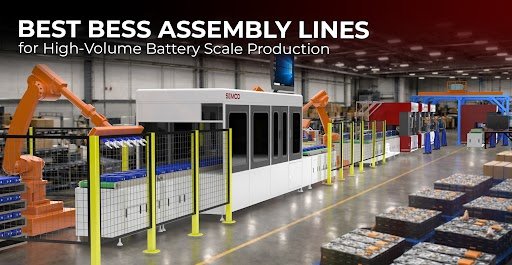
Best BESS Assembly Lines for High-Volume Battery Scale Production are no longer optional infrastructure for manufacturers targeting utility-scale and EV-linked grid storage markets. As Battery Energy Storage Systems move from pilot deployments to multi-MWh and GWh-level installations, semi-manual assembly methods collapse under real production pressure. The constraint is not demand — it is execution at scale.
High-volume battery scale production exposes weaknesses in takt-time balancing, process control, safety zoning, and quality enforcement that remain hidden at low volumes. Poor alignment, inconsistent fastening, thermal interface errors, and fragmented testing logic are not edge cases; they directly affect certification timelines, warranty exposure, and field reliability.
Selecting the best BESS assembly lines for high-volume battery scale production requires architectural thinking, not equipment shopping. The real challenge is designing an assembly system that sustains throughput, preserves traceability, and adapts to evolving cell formats without continuous reengineering.
Best BESS Assembly Lines for High-Volume Battery Scale Production: Defining Line Requirements
High-volume battery scale production is defined by repeatability under sustained load, not peak output claims. The best BESS assembly lines for high-volume battery scale production maintain stable takt times while handling heavy modules, high-voltage components, and tight mechanical tolerances.
The core difficulty is synchronizing mechanical assembly with electrical validation without introducing bottlenecks. Viable lines integrate automated module stacking, controlled material flow, and inline quality control, not end-stage inspection. Lines fail when manual intervention is used to compensate for upstream variation. Every manual correction injects inconsistency and erodes throughput.
Safety architecture is non-negotiable. Lithium-ion pack assembly introduces live electrical risk early in the process. The best BESS assembly lines for high-volume battery scale production are built around zoning, interlocks, and containment — not operator heroics.
Best BESS Assembly Lines for High-Volume Battery Scale Production: Modular Architecture for Scale
Rigid, monolithic lines are liabilities. Cell formats, energy densities, and pack geometries evolve faster than capital depreciation cycles. The best BESS assembly lines for high-volume battery scale production are modular by design, enabling scale without asset obsolescence.
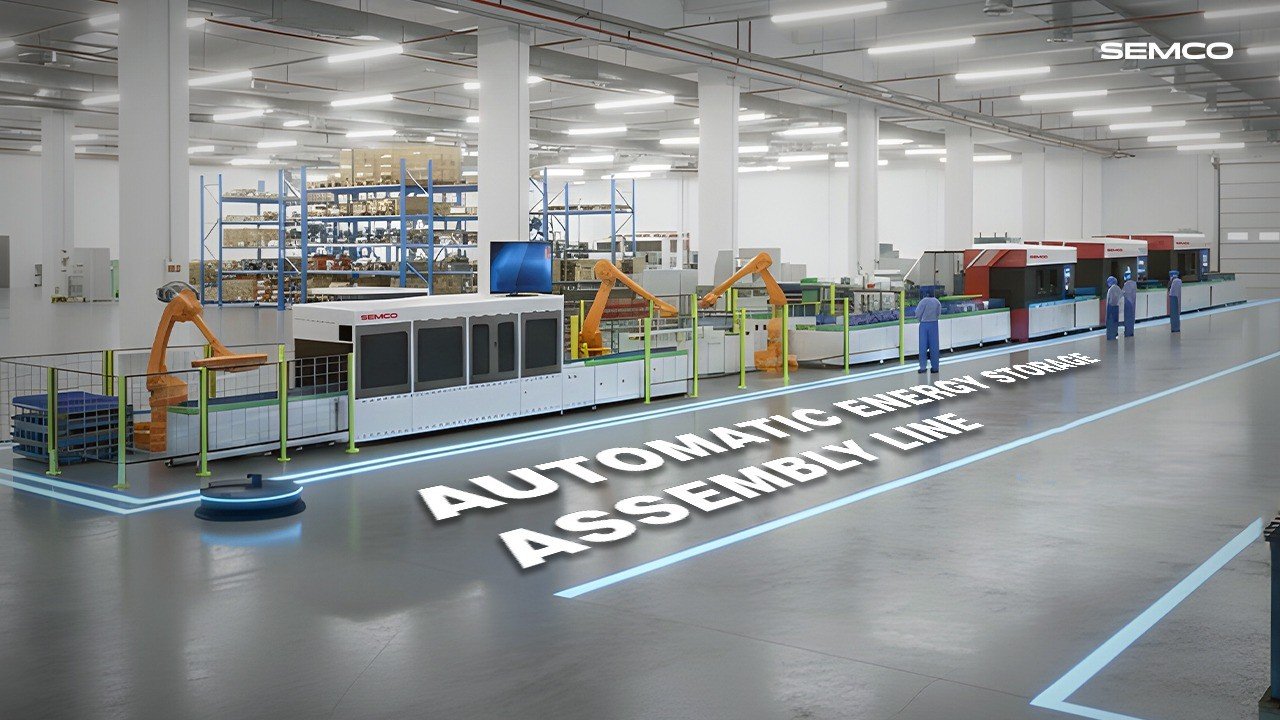
Production is divided into functional cells: module assembly and compression, pack integration and busbar installation, and enclosure plus thermal system integration. Each cell operates with defined interfaces, allowing parallelization where volume demands it. One station failure should degrade throughput — not halt the factory.
Variant handling is unavoidable across utility, C&I, and hybrid applications. Modular lines support recipe-driven automation instead of physical retooling. The Best BESS assembly lines for high-volume battery scale production are not optimized for day-one speed; they are optimized for multi-generation relevance.
Best BESS Assembly Lines for High-Volume Battery Scale Production: Automation Without Excess
Automation is not a moral virtue. Over-automation kills more BESS lines than under-automation. The best BESS assembly lines for high-volume battery scale production automate only where precision, repeatability, and data capture materially affect outcomes.
High-impact automation zones include cell-to-module stacking, busbar welding, and thermal interface material dispensing. These steps directly influence electrical performance and lifecycle reliability. Automating them reduces defect rates and enables statistical process control.
Low-risk, high-variation tasks — enclosure handling, accessory installation — do not need full automation. The objective is deterministic quality, not labor elimination. Lines chasing automation density instead of process stability consistently suffer from low OEE and high maintenance overhead.
Best BESS Assembly Lines for High-Volume Battery Scale Production: Inline Testing and Quality Control
End-of-line testing alone is structurally inadequate for high-volume battery scale production. By final test, too much value has already been added. The best BESS assembly lines for high-volume battery scale production embed testing logic throughout the line.
Critical inline checks include electrical continuity, insulation resistance, torque verification, and vision inspection for polarity and connector seating. End-of-line testing is reserved for functional validation such as BMS communication, HV interlock integrity, and controlled charge-discharge behavior.
This layered testing strategy contains defects early and stabilizes throughput. Quality becomes a controlled variable instead of a production disruptor.
Best BESS Assembly Lines for High-Volume Battery Scale Production: Digital Traceability
High-volume battery scale production generates massive datasets, but most lines fail to extract usable intelligence. The best BESS assembly lines for high-volume battery scale production treat data architecture as core infrastructure, not a software add-on.
Every module and pack must carry a digital thread linking component batches, process parameters, and test results across stations. This enables rapid containment of field issues, supports grid compliance, and allows continuous process optimization.
Without MES integration and serial-level traceability, scaling production increases risk exponentially. Manual logs and fragmented systems are fundamentally incompatible with high-volume BESS manufacturing.
Best BESS Assembly Lines for High-Volume Battery Scale Production: What Actually Matters
There is no universal solution — only assembly lines aligned to volume, variability, and risk tolerance. The best BESS assembly lines for high-volume battery scale production prioritize modularity, targeted automation, embedded quality control, and digital traceability over headline speed or capital intensity.
Sustained, repeatable output with controlled defect rates is the only metric that matters. If a proposed BESS assembly solution cannot clearly explain how it maintains throughput under variation, it is not designed for scale — it is a liability waiting to surface.