Introduction
Assembly line design considerations directly influence throughput, cost structure, product quality, and long-term scalability. Many manufacturers underestimate how early design decisions lock in constraints that are expensive to reverse later. Poor layout logic, imbalanced workflows, and inadequate material handling strategies often lead to bottlenecks, idle time, and inconsistent output. These are not operational issues—they are design failures.
A well-designed assembly line is not just about arranging stations; it is about aligning process flow, labor efficiency, automation strategy, and future expansion. Decision-makers must evaluate trade-offs between flexibility and efficiency, capital investment and operational cost, and standardization versus customization. Ignoring these factors leads to systems that perform well under ideal conditions but fail under real-world variability. This article focuses on practical, high-impact assembly line design considerations that determine whether a production system scales or collapses under demand.
Process Flow Optimization and Line Balancing
The foundation of any assembly line is a stable and logical process flow. Without it, even advanced automation will fail to deliver consistent results. Line balancing is critical—each workstation must have a workload aligned with takt time to avoid accumulation or starvation.
In real-world scenarios, variability in task time is unavoidable. Designing for the “average” cycle time is a mistake. Instead, account for fluctuations by incorporating buffer zones or parallel stations where necessary. Ignoring this leads to hidden inefficiencies that only appear under peak load.
Key factors to evaluate include:
- Task sequencing based on dependency and ergonomics
- Cycle time variation across stations
- Bottleneck identification and mitigation
Effective assembly line design considerations require simulation or time-study validation before implementation. Assumptions without data will result in misalignment that becomes expensive to correct after deployment.
Layout Design and Space Utilization
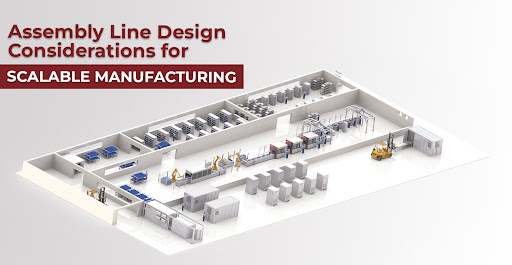
Physical layout is not just about fitting machines into available space. It determines material flow efficiency, worker movement, and safety compliance. Poor layout decisions increase handling time, create congestion, and reduce overall productivity.
Linear layouts are simple but often inefficient for complex assemblies. U-shaped or cellular layouts provide better visibility, reduced movement, and improved communication between stations. However, they require more careful planning to avoid cross-flow conflicts.
Critical layout considerations include:
- Minimizing unnecessary movement of materials and operators
- Ensuring clear paths for logistics and maintenance access
- Planning for future expansion without major redesign
Space constraints should not dictate poor design. Instead, optimize layout based on process requirements first, then adapt infrastructure accordingly. Compromising on layout leads to permanent inefficiencies that compound over time.
Material Handling and Logistics Integration
Material handling is one of the most underestimated assembly line design considerations. Inefficient logistics can silently reduce throughput even when the assembly process itself is optimized.
The goal is to ensure that the right material arrives at the right station at the right time without disrupting workflow. Over-reliance on manual handling introduces inconsistency, while poorly designed automation creates rigidity.
Effective strategies include:
- Implementing just-in-time material delivery systems
- Using standardized containers and flow racks
- Integrating conveyors or AGVs where volume justifies investment
A common mistake is designing the assembly line first and “adding” logistics later. This approach guarantees inefficiency. Material flow must be designed in parallel with process flow to avoid systemic delays and excess inventory buildup.
Automation Strategy and Human-Machine Balance
Automation is not a universal solution. Blindly increasing automation often reduces flexibility and increases downtime risk. The real challenge is determining where automation adds value and where human intervention is more effective.
High-repeatability tasks with low variability are ideal candidates for automation. In contrast, complex or frequently changing processes benefit from manual or semi-automated setups. Over-automation in such areas leads to frequent reprogramming and underutilized assets.
Key evaluation criteria include:
- Process stability and repeatability
- Volume consistency and demand predictability
- Maintenance capability and technical expertise
Assembly line design considerations must include lifecycle cost analysis, not just initial capital expenditure. A poorly planned automation strategy creates dependency on specialized maintenance and reduces adaptability to product changes.
Quality Control Integration Within the Line
Quality control should not be treated as a separate downstream function. Integrating inspection and validation within the assembly line prevents defect propagation and reduces rework costs.
Inline testing systems, poka-yoke mechanisms, and automated inspection tools help detect issues at the source. However, excessive inspection without process control is wasteful. The focus should be on preventing defects rather than detecting them.
Important considerations include:
- Placement of inspection points at critical stages
- Balancing inspection time with production speed
- Using data feedback for continuous improvement
Ignoring quality integration leads to delayed defect detection, which multiplies cost and complexity. Effective assembly line design ensures that quality assurance is embedded, not appended.
Scalability and Future-Proofing the Line
Most assembly lines fail not because they are inefficient today, but because they cannot adapt to tomorrow’s requirements. Scalability must be a core design principle, not an afterthought.
Designing for modular expansion allows capacity increases without disrupting existing operations. Flexible tooling and reconfigurable workstations enable adaptation to new product variants. Without these, even minor changes require significant downtime and reinvestment.
Key strategies include:
- Modular station design for easy expansion
- Standardized interfaces for equipment upgrades
- Reserving physical and logistical space for scaling
Assembly line design considerations must anticipate growth, product evolution, and technology changes. Short-term optimization at the cost of long-term flexibility is a predictable failure pattern in manufacturing systems.
Conclusion
Assembly line design is not a theoretical exercise—it is a series of irreversible decisions that define operational performance for years. Poor design choices do not just reduce efficiency; they create structural limitations that no amount of operational improvement can fix.
The focus must shift from isolated optimization to system-level thinking. Process flow, layout, material handling, automation, and quality control are interconnected. Ignoring this interdependence results in fragmented systems that underperform despite high investment.
Decision-makers who treat assembly line design considerations as a strategic function, rather than a technical afterthought, gain a significant competitive advantage. Everyone else ends up troubleshooting problems that were designed into the system from day one.