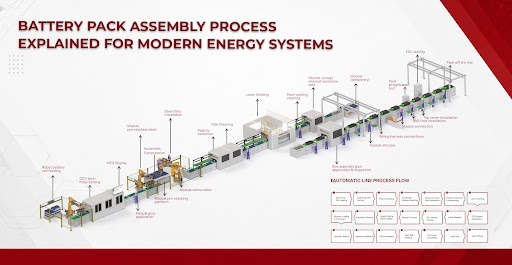
Battery manufacturing has shifted from a component-focused operation to a system-level engineering discipline. As demand accelerates across electric vehicles, grid-scale storage, telecom backup, and industrial power systems, manufacturers are under pressure to improve throughput without compromising safety, thermal stability, or lifecycle performance. The battery pack assembly process explained in practical terms is no longer just about connecting cells together. It involves precision automation, electrical validation, thermal management integration, traceability, and quality assurance at every production stage.
Production failures in battery systems rarely originate from a single catastrophic defect. Most problems emerge from accumulated process inconsistencies such as poor weld integrity, inaccurate torque application, uneven thermal distribution, or inadequate insulation resistance. These issues become more severe as energy density increases and pack architectures become more compact. Understanding the complete assembly workflow is therefore essential for manufacturers, integrators, procurement teams, and engineering decision-makers evaluating scalable battery production strategies.
Cell Sorting and Matching Define Pack Reliability
The foundation of a stable battery pack begins with cell grading and matching. Even when cells come from the same production batch, small variations in internal resistance, voltage, and capacity can create major imbalances during charging and discharging cycles. If unmatched cells are assembled into a module, the weakest cell limits overall pack performance and accelerates degradation.
Modern battery assembly lines use automated cell sorting systems to classify cells according to electrical characteristics before integration. High-volume manufacturers rely on data-driven matching algorithms to group cells with near-identical performance profiles. This step becomes increasingly important in lithium-ion battery manufacturing because higher energy densities leave less tolerance for thermal and electrical variation.
Key parameters typically measured include:
- Open circuit voltage
- Internal resistance
- Capacity deviation
- Self-discharge behavior
- Temperature response
Skipping or simplifying this stage creates downstream problems that are expensive to diagnose after final pack assembly. In large-scale energy storage systems, poor cell matching can also increase thermal runaway risk and reduce usable system capacity over time.
Module Assembly Requires Mechanical and Thermal Precision
After sorting, cells move into the module assembly stage where mechanical structure, electrical interconnection, and thermal pathways are established. This phase directly affects structural integrity, vibration resistance, and long-term operational stability. Poor module design can cause stress concentration, weld fatigue, and uneven cooling performance under high load conditions.
Automated battery pack production lines typically use robotic handling systems to position cylindrical, prismatic, or pouch cells into carriers or fixtures. Laser welding, ultrasonic welding, or busbar bonding technologies are then used to create electrical connections. The selection of joining technology depends on current requirements, material compatibility, and production speed targets.
Thermal management integration also begins at this stage. Cooling plates, thermal pads, gap fillers, and insulation barriers are installed to control heat propagation between cells. Inadequate thermal interface quality often leads to localized overheating, especially in high-capacity battery energy storage systems.
Manufacturers increasingly prioritize inline inspection systems during module assembly to detect:
- Weld inconsistencies
- Misalignment
- Surface contamination
- Compression variation
- Insulation defects
The cost of rework rises sharply once defective modules advance to pack-level integration.
Battery Management System Integration Controls Safety
The Battery Management System (BMS) is the operational control layer of the entire battery pack. While cells store energy, the BMS determines whether the system operates safely, efficiently, and within defined performance limits. Improper BMS integration remains one of the most common causes of field failures in advanced battery systems.
During assembly, voltage sensing lines, temperature sensors, communication harnesses, and balancing circuits are connected to the module architecture. Manufacturers must ensure low-noise signal transmission and secure connector placement because unstable communication can generate inaccurate state-of-charge calculations or false fault detection.
A properly integrated BMS performs several critical functions:
- Cell voltage monitoring
- Temperature monitoring
- Charge balancing
- Overcurrent protection
- Fault isolation
- Thermal event detection
In EV battery assembly and grid storage applications, software calibration has become equally important as hardware installation. The BMS must align with the pack chemistry, discharge profile, and thermal management strategy. Misconfigured firmware can reduce battery lifespan even when physical assembly quality is acceptable.
Advanced production facilities now use automated end-of-line communication testing to verify CAN bus functionality, sensor accuracy, and protection response before pack sealing begins.
Pack Enclosure Assembly Influences Durability and Compliance
Once modules and control systems are integrated, the battery pack moves into enclosure assembly. This stage determines environmental protection, structural durability, electromagnetic shielding, and service accessibility. In industrial and transportation applications, enclosure failures can expose battery systems to moisture ingress, dust contamination, vibration damage, or thermal stress.
Pack housing materials vary depending on application requirements. Aluminum remains common due to its balance between weight, corrosion resistance, and thermal conductivity. Steel enclosures are often used in stationary energy storage systems where structural rigidity takes priority over weight reduction.
Critical enclosure assembly considerations include:
- IP-rated sealing integrity
- Compression consistency
- Cable routing protection
- Venting pathways
- Fire containment strategy
- Shock and vibration resistance
Battery thermal management systems are fully integrated during this phase. Cooling loops, liquid circulation channels, or air-flow systems are tested for leakage and operational efficiency before final closure. Manufacturers also install insulation barriers to prevent short circuits caused by mechanical deformation or condensation exposure.
As pack sizes increase in utility-scale storage projects, enclosure engineering has become closely tied to transportation regulations, fire safety standards, and grid compliance requirements.
Testing and Validation Determine Production Readiness
Final testing is not a procedural formality. It is the only stage where manufacturers can validate whether the assembled battery pack meets electrical, thermal, and safety specifications under operational conditions. Weak testing protocols create hidden reliability risks that frequently emerge during deployment rather than production.
Comprehensive battery pack testing generally includes electrical validation, insulation resistance measurement, communication verification, leak detection, and charge-discharge cycling. High-voltage systems also require dielectric withstand testing to confirm operator and equipment safety.
Production environments increasingly adopt automated testing stations capable of generating traceable digital records for every pack. This supports warranty management, compliance audits, and root-cause analysis when failures occur in the field.
Common validation procedures include:
- High-voltage isolation testing
- Capacity verification
- Thermal performance testing
- BMS communication validation
- Weld continuity inspection
- Vibration and shock testing
For battery energy storage systems, Factory Acceptance Testing (FAT) and Site Acceptance Testing (SAT) are now standard procurement requirements. Buyers expect evidence that battery packs can operate reliably under real-world environmental and load conditions before commissioning approval is granted.
Automation and Traceability Are Reshaping Battery Manufacturing
The increasing complexity of battery systems has made manual assembly approaches difficult to scale. Manufacturers are now investing heavily in automation, machine vision inspection, MES integration, and digital traceability systems to improve consistency and reduce production variability.
Automated battery production lines allow manufacturers to maintain tighter tolerances across welding, dispensing, torque application, and testing operations. More importantly, automation enables full traceability from raw cell input to final pack serialization. This is becoming essential for industries facing strict regulatory and warranty accountability requirements.
Modern smart manufacturing systems can track:
- Cell batch history
- Welding parameters
- Torque data
- Thermal test results
- BMS firmware versions
- Operator interventions
This level of visibility supports predictive quality control and faster defect isolation. It also helps manufacturers comply with evolving international safety standards for lithium-ion battery systems.
The battery pack assembly process explained from a manufacturing perspective is ultimately a balance between precision, scalability, and risk control. Companies that fail to standardize assembly workflows often experience inconsistent pack performance, higher warranty exposure, and operational inefficiencies that become difficult to correct at scale.
You have not enough Humanizer words left. Upgrade your Surfer plan.