Introduction
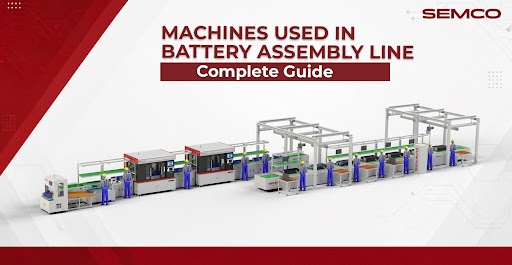
Battery production has become a highly sophisticated process driven by precision, automation, and strict quality control. With rising demand for lithium-ion batteries in electric vehicles, renewable energy storage, and electronics, manufacturers must scale operations without sacrificing reliability. This is where machines used in battery assembly line processes play a critical role. Every stage—from electrode fabrication to final pack assembly—depends on specialized equipment designed to handle sensitive materials and maintain exact specifications. Inefficient machine integration or poor equipment choices can lead to defects, safety concerns, and production delays. This guide explores the essential machinery involved, their functions, and why optimizing these systems is key to achieving efficient and scalable battery manufacturing.
Electrode Manufacturing Equipment
Electrode production directly influences battery efficiency and lifespan, making it one of the most critical stages. This process relies on key machines such as mixers, coating systems, calendering units, and slitting machines, each contributing to performance consistency.
Mixing equipment ensures a uniform blend of active materials, binders, and solvents. Any inconsistency at this stage can compromise electrode quality. Coating machines apply the prepared slurry onto current collectors with precise thickness control, which impacts both capacity and energy efficiency.
Calendering systems compress coated electrodes to achieve optimal density and porosity, affecting conductivity and structural strength. Slitting machines then cut electrodes into accurate sizes for further assembly.
Important factors in this stage include:
- Consistent material distribution
- Accurate thickness control
- Ability to scale production speeds
Even minor inconsistencies here can carry forward, affecting the entire battery assembly process.
Cell Assembly Machines
Cell assembly converts processed electrodes into functional battery cells. The type of machinery used depends on the cell design—cylindrical, prismatic, or pouch—but the objective remains consistent: precision and reliability.
Winding machines are typically used for cylindrical cells, rolling electrodes and separators into compact structures. Stacking machines are preferred for pouch and prismatic formats, where layered assembly is required.
Separator handling systems ensure proper insulation between electrodes, preventing internal short circuits. Electrolyte filling machines inject electrolyte under controlled environments, often using vacuum conditions to ensure thorough absorption.
Automation at this stage is vital for:
- Maintaining alignment precision
- Minimizing contamination risks
- Ensuring consistent production output
Small errors in alignment or filling can lead to reduced performance or safety issues, making advanced machinery essential.
Formation and Testing Systems
Formation is the stage where battery cells are activated through controlled charge and discharge cycles. This process stabilizes the internal chemistry and prepares the cells for real-world use.
Formation systems typically include programmable charge-discharge units, temperature-controlled environments, and monitoring systems that track performance data. These machines must manage large volumes while maintaining strict operational control.
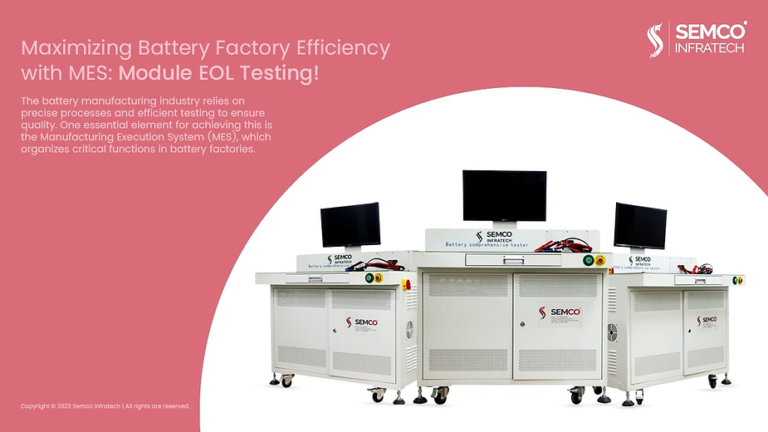
After formation, testing equipment evaluates key parameters such as capacity, internal resistance, and overall cell performance. This helps identify defective units early in the process.
The significance of this stage includes:
- Ensuring long-term reliability
- Detecting early defects
- Creating traceable quality data
Without effective formation and testing systems, manufacturers risk inconsistencies and potential safety failures.
Module and Pack Assembly Equipment
Once individual cells pass testing, they are assembled into modules and complete battery packs. This stage combines mechanical structure, electrical connections, and thermal management.
Laser welding machines are widely used for connecting cells due to their precision and controlled heat impact. Automated assembly systems position and secure cells accurately within modules.
Dispensing machines apply thermal interface materials to manage heat dissipation, while specialized equipment integrates battery management systems (BMS) for monitoring and control.
Key considerations at this stage include:
- Mechanical stability
- Reliable electrical connections
- Efficient thermal management
Any faults introduced here can affect the entire battery system, making precision equipment and process control essential.
Automation and Quality Control Integration
Modern battery manufacturing heavily depends on automation and real-time quality monitoring. Advanced inspection systems, sensors, and AI-based analytics are embedded throughout the production line to identify defects instantly.
Material handling is streamlined through automated guided vehicles (AGVs) and conveyor systems, reducing manual intervention and contamination risks. Manufacturing execution systems (MES) track and analyze production data, enabling better decision-making and continuous improvement.
Advantages of automation include:
- Lower risk of human error
- Higher production efficiency
- Improved data-driven process optimization
Quality control is no longer a separate step but integrated into every stage of machines used in battery assembly line operations.
Conclusion
The success of battery manufacturing depends on how effectively machinery is selected, integrated, and managed. Each machine—from electrode processing equipment to final assembly systems—directly impacts performance, safety, and scalability. Decision-makers must focus on building a cohesive system rather than optimizing individual components in isolation. Strategic investment in precision equipment, automation, and quality control is essential for maintaining competitiveness in a rapidly evolving battery industry.