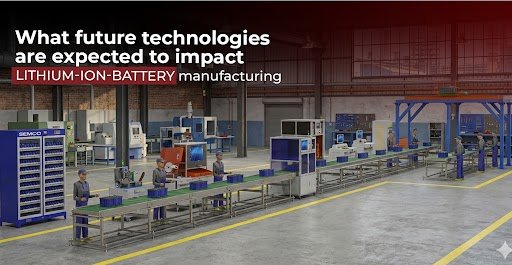
Lithium-ion battery manufacturing is under intense pressure. Demand from electric vehicles, grid-scale storage, and consumer electronics is accelerating faster than most factories can scale. At the same time, margins are tightening, quality expectations are rising, and governments are imposing stricter sustainability requirements. The traditional production model—incremental process optimization and labor-intensive quality checks—is no longer sufficient.
Future technologies are expected to fundamentally reshape lithium-ion battery manufacturing by increasing throughput, improving yield, reducing energy intensity, and enabling traceability at scale. The focus is shifting from isolated equipment upgrades to fully integrated, data-driven production ecosystems. For decision-makers, the key question is not whether change is coming, but which technologies will deliver durable competitive advantage and which will become stranded investments.
Artificial Intelligence and Predictive Process Control
Artificial intelligence is moving from pilot trials to core production infrastructure. In lithium-ion battery manufacturing, AI is primarily being deployed in electrode coating optimization, defect detection, and predictive maintenance.
Advanced machine learning models analyze thousands of process parameters—coating thickness, slurry viscosity, drying temperature, and calendaring pressure—to predict performance deviations before they create scrap. This reduces yield loss and stabilizes quality in high-speed lines. Inline vision systems combined with deep learning also identify micro-defects in electrodes and separators that human inspection would miss.
The real value lies in closed-loop control. Instead of operators reacting to problems, AI systems dynamically adjust process parameters in real time. However, implementation requires:
- Clean, structured historical data
- Integration across MES and SCADA systems
- Skilled data engineers embedded in operations
Without these foundations, AI remains an expensive dashboard rather than a productivity driver.
Dry Electrode Manufacturing and Solvent-Free Processing
Traditional cathode and anode fabrication relies on solvent-based slurry coating, followed by energy-intensive drying. This step consumes large floor space, significant capital expenditure, and high operational energy.
Dry electrode technology eliminates solvents and the associated drying ovens. By using binders that mechanically fuse active materials without liquid carriers, manufacturers can:
- Reduce energy consumption
- Shrink plant footprint
- Lower capital costs per GWh
The strategic impact is significant for gigafactories where real estate and energy costs dominate financial models. However, scaling dry processing presents engineering challenges in uniformity, adhesion strength, and long-term cell stability.
Companies investing early must prepare for extensive pilot validation and equipment redesign. The payoff is long-term structural cost reduction, not short-term incremental gain.
Advanced Automation and Robotics in Gigafactories
As production volumes scale, manual intervention becomes a bottleneck and a source of variability. Future lithium-ion battery manufacturing facilities are evolving toward highly automated, robotics-driven environments.
Next-generation robotic systems handle:
- Electrode stacking and winding
- Tab welding and assembly
- Module and pack integration
Automation improves repeatability and reduces defect rates in high-precision processes such as laser welding. It also enhances worker safety in environments involving hazardous materials.
However, automation without flexible design can create rigidity. Demand volatility in EV markets requires modular production lines that can switch cell formats or chemistries without massive retooling. The future lies in reconfigurable robotics integrated with digital twins, allowing simulation before physical adjustments.
Solid-State and Next-Generation Materials Integration
Solid-state batteries and alternative chemistries—such as high-nickel cathodes and silicon-rich anodes—are forcing a rethink of manufacturing architecture. These materials introduce new constraints in moisture sensitivity, pressure control, and interfacial stability.
For example, solid electrolytes may require entirely different lamination and densification processes compared to liquid systems. Existing lithium-ion battery manufacturing lines cannot simply be retrofitted without significant redesign.
Decision-makers must evaluate:
- Compatibility of current equipment with emerging chemistries
- Long-term material supply security
- Capital amortization risks
Investing in adaptable infrastructure, rather than chemistry-specific equipment, reduces exposure to technological shifts. Manufacturing flexibility will be as important as material innovation itself.
Digital Twins and End-to-End Traceability
Digital twins are becoming essential in complex gigafactory operations. A digital twin replicates the physical production line in a virtual environment, enabling simulation of process changes, bottleneck analysis, and predictive failure modeling.
In lithium-ion battery manufacturing, digital twins support:
- Rapid commissioning of new lines
- Optimization of throughput under varying demand
- Lifecycle traceability of each cell
Traceability is no longer optional. Automotive OEMs demand detailed production history for every battery cell due to warranty and safety liabilities. Blockchain-enabled data logging and integrated MES systems are increasingly being adopted to ensure compliance.
The operational advantage is faster root-cause analysis during field failures, reducing recall risks and financial exposure.
Sustainable and Closed-Loop Recycling Technologies
Regulatory pressure and raw material volatility are accelerating investment in battery recycling and closed-loop manufacturing. Hydrometallurgical and direct recycling processes are being integrated closer to production sites.
Future lithium-ion battery manufacturing facilities are expected to include on-site recycling streams to recover lithium, nickel, and cobalt from scrap and end-of-life cells. This reduces dependence on mined materials and improves supply chain resilience.
The challenge is economic viability. Recycling systems must operate at scale to compete with virgin material sourcing. Integration requires:
- Standardized pack disassembly designs
- Material recovery optimization
- Logistics coordination
Sustainability is becoming a cost and compliance issue, not just a branding consideration.
Conclusion
Future technologies are expected to transform lithium-ion battery manufacturing from labor-intensive, energy-heavy operations into highly automated, data-driven, and flexible production ecosystems. Artificial intelligence, dry electrode processing, robotics, advanced materials integration, digital twins, and recycling infrastructure will define the next competitive frontier.
The critical mistake would be treating these innovations as isolated upgrades. Competitive advantage will go to manufacturers who integrate process control, materials strategy, automation, and sustainability into a coherent long-term roadmap. Capital is limited, and technology cycles are shortening. Strategic sequencing of investments—not technological enthusiasm—will determine who leads and who becomes obsolete.